Outdated Drivers Are Slowing You Down
One free scan finds every outdated or missing driver and matches the right update for your exact hardware.Free scan · exact hardware matchWindows Errors? Fix Them Before They Spread
Repair common Windows errors and clear accumulated junk for a smoother, more stable PC - no reinstall needed.Free scan · no reinstallStore antique silverware clean and dry, wrap each piece in sulfur-free, unbuffered archival tissue, and keep it in an individually sealed enclosure that limits exposure to sulfur-containing gases and humidity. Handle it with clean cotton gloves, and resist the urge to polish it routinely. Each removal of tarnish also removes a little of the silver itself, and repeated polishing can wear through plate and soften decorative detail. Before any cleaning, identify what the object is made of and how it is built, because those two facts decide which treatments are safe.
Identify the piece before you store or clean it
Most damage to antique silver happens during a well-meant clean rather than during storage. A quick examination tells you which care route is appropriate. The Canadian Conservation Institute (CCI) recommends examining an object closely before any treatment, and the checks below follow its guidance in Silver – Care and Tarnish Removal (CCI Notes 9/7).
- Read the hallmarks. Look for marks that indicate sterling or another silver alloy. Marks that read as plate or are accompanied by a base-metal core indicate silver plate. A plated object has a thin silver layer over a different metal, so the base can show through once the surface wears.
- Check the construction. Look for solder joins, hollow handles, hollow feet, and sealed hollow bodies such as some hollowware and candlesticks. Hollow sections can trap liquid.
- Look for decoration that is easy to damage. Engraving, chasing, embossing, and gilding are all vulnerable to abrasive or chemical treatment.
- Note any nonmetal parts. Wood, ivory, bone, and similar components may be glued or pinned to the silver. These must stay dry, and they are the first things to fail when a piece is immersed.
If the piece is valuable, fragile, plated, composite, or unusually constructed, the CCI advises consulting a qualified conservator before attempting treatment. That advice applies even when the piece looks sturdy.
How tarnish forms and what that means for storage
Silver tarnishes when it reacts with sulfur-containing gases in the air, and humidity affects how quickly that reaction develops (CCI, Understanding how silver objects tarnish). Storage therefore has two aims: reduce the sulfur gases that reach the surface, and keep humidity low and stable.
Do these 3 things before closing this tab:
1Fix the driver behind crashes, sound loss and screen glitches2Repair Windows errors before they cause bigger problems3Scan for outdated or missing drivers - takes under a minute#1 Best Overall

- SHINES AND PROTECTS: Cleans, shines, and protects gold (14 k and 18 K), silver, and platinum. Use it in jewelry, coins, and other fine valuables. It's a tarnish remover that restores the original brilliance in metals, prevents new tarnish and gives jewelry a layer of protection. VALUE. It has three uses: silver jewelry cleaner, gold jewelry cleaner, and platinum jewelry cleaner.
- SAFE for your health and the environment. The white section of the Mayflower polishing cloth is treated with non toxic ingredients that keep your health safe and protect the environment. The gray cloth is untreated, and it's used for a final shine.
- TWO-STEP SYSTEM: Easy and simple two-step system. Clean with the white cloth, shine with the gray cloth. NO ADDITIONAL PASTE OR SOLUTION NEEDED. Our proprietary formula is dry-impregnated in the white flannel, effectively removing dirt and grease, even in heavily tarnished items. Both sides of the white flannel contain the active cleaning ingredients.
- PRO SIZE: This extra-large polishing cloth (11 x 14 inches opened) makes cleaning easy, no matter the size of your items. It’s perfect for large pieces like silverware, silver plates, and serving trays. The generous size of this platinum, silver and gold polish cloth provides a comfortable grip, making it easier to clean larger jewelry such as chains, necklaces, gold watches, bracelets, and other oversized pieces. At the same time, the Mayflower jewelry cleaner, offers excellent control for smaller items like rings, coins, and pendants. Its versatile size also makes it a great choice for cleaning antiques and musical instruments.
- MADE IN USA: This is a product made in USA with high quality materials. We guarantee our product with 60 day money back.
Tarnish is also not always a reason to clean. Whether a bright finish matters depends on how the object is used and what condition it is in. For a piece kept in a cabinet and rarely handled, a light tarnish layer over the surface may be preferable to repeated polishing.
Storage options compared
The CCI’s storage guidance turns on five factors: the seal of the enclosure against pollutants, whether each piece is separated and supported, humidity control, suitability for plated or fragile objects, and practicality for display versus long-term storage. The table compares common approaches against those factors. Where a published source does not address a cell, the cell says so.
| Approach | Seal against sulfur gases | Separation and support | Humidity control | Suitability for plated, composite or fragile pieces | Best use |
|---|---|---|---|---|---|
| Open display on a shelf or in a cabinet | Not stated: CCI guidance centres on sealed enclosures, so open display offers no sealed barrier | Depends on how the piece rests; not specified in CCI guidance | Not controlled unless the room is separately managed | Not stated; handling and dust exposure are the main concerns | Pieces in regular use or on show |
| Individual sealed polyethylene bag | Sealed, as CCI recommends for individual pieces | One piece per bag, which avoids contact with neighbouring objects | Stabilises humidity around the piece when paired with suitable materials | Suitable for many objects; check for hollow components and nonmetal parts that may need separate support | Long-term storage of individual pieces |
| Sulfur-free, unbuffered archival tissue wrap | Tissue alone does not seal; it is used inside a sealed enclosure | Supports and wraps each piece, buffering humidity changes | Buffers short-term humidity changes | Suitable as a support layer; avoid pressing tissue into engraved detail | Support inside a sealed enclosure |
| Sealed enclosure with silica gel or activated charcoal | Sealed enclosure is the base; sorbents are added inside it | Depends on the case design | Silica gel helps keep relative humidity low in a suitable case or enclosure | Not stated for specific objects; confirm that sorbents do not contact fragile surfaces | Cabinets and cases for long-term storage |
The sealed bag and tissue combination is the approach CCI describes most directly. Silica gel and activated charcoal are supplementary tools, used inside a suitable case or enclosure rather than in place of one.
Rank #2

- Goddard's proprietary cotton blend, infused with polishing and anti-tarnish agents, instantly removes tarnish from silver and other jewelry surfaces..
- Ideal for maintaining a brilliant shine on jewelry, picture frames, and other silver that can't be rinsed. Nonabrasive material safely shines all antiques..
- Quick & Easy: Simply wipe any silver surface to remove tarnish. Once clean, buff with an unused portion of the cloth to produce a brilliant shine..
- Leaves behind a tarnish resistant barrier to slow future oxidation between cleanings..
- A Trusted Tradition: Joseph Goddard invented the world's first silver polish in 1839. Today, we honor his legacy by combining traditional excellence with today's advanced technology..
Sealed bags and individual pieces
CCI recommends storing each piece individually in a sealed polyethylene bag or another appropriate sealed enclosure. Keeping pieces apart prevents scratching and stops one object’s surface from contacting another. Do not stack pieces loosely in a drawer, even if each is wrapped, because wrapping does not prevent abrasion where items press against one another.
What’s actually slowing this PC down?
Pick the symptom - the matching free tool is one click away.
Tissue and wrapping
Use sulfur-free archival tissue, specifically non-buffered or unbuffered tissue, to support or wrap each piece. Buffered papers contain alkaline substances that can react with silver and with nearby materials, which is why CCI specifies unbuffered tissue. Check the product description for both features before buying. Wrap gently and avoid forcing tissue into engraved or chased areas.
Humidity and sorbents
CCI’s tarnish guidance states that silver is best stored in dry conditions, below 50% relative humidity. This is a conservation threshold for institutional collections, not a guarantee that a single humidity reading will prevent tarnish. Pollutant levels, enclosure materials, and how stable the humidity is over time all matter.
Rank #3
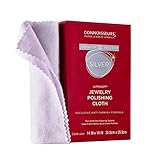
- SILVER JEWELRY POLISHING CLOTH: Two-step dry-cleaning system polishes silver to a high luster; Removes tarnish and helps prevent further buildup; Includes one jewelry cleaning cloth for silver jewelry
- EASY TWO-STEP PROCESS: Gently rub jewelry with the lighter Ultrasoft inner cloth to remove dirt and apply anti-tarnish shield; Use the darker Ultrasoft outer cloth to buff and polish to a brilliant, lustrous finish
- POLISH IT PRETTY: Convenient polishing cloths and wipes keep jewelry sparkling like new; Perfect for at-home or on-the-go use; Choose from our Gold Polishing Cloth, Silver Polishing Cloth, and Jewelry Wipes
- FIND THE PERFECT CLEANSER: We've got everything you need to keep rings, necklaces, earrings, and bracelets gleaming, from dip, gel, foam, or drop Connoisseurs jewelry cleaners to sonic cleaning devices and polishing wipes or cloths
- THE GOLD STANDARD IN JEWELRY CARE: Connoisseurs is the world leader in jewelry care; We believe it's an essential part of every woman's beauty routine, which is why our jewelry cleaning products make it easy to take care of your pieces
- Silica gel can help keep relative humidity low inside a suitable case or enclosure.
- Activated charcoal or another suitable sorbent can reduce tarnishing gases.
- Confirm that the enclosure materials and nearby items do not emit sulfur compounds. A wooden cabinet finished with some treatments, or a rubber-based material, can release gases that accelerate tarnish.
Handling silver safely
Use clean cotton gloves when handling polished silver. Skin salts and oils transfer readily to the surface and can leave marks that later need treatment. Keep silver clean and free of dust and surface grime before storage, since dirt on a surface can hold moisture and pollutants against the metal.
Lift pieces by sturdy parts such as the bowl or body rather than by thin handles, delicate finials, or attached nonmetal components. Support heavy hollowware from below.
Recommended Free Tools
Cleaning and treatment: the options and their limits
CCI’s silver guidance does not present cleaning as a single routine. Each method takes away something, so the choice depends on the object. The table below sets out the trade-offs the CCI describes.
Rank #4
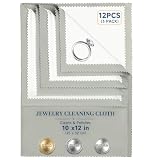
- EFFECTIVE TARNISH REMOVAL – Designed to easily remove tarnish, dirt, and oils from silver and gold jewelry. Restores shine and brilliance without harsh chemicals, keeping your valuables looking like new.
- SOFT & DURABLE MICROFIBER – Made of premium microfiber with professional cleaning ingredients. Ultra-soft, lint-free, and highly effective at absorbing dirt and oils without scratching jewelry, coins, watches, silverware, or musical instruments.
- LARGE SIZE & VALUE PACK – Each cloth measures 10" x 12", larger than standard jewelry cloths for easier handling. Includes 3 packs total, and each pack contains 4 cloths stitched together (12 cloths in total), designed for convenient use, storage, and long-term daily jewelry care.
- MULTI-LAYER DESIGN – Inner treated layer quickly cleans and removes tarnish; outer gray layer polishes and adds shine. Double-sided use makes cleaning simple, effective, and time-saving.
- REUSABLE BUT NOT WASHABLE – The cloth can be reused many times for routine care, but should never be washed, as washing will remove the cleaning agents. Suitable for gold, silver, diamond, platinum jewelry, coins, watches, silverware, and other collectibles.
| Method | Abrasiveness and silver loss | Compatibility with plating and decoration | Can the object safely get wet? | Hollow or attached components |
|---|---|---|---|---|
| Polishing | Abrasive; removes tarnish and some underlying silver, and can leave fine scratches | Can wear through thin plating and damage gilding or delicate surface decoration | Not a wet method | Not stated for hollow components specifically; avoid heavy pressure around joins |
| Washing with detergent and water, then thorough rinsing and drying | Not abrasive; CCI describes it as a gentler option for suitable objects | Suitable only where the construction tolerates moisture | Only for objects that can safely get wet | Nonmetal parts must be kept dry; trapped liquid in hollow parts is a risk |
| Chemical dips | Can over-clean engraved or embossed surfaces | Can damage materials such as wood and some metals | Involves liquid immersion | Unsuitable for composite pieces; liquid can become trapped in hollow parts. Also poses user hazards |
| Electrochemical reduction | Not described as abrasive; uses an aqueous solution | Not stated for specific finishes | Involves aqueous immersion | Unsuitable for objects with sealed hollow components |
Chemical dips and electrochemical reduction are not universal household methods. Treat them as specialist options that require object-specific judgment, and do not assume a product that works on flatware will suit a hollow teapot or a piece with a wooden handle.
When a clean is genuinely needed
If tarnish removal is necessary, match the method to the material and construction described above. Start with the least aggressive option the object tolerates. For plated, composite, gilded, or unusually constructed pieces, or any object of significant value, consult a conservator before trying anything.
Independent reader supportYour contribution helps us test, update, and keep practical guides available for everyone.When to call a conservator
Seek professional advice before treatment in any of these situations:
Best Value

- SHINES AND PROTECTS: Clean, shine, and protect gold (14 k and 18 K), silver, and platinum. Use it in jewelry, coins, and other fine valuables. It's a tarnish remover that restores the original brilliance in metals, prevents new tarnish and gives jewelry a layer of protection. VALUE. It has three uses: silver polishing, gold polishing, and platinum polishing.
- PRO SIZE: Large size cloths for the easy polish of silverware, antiques, and big pieces of jewelry. Better handle of small pieces. The size of each cloth open and flat is 11 x 14 inches. The color of the outer cloth (gray) may vary. The cleaning ingredients are in the white inner flannel.
- TWO-STEP SYSTEM: Easy and simple two-step system. Clean with the white cloth, shine with the gray cloth. Our proprietary formula is dry-impregnated in the white flannel, effectively removing dirt and grease. Both sides of the white flannel contain active ingredients—no additional paste or solution needed. The gray outer cloth, is untreated and designed to gently remove any remaining residue and provide a final, brilliant shine. Both cloths are made of ultra-soft cotton, safe for delicate and valuable items.
- MADE IN USA: This is a product made in USA with environmentally friendly ingredients, and quality materials. We guarantee our product with 60 day money back.
- SAFE for your health and the environment. The white section of the Mayflower cloth is treated with non toxic ingredients that keep your health safe and protect the environment.
- The piece is valuable, fragile, or has a documented history that a cleaning could affect.
- The hallmarks show plate, or the base metal is visible through worn areas.
- The object contains wood, ivory, bone, or other nonmetal attachments.
- The object has sealed hollow components or unusual joins.
- You are unsure whether a method will harm the decoration.
The CCI’s general metal-care guidance also covers abrasion and plating risks across metal objects, and is a useful reference for collectors who keep a mixed collection (CCI, Caring for metal objects).
A practical routine
- Examine each piece for hallmarks, plate, joins, hollow sections, decoration, and nonmetal parts.
- Clean gently to remove dust and grime, using clean cotton gloves.
- Wrap each piece in sulfur-free, unbuffered archival tissue as support.
- Place each wrapped piece in its own sealed polyethylene bag or another appropriate sealed enclosure.
- Store in a stable, dry location, with sorbents in a suitable case if you use one, and check the enclosure periodically for condition.
- Leave pieces unpolished until the finish is genuinely needed for use or display.
This routine keeps intervention to a minimum, which is the central principle of the CCI guidance.
Specialist storage supplies such as tarnish-resistant bags are available from many suppliers, and their claims vary. Look for sealed construction and sulfur-free materials, and do not expect any bag to prevent all tarnish on its own.
Quick Recap
Product prices and availability are accurate as of the date/time indicated and are subject to change. Any price and availability information displayed on Amazon at the time of purchase will apply.