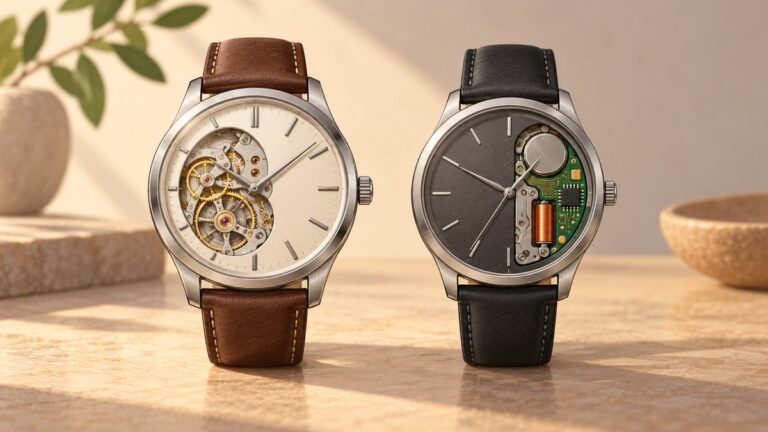
A watch turns stored energy into a readable time display. In a mechanical watch, a wound spring drives gears while an escapement and balance regulate their motion. An automatic watch adds a rotor that winds the spring as you move; a quartz watch instead relies on an electronically stimulated crystal as its time reference. The materials vary by component and maker, from a watch case to the exceptionally fine spring inside its movement.
How a mechanical watch turns stored energy into time
A mechanical watch stores energy in its mainspring. As the spring unwinds, it sends energy through a gear train that moves the hands. But gears alone would let the spring run down too quickly. The escapement meters the energy into controlled impulses, and the balance wheel with its hairspring oscillates to regulate the movement’s rate.


The parts and their jobs
- Mainspring: Stores energy when wound and releases it as it unwinds.
- Gear train: Transfers that energy through the movement to drive the hands.
- Escapement: Locks and releases the escape wheel in measured steps, delivering impulses to the balance.
- Balance and hairspring: Oscillate together to set the pace of those steps.
The escapement’s operation is small but essential: the pallet fork alternately holds and releases the escape wheel, while passing an impulse to the balance. The Fondation Haute Horlogerie notes that “The balance spring, for example, is no thicker than a human hair.” Fondation Haute Horlogerie’s mechanical-watch explainer describes the relationship between these components.
How manual, automatic, and quartz watches differ
These watch types differ chiefly in how they obtain energy and what regulates their timekeeping. “Automatic” describes a winding mechanism, not a separate kind of regulator: an automatic watch is mechanical.
#1 Best Overall
| Type | Energy source | How it is wound or powered | Timekeeping regulator |
|---|---|---|---|
| Manual mechanical | Wound mainspring | Wound by turning the crown | Balance wheel and hairspring, controlled by an escapement |
| Automatic mechanical | Wound mainspring | A rotor winds the spring as the wearer moves; many can also be wound by the crown | Balance wheel and hairspring, controlled by an escapement |
| Quartz | Electrical energy | An electronic circuit stimulates a quartz crystal; the cited source describes quartz watches generally, not a particular battery or power-cell design | Vibrations of the quartz crystal provide the time reference |
| Automatic quartz | Electricity generated by a rotor-based charging mechanism | Wrist motion turns a rotor that generates electricity | Quartz regulation |
For the mechanical basics, see Seiko’s explanation of mechanical watches and Orient’s step-by-step mechanical-watch explainer. Longines describes automatic winding; the Federation of the Swiss Watch Industry explains mechanical, quartz, and automatic-quartz distinctions.
What accuracy figures do—and do not—tell you
Accuracy depends on the particular movement and model, so a brand’s stated figure should not be treated as a universal specification. Swatch’s technical-information page gives a range of −5 to +40 seconds per day for its automatic watches; the page does not state a publication year. That is a Swatch figure, not an industry-wide limit or a claim about every automatic watch. Swatch’s technical information explains its published range.
Rank #2
Why watches use different materials
There is no single material recipe for every watch. Choices depend on the component and the maker, and the case is only the most visible example. Rolex documents use of 904L steel for its cases and grade 5 titanium under its RLX titanium designation. It also says its laboratory controls 18 kt gold alloys, 950 platinum, Oystersteel, and RLX titanium in its watchmaking. These are Rolex examples, not a universal inventory of watch materials or proof that every brand uses the same alloys.
The range implied by “alloys galore” extends beyond the exterior: a watch includes many small movement components as well as its case. The available maker information establishes specific Rolex material examples, but does not provide an exhaustive alloy list across brands or identify a standard alloy for every movement part. Rolex’s materials page describes the materials it documents.
Quick Recap
Product prices and availability are accurate as of the date/time indicated and are subject to change. Any price and availability information displayed on Amazon at the time of purchase will apply.