Free tools Windows power users keep installed
One-click scans. No signup required.
Short answer: the Google Pixel Watch 4 is now accurate enough for most everyday runs, walks and gym sessions, but it is not a complete Garmin Forerunner replacement for serious endurance training. Its dual-frequency GPS produced distances close to a Garmin Forerunner 970 in reported tests, while Garmin generally drew cleaner routes in difficult areas. Pixel Watch 4 heart-rate averages were also close to a Garmin-connected chest strap, but wrist-based readings could lag or run slightly low during hard efforts.
The more important difference is not a tiny distance discrepancy. Pixel Watch 4 is a smartwatch with strong fitness tools; Garmin is a training watch with smartwatch features.
As an Amazon Associate I earn from qualifying purchases.
What was compared
The published hands-on comparison used a Google Pixel Watch 4 against a dual-band Garmin Forerunner 970. The testing covered a half-marathon, a 19-mile run, shorter runs, hiking, step counts, elevation and running-form metrics. Heart rate was compared with Garmin equipment, including a Garmin HRM 200 chest strap for the long-run comparison.
What’s actually slowing this PC down?
Pick the symptom - the matching free tool is one click away.
The available test report does not identify every detail a laboratory-style study would normally document, including the Pixel Watch 4 case size, cellular configuration, phone model, operating-system versions, firmware builds, weather, workout settings and whether both watches used identical pause, music and display settings. The watches were worn on opposite wrists, which is practical but can itself introduce small differences in arm movement and optical-sensor fit.
#1 Best Overall

- The Google Pixel Watch 4 is a stunning display of precision craftsmanship, with Gemini, your built-in AI assistant, Google’s longest-lasting battery, and comprehensive tools for next-level health and fitness performance[1,2,3,4]
- See it all and do the most with the Actua 360 domed display; it’s 10% larger and 50% brighter than Pixel Watch 3, and as durable as ever with scratch-resistant Gorilla Glass[1]
- The Google Pixel Watch 4 has Gemini built in[4]; just ask questions and your ultra capable AI assistant will deliver quick responses for personalized help; and stay connected when you’re texting with AI-powered quick replies that are hyper-relevant[5,6]
- Get up to 30 hours of battery life or up to 48 hours in Battery Saver mode[3]; plus, the new side charging dock gives you 15 hours of battery in 15 minutes or less[7]
- Train smarter with 40+ exercise modes and real-time stats on your wrist[8]; and with high-precision dual-frequency GPS, you get more accurate route tracking on runs and hikes[1]
Garmin is best treated as a practical benchmark, not ground truth. Both watches depend on satellite reception, antenna position, body movement, algorithms and post-processing. A measured course or surveyed track would be a stronger reference than either consumer watch.
Source: Android Central’s Pixel Watch 4 fitness testing.
GPS accuracy: close totals, less consistent route lines
Pixel Watch 4’s biggest fitness improvement is dual-frequency GPS. In the reported comparison, that translated into distances that were usually very close to the Garmin’s:
| Test | Pixel Watch 4 | Garmin comparison |
|---|---|---|
| Neighborhood run | 5.00 miles | 5.01 miles |
| 19-mile run | Reference distance reported by Pixel Watch 4 | Garmin recorded 0.02 miles more |
| Half-marathon | About 100 metres less than Garmin over roughly 13.2 miles | Longer recorded distance |
That is a strong result for ordinary running. A difference of 0.01 miles over five miles is irrelevant to most training decisions, and a few hundred metres over a half-marathon may not change a recreational runner’s result.
Final distance does not tell the whole story, however. The Garmin generally produced cleaner traces around tall buildings, sharp turns, trees and underpasses. Pixel Watch 4 sometimes drifted sideways, took a wider arc through a 90-degree turn or failed to maintain a perfectly straight line through an underpass. Those errors can affect instant pace, mile splits and confidence in a route even when the final total looks excellent.
Rank #2
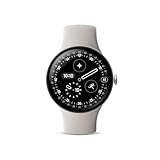
- The Google Pixel Watch 4 is a stunning display of precision craftsmanship, with Gemini, your built-in AI assistant, Google’s longest-lasting battery, and comprehensive tools for next-level health and fitness performance[1,2,3,4]
- See it all and do the most with the Actua 360 domed display; it’s 10% larger and 50% brighter than Pixel Watch 3, and as durable as ever with scratch-resistant Gorilla Glass[1]
- The Google Pixel Watch 4 has Gemini built in[4]; just ask questions and your ultra capable AI assistant will deliver quick responses for personalized help; and stay connected when you’re texting with AI-powered quick replies that are hyper-relevant[5,6]
- Get up to 30 hours of battery life or up to 48 hours in Battery Saver mode[3]; plus, the new side charging dock gives you 15 hours of battery in 15 minutes or less[7]
- Train smarter with 40+ exercise modes and real-time stats on your wrist[8]; and with high-precision dual-frequency GPS, you get more accurate route tracking on runs and hikes[1]
What this means in different environments
- Open roads and parks: Pixel Watch 4 should be close enough for most running and walking.
- Urban canyons: Reflected satellite signals can create loops and lateral drift. Garmin usually handled the reported difficult sections better, although it was not error-free.
- Tight turns: Pixel Watch 4 may cut or widen corners, making the map and short-term pace less tidy.
- Underpasses and tree cover: Brief losses or distortions in the route line are possible on either watch.
- Hiking and slow movement: Low-speed GPS is inherently vulnerable to small positional errors; do not judge a watch from one trail recording.
Dual-frequency GPS is not a magic setting that makes every recording perfect. Mode behavior can change with firmware, and comparisons are only meaningful when both watches use comparable GPS configurations and are started manually at the same point.
Heart rate: good for general use, not a chest-strap substitute
Pixel Watch 4’s optical heart-rate sensor generally followed the comparison sensors. During harder efforts and rapid changes, it tended to read about 1–2 beats per minute low in the cited testing. On a 19-mile run, Pixel Watch 4 averaged 161 beats per minute, compared with 162 beats per minute from a Garmin-connected HRM 200 chest strap.
Quick wins for a faster PC:
Fix the driver behind crashes, sound loss and screen glitchesFind Drivers →Clear out junk files and repair common Windows errorsFree Scan →That one-beat average difference is encouraging, but it does not prove beat-for-beat agreement. An average can hide a delayed response at the start of an interval, an under-read peak or a mismatch in the time spent inside a training zone. For easy running, steady cardio and general health trends, the Pixel Watch 4’s readings should be useful. For short intervals, threshold work and race pacing, a chest strap remains the safer reference.
Google says Fitbit heart-rate accuracy varies with physiology, placement and activity type. Fit the watch securely above the wrist bone, especially during exercise. Cold weather, reduced skin perfusion, sweat, tattoos, loose placement and vigorous wrist movement can all make optical readings less reliable. Strength training is particularly difficult because gripping and flexing the wrist can interfere with optical sensing.
One potentially important limitation reported in the comparison was that Wear OS did not support pairing the Pixel Watch 4 directly with an external heart-rate monitor. Compatibility can change with software updates, so check the current Fitbit and Wear OS implementation before buying. If direct chest-strap recording is central to your training, Garmin has the clearer advantage.
Rank #3

- The new Google Pixel Watch 5 offers a smarter way to a healthier you.[1,2]; Designed for Gemini Intelligence, get proactive help, and personalized insights from Google Health[3,4]; watch is compatible with Android devices only; not compatible with iOS devices
- Precision-crafted to do it all: The Google Pixel Watch 5 features the domed Actua 360 display with scratch-resistant Gorilla Glass and up to 40 hours of battery life[1,5]
- Metrics that matter: Advanced sensors help you stay ahead of your health and wellness; and Google Pixel’s most accurate heart rate tracking is fine-tuned for your activity[6,7]
- Understand your sleep like never before: Your watch captures insights like the time spent in sleep stages to breathing regularity, then summarizes it all in a personalized Sleep Score[8,9]
- Detects loss of pulse, then calls for help: Pixel Watch 5 is the only smartwatch to feature Loss of Pulse Detection, which can prompt a call to emergency services[10]
Source: Google’s heart-rate accuracy guidance.
Automatic activity detection is convenient, but start important workouts manually
Automatic detection correctly recognized a four-mile run in the cited test and recorded a duration only four seconds different from Garmin’s. Its estimated distance, however, was 4.6 miles, and the automatically detected activity did not include a GPS map that could explain the discrepancy.
That is the right way to use automatic detection: treat it as passive logging and a reminder, not as the recording mode for a race, pace workout or route you need to analyse. Open the Exercise app and start the activity manually whenever distance, pace, splits, GPS or a map matters.
Steps and elevation
Step counts differed between the watches:
- During the half-marathon, Garmin recorded 23,041 steps and Pixel Watch 4 recorded 21,852.
- During the 19-mile run, Garmin recorded 34,260 steps and Pixel Watch 4 recorded 33,960.
These figures show that step counts are algorithmic estimates, not direct measurements. Neither result establishes which watch was correct. Wrist position, arm swing and the use of poles or a stroller can change the result. Google has reportedly changed and then reverted a step-counting adjustment for walking with a stroller or trekking poles, so software version and date matter.
Elevation was much closer in the long-run comparison: Pixel Watch 4 was reported to be within 0.8 feet of Garmin. That is a very small difference in one test, not a guarantee that every climb, descent or trail will match.
Running dynamics: similar basics, different interpretations
Pixel Watch 4 and Garmin produced the same stride length on two long runs, while cadence differed by zero or one step per minute. Other running-form values, including ground-contact time and vertical metrics, differed more. Garmin portrayed the runner as more efficient, and COROS results were reportedly closer to Garmin’s than to Google’s.
Do these 3 things before closing this tab:
1Scan for outdated or missing drivers - takes under a minute2Repair Windows errors before they cause bigger problems3Fix the driver behind crashes, sound loss and screen glitchesRank #4

- 2yrs of data included when you buy Pixel Watch 4 LTE[23]; Google Fi powers your messaging, navigation, and music on the go; offer only valid on Pixel Watch 4 LTE sold by and shipped from select sales channels
- The Google Pixel Watch 4 is a stunning display of precision craftsmanship, with Gemini, your built-in AI assistant, Google’s longest-lasting battery, and comprehensive tools for next-level health and fitness performance[1,2,3,4]
- See it all and do the most with the Actua 360 domed display; it’s 10% larger and 50% brighter than Pixel Watch 3, and as durable as ever with scratch-resistant Gorilla Glass[1]
- The Google Pixel Watch 4 has Gemini built in[4]; just ask questions and your ultra capable AI assistant will deliver quick responses for personalized help; and stay connected when you’re texting with AI-powered quick replies that are hyper-relevant[5,6]
- Get up to 30 hours of battery life or up to 48 hours in Battery Saver mode[3]; plus, the new side charging dock gives you 15 hours of battery in 15 minutes or less[7]
Cadence and stride length can be useful when tracked consistently over time. Ground-contact time, vertical oscillation, vertical ratio and running power are more dependent on sensor placement and algorithmic interpretation. They should be used as trends alongside pace, effort and performance—not treated as laboratory measurements or diagnoses.
Fitbit versus Garmin: the larger difference
| Area | Pixel Watch 4 and Fitbit | Garmin Forerunner |
|---|---|---|
| Everyday smartwatch | Stronger Google apps, notifications, messaging, Maps, Wallet, voice assistance and third-party Wear OS apps | Functional notifications and smart features, but less phone-like |
| Health and wellness | Strong Fitbit sleep, health-trend and cardio-load presentation | Broad training, recovery and health metrics with a more performance-focused presentation |
| Workout display | Useful core fields such as distance, duration, heart rate, pace, time and heart-rate zone; comparatively limited customization | Many more customizable data fields and screens |
| Structured training | Fitbit coaching and planned workouts may help, with availability and subscription terms varying | Garmin Coach, daily suggested workouts and deeper race-oriented planning |
| External sensors | Direct external HR-monitor support was a reported limitation; verify current software | Broad support for chest straps, cycling sensors, power meters and other accessories |
| Multisport | Less suitable for triathlon and complex multisport sessions | Designed for running, cycling, swimming and multisport use, depending on model |
| Navigation | Google Maps and smartwatch navigation are useful, but not the same as Garmin’s course and training ecosystem | Stronger route, course, climb and endurance-navigation tools, depending on model |
| Battery | Convenient fast charging, but normally a daily or every-other-day routine | Much better suited to multi-day activities and infrequent charging |
| Subscription | Some Fitbit coaching or analysis may depend on Fitbit Premium | Core Garmin Connect training tools generally do not require a comparable mandatory coaching subscription |
Pixel Watch 4’s in-run experience is the clearest practical shortfall for serious runners. If you want several custom pages showing lap pace, average pace, heart-rate fields, power, cadence, running dynamics and navigation at once, Garmin is substantially more flexible.
Depending on the current software and model, Garmin also leads in triathlon modes, open-water swimming, power-meter and FTP-related tools, route-based climb information and advanced training-load or recovery metrics. Feature availability can change, so confirm the exact current list before purchase.
Independent reader supportYour contribution helps us test, update, and keep practical guides available for everyone.Battery, charging and outdoor use
Google rates the Pixel Watch 4 at up to 30 hours with the always-on display enabled for the 41 mm model and up to 40 hours for the 45 mm model. Google also lists a battery-saver estimate of up to 48 hours for the 41 mm model and fast charging of approximately 15 minutes to 50%, 25 minutes to 80% and 45 minutes to 100% in the cited technical material.
The Tool Desk
Outbyte PC Repair FREEClear out junk files and repair common Windows errorsFree Scan →Outbyte Driver Updater FREEScan for outdated or missing drivers - takes under a minuteDriver Scan →Those are “up to” manufacturer estimates, not continuous GPS figures. In the reported hands-on testing, some GPS activities used about 7.5% of the battery per hour, while the 19-mile run used closer to 12% per hour. A separate test found the 45 mm model could approach Google’s 40-hour estimate in real-world use, depending on GPS and streaming.
Best Value

- 2yrs of data included with Pixel Watch 4 LTE[23]; Google Fi powers your messaging, navigation, and music on the go; offer only valid on Pixel Watch 4 LTE sold by and shipped from select sales channel
- The Google Pixel Watch 4 is a stunning display of precision craftsmanship, with Gemini, your built-in AI assistant, Google’s longest-lasting battery, and comprehensive tools for next-level health and fitness performance[1,2,3,4]
- See it all and do the most with the Actua 360 domed display; it’s 10% larger and 50% brighter than Pixel Watch 3, and as durable as ever with scratch-resistant Gorilla Glass[1]
- The Google Pixel Watch 4 has Gemini built in[4]; just ask questions and your ultra capable AI assistant will deliver quick responses for personalized help; and stay connected when you’re texting with AI-powered quick replies that are hyper-relevant[5,6]
- Get up to 30 hours of battery life or up to 48 hours in Battery Saver mode[3]; plus, the new side charging dock gives you 15 hours of battery in 15 minutes or less[7]
GPS mode, always-on display, cellular service, music streaming, temperature and software can change endurance considerably. Pixel Watch 4 can handle a long race or extended workout, but Garmin remains the better choice for ultramarathons, bikepacking, multi-day hikes, remote travel and anyone who dislikes charging every day or two.
The Pixel Watch 4’s display is rated by Google at up to 3,000 nits, which helps in bright outdoor conditions. Brightness is not the same as workout usability: Garmin can still show more data at once, while limited Pixel Watch 4 layouts may require more swipes or screen changes during intervals. Gloves, accidental touches and display-wake behavior also matter in cold or wet conditions.
Google’s product material also highlights safety functions such as satellite communication and health-related alerts. Availability varies by region, carrier, account and software version, and those features should not be treated as independently validated medical or emergency systems.
Which watch should you choose?
Choose Pixel Watch 4 if you are:
- An Android or Pixel-phone user who wants a conventional smartwatch first.
- A runner, walker, cyclist or gym user who mainly needs credible distance, pace and heart-rate tracking.
- More interested in Google apps, calls, messages, Maps, Wallet and notifications than advanced training data.
- Happy to start important workouts manually.
- Comfortable charging every day or two.
- Interested in Fitbit’s sleep and wellness presentation.
Choose a Garmin Forerunner if you are:
- Training seriously for a marathon, ultramarathon or other race.
- Using a chest strap, power meter, cadence sensor, foot pod or other external equipment.
- Doing triathlon, open-water swimming, multisport or long-distance cycling.
- Building structured workouts and wanting extensive on-watch data customization.
- Using routes, courses, climb information or advanced training analytics.
- Going several days between charges or spending time away from power.
What about Forerunner 970, 570 or 265?
The Forerunner 970 is the premium benchmark used in the cited comparison, but it is not automatically the best-value Garmin for every buyer. Forerunner 570 and 265 models can provide a more affordable route into Garmin’s training ecosystem, with differences in maps, materials, battery and advanced metrics depending on the model. Compare the current specifications on Garmin’s official comparison page rather than assuming every Forerunner has the same sensors or features.
Important health qualification
Heart rate, calories, sleep stages, blood oxygen, stress, readiness and recovery scores are consumer-wearable measurements and algorithmic estimates. Neither watch should be used as a medical instrument. Consult a clinician about symptoms or medical decisions.
For Fitbit Premium, check which features are currently included and whether a trial is offered at the time of purchase on the official Fitbit Premium page. Offers, prices, included trials, LTE charges and feature availability vary by region, date and configuration.
Quick Recap
Product prices and availability are accurate as of the date/time indicated and are subject to change. Any price and availability information displayed on Amazon at the time of purchase will apply.




