What’s actually slowing this PC down?
Pick the symptom - the matching free tool is one click away.
OV-Watch is an open-source smartwatch project by Kingham Xu, built around an STM32 microcontroller, FreeRTOS and LVGL. Its author estimates the build at about 100 RMB—roughly US$20—but that is an approximate project cost, not a verified price for a complete watch sold at retail. The project publishes files for reproducing the hardware, though Xu cautions that assembling it can be difficult.
What is the OV-Watch?
OV-Watch is a DIY smartwatch design rather than a confirmed mass-market product. The project combines STM32 hardware with FreeRTOS, an operating system for embedded devices, and LVGL, a graphics library for the user interface. Secondary coverage identifies the MCU as an STM32F411; the project’s own description more generally calls it an STM32 watch.
Xu’s Hackaday project description calls the total cost “about 100 RMB,” which it equates to “about $20 USD.” The page, created in 2024 and later updated, does not provide a standardized bill of materials or explain whether that estimate includes shipping, tools, labor or a particular production quantity. Treat the figure as the author’s approximate build-cost claim, not a current parts quote or an offer to buy a finished watch. See the OV-Watch project description.
What can the watch do?
The project lists basic watch functions, a calculator, timer, calendar, games, NFC card storage and Bluetooth connection to a smartphone for synchronizing time and data. These are features documented by the project, not independently tested claims about reliability or compatibility.
Quick wins for a faster PC:
Repair Windows errors before they cause bigger problemsFix Now →Scan for outdated or missing drivers - takes under a minuteDriver Scan →Clear out junk files and repair common Windows errorsFree Scan →#1 Best Overall
- Attention: This is a wearable watch style development board that is not a standard pre configured smartwatch. It is a DIY module that requires customers to develop their own applications to fully utilize its features. This product is aimed at technology enthusiasts, developers or programming enthusiasts, manufacturers, etc.
- High-performance Microcontroller:Based on the ESP32-S3R8 microcontroller,Equipped with ESP32-S3R8 Xtensa 32-bit LX7 dual-core processor, up to 240MHz main frequency.Supports 2.4GHz Wi-Fi (802.11 b/g/n) and Bluetooth 5 (LE), with onboard antenna
- Integrate Multiple Function Modules:it integrates a 2.06inch AMOLED capacitive touch display, 6-axis IMU, RTC chip, audio codec chip, power management IC, and so on.
- Diverse Application Scenarios:Onboard ES8311 Audio Codec Chip And ES7210 Echo Cancellation Circuit. Meet Daily Audio Application Scenarios,such as Audio Playback and Audio Capture.Supports Offline Voice Recognition And AI Speech Interaction.Allows Access To Online Large Model Platforms Such As DeepSeek, Doubao, Etc.
- Wearable Design.Detachable Watch Straps For Easy Replacement And Convenient Matching With Different Styles
Features vary by hardware revision. The English README lists a 1.14-inch screen on V1.0 and V1.1, then a 1.69-inch touchscreen beginning with V2.0. Its table lists NFC for V2.2, Bluetooth and magnetic charging for V2.2 and V2.3, but does not list NFC for V2.3. The version distinction matters: the feature list should not be read as a promise that every OV-Watch build includes every function.
Hackaday’s project page says V2.3 added an LED matrix intended to improve PPG signal strength for the heart-rate section and changed to a double-layer board. That describes design changes; it does not establish heart-rate accuracy. The available project material also does not establish battery runtime or which phone operating systems are supported.
Rank #2

- High-performance foundation line, ARM Cortex-M4 core with DSP and FPU, 512 Kbytes Flash, 180 MHz CPU, ART Accelerator, Dual QSPI
- On-board ST-LINK/V2-1 debugger/programmer with SWD connector
- Can be powered from USB
- Three LEDs, Two Push-buttons
- Support of wide choice of Integrated Development Environments (IDEs) including IAR, ARM Keil, GCC-based IDEs
What changed in the later software revisions?
The Hackaday description gives a V2.3.2 snapshot and reports about 350 kB of ROM use. That is a project-reported memory figure for that snapshot, not a timeless specification or independent benchmark. The English GitHub README includes later V2.4.0 and V2.4.1 notes:
- V2.4.0: adds a bootloader and in-application programming (IAP) over-the-air upgrades via Bluetooth, alongside hardware and software fixes.
- V2.4.1: describes UART I/O deinitialization during sleep, long-press shutdown and a button behavior change. The note reports sleep-state current “over 800 uA”; it gives no complete battery-life result or measurement conditions, so that figure cannot be converted into runtime.
Because the repository’s main-branch documentation can change, check the English project README for the version notes and files currently published there.
Rank #3
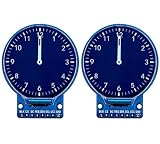
- 1.28-inch round IPS color screen,support 65K color display,display rich colors
- 240X240 resolution, clear display. IPS full view panel, ultra wide viewing angle
- Use 4-wire SPI serial bus, requiring only a few I/O pins to light up the display
- Operation Voltage: 3.3V, compatible with Arduino, STM32, Raspberry Pi
- Widely used with many development boards to display temperature humidity, image, text, number etc.
Can you build the OV-Watch yourself?
Yes, in the sense that the project lists the design and firmware files needed to attempt a reproduction. The published materials include BOM spreadsheets, schematics, Gerbers, firmware and case STL files. A BOM and fabrication files are a starting point, not a guarantee that assembly will be easy: Xu specifically warns that soldering or replicating the hardware can be difficult.
The full-watch route makes sense if you want the wearable itself and are prepared to source parts, arrange PCB fabrication, solder components and print or otherwise produce the enclosure. The files listing is on Hackaday’s OV-Watch files page. It does not establish a current parts total or retail availability.
Rank #4

- STM32F103C8T6 ARM STM32 minimum system development module.
- ST-Link V2 support the full range of STM32 SWD interface debugging, simple interface (including power supply), 4 line speed, stable work.
- Use the current smart phones of Mirco USB interface, easy to use, USB communication and power supply can be done.
- The board lead to all the I/O resources.Download with SWD debug interface, which requires a minimum of 3 wires to complete debug a download task
Can you learn LVGL without building the whole watch?
Yes. Xu suggests the FriPi STM32F411 development board for people who find the watch hardware difficult to solder or reproduce and want to focus on coding or LVGL instead. That is a lower-friction software-learning path, not the finished OV-Watch and not a guaranteed drop-in hardware substitute. Confirm that a particular board has the MCU and peripherals needed for your project; the project sources do not establish current stock or a cost comparison.
Quick Recap
Best Value

- Experience unrivaled performance with the STM32H723ZGT6 core board, featuring a blazing 550MHz main frequency for seamless operation
- Harness the power of 1MB Flash and 564K SRAM on the STM32H723 development board, ensuring ample storage and memory for your projects
- Seamlessly expand your capabilities with the external W25Q64, boasting 8M bytes of capacity on the STM32H723 core board system learning board
- Effortlessly navigate through tasks with the convenient Type C interface, SPI LCD, and 108 IO ports on the STM32H723 core board
- Elevate your development experience with the STM32H723 core board, equipped with a screen interface and camera port for enhanced functionality
| Path | Best suited to | What it involves | Closeness to the watch |
|---|---|---|---|
| Reproduce OV-Watch | A builder seeking the wearable | Use the project BOM, schematics, Gerbers, firmware and case files; handle sourcing, board fabrication, soldering and enclosure work. | Uses the published watch design. |
| Use a development board | A learner focused on STM32 coding or LVGL | Follow Xu’s suggestion to try a FriPi STM32F411 development board; check its peripherals against your learning project. | Provides a learning route, not the complete watch design. |
Product prices and availability are accurate as of the date/time indicated and are subject to change. Any price and availability information displayed on Amazon at the time of purchase will apply.