The Tool Desk
Outbyte Driver Updater FREEFix the driver behind crashes, sound loss and screen glitchesFind Drivers →Outbyte PC Repair FREEClear out junk files and repair common Windows errorsFree Scan →The Galaxy Watch4 Classic is a 2021 stainless-steel Wear OS watch whose physical rotating bezel sets it apart. For a successful setup, first identify the exact size and Bluetooth or LTE model, then pair it through Galaxy Wearable on Android. In 2026, it can still be a worthwhile used buy if the bezel is what you want and the price reflects the age, battery condition, and support uncertainty.
Identify the exact Watch4 Classic
Before opening the box—or buying a used watch—check the model number, case size, connectivity, color, and condition. “Galaxy Watch4 Classic” alone does not tell you whether the watch has LTE or which charger and carrier arrangements may apply.
| Configuration | Model number |
|---|---|
| 42mm Bluetooth/Wi-Fi | SM-R880 |
| 46mm Bluetooth/Wi-Fi | SM-R890 |
| 42mm LTE | SM-R885 |
| 46mm LTE | SM-R895 |
Samsung’s U.S. datasheets list these model identifiers and specifications for the Bluetooth/Wi-Fi models and LTE models. Match the number on the box or watch to the seller’s description; confirm LTE from the full model number rather than a listing title.
42mm or 46mm?
| Specification | 42mm | 46mm |
|---|---|---|
| Display | 1.2-inch Super AMOLED, 396 × 396 | 1.4-inch Super AMOLED, 450 × 450 |
| Typical battery capacity | 247mAh | 361mAh |
| Case dimensions | 41.5 × 41.5 × 11.2mm | 45.5 × 45.5 × 11.0mm |
| Weight | 46.5g | 52g |
| Case material | Stainless steel | Stainless steel |
| RAM and storage | 1.5GB / 16GB | 1.5GB / 16GB |
The 46mm offers a larger screen and more battery capacity, but also a larger, heavier case. The 42mm is less visually prominent and may suit a smaller wrist better. Both are relatively substantial cases; try one on if possible, and check band fit. The watch takes standard 20mm bands, although the included band and its condition can vary.
#1 Best Overall
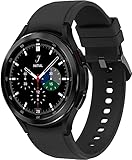
- Rotating Bezel Navigation: Physical rotating bezel allows precise and intuitive control of apps and menus.
What comes in the box?
Contents can differ by country, carrier, seller, and whether the package is new, open-box, refurbished, or used. Check and show the actual package rather than assuming a universal bundle. Look for the watch, its band, the wireless charging puck, printed documentation, and any seller- or region-specific extras. If an item is missing, establish that before purchase; in particular, verify that a compatible charging puck is included or budget for one.
For a used watch, inspect the screen, case, rotating bezel, buttons, sensor area, band pins, and charging surfaces. Ask for the exact model number, a clear factory-reset status, battery-condition information if available, and a return policy. Confirm that the serial and model details match the listing.
Hardware tour: bezel, buttons, sensors, and band
The Classic’s defining control is its physical rotating bezel. Turn it to scroll through lists, notifications, and tiles, then tap the screen to select. The official datasheet describes the interface as two buttons plus a physical rotating bezel.
- Top side button: Home control; depending on software and configuration, pressing or holding it can perform other actions.
- Bottom side button: Back control; its precise behavior may vary with software settings.
- Microphone and speaker: Used for supported voice, call, and audio features.
- Back sensor area: Contains the BioActive Sensor used by supported health measurements.
- Band-release buttons: Press to release the band from the case; make sure each replacement band pin is seated securely.
- Charging area: The watch aligns with its wireless charging puck on the back.
Touch controls complement the bezel: swipe left or right to move between panels or tiles, swipe down for quick settings, and swipe up to open the apps screen. A short press of Home generally returns to the watch face or app launcher, while Back returns to the previous screen. Because the watch may run a much newer One UI Watch version than it did at launch, treat menu names and button behavior as software-version dependent.
Charge and power on
- Connect the supplied wireless charging puck to a suitable USB power source.
- Place the watch on the charging head with the display facing upward, as described in Samsung’s charging instructions.
- Check that the charging animation appears and that the watch is seated correctly.
- Give it enough charge to complete pairing and software updates before relying on it for the day.
- Press and hold the Home button to power on if the watch does not start automatically.
Do not assume any Qi pad or a phone’s reverse-wireless-charging feature will work. Samsung identifies the Watch4 Classic’s system as WPC-based wireless charging; compatibility can depend on charger, phone, case, alignment, and software. If charging fails, clean the charging surfaces, reseat the watch, check the puck and cable, and remove any case that interferes with alignment. Stop using a watch with physical damage or a swollen battery and seek professional service.
Rank #2
- 1.2 "(30.5mm) w/ Rotating Bezel, Super AMOLED, 396 x 396 pixels (~330 ppi density), 16M Colors, CPU: Dual-Core 1.15GHz, 247mAh Battery, Android Wear OS, One UI Watch 3, Bluetooth, Wi-Fi
- The Galaxy Watch4 Classic uses red LEDs and infrared rays to calculate your SpO2 levels or the amount of oxygen in your blood.
- Glass front (Gorilla Glass DX+), MIL-STD-810G compliant, 50m water-resistant (IP68), Compatible with standard 20mm straps, ECG certified, Blood pressure monitor
- 5 ATM / IP68 The water and dust resistance rating, Military-grade durability, Larger screen but lighter and thinner for more comfort.
- Compatible with Android Phones Running Android 6.0 and Above. NOT compatible with iOS.
Pair the watch with an Android phone
The normal setup path uses Samsung’s Galaxy Wearable app on an Android phone. At launch, Samsung listed Android 6.0 or later and more than 1.5GB of phone RAM as minimum compatibility requirements. Those original minimums are not a guarantee that every such phone will deliver a good experience in 2026: current app versions, phone software, Google services, region, and Samsung-specific features all matter. iPhone is not the intended supported pairing path.
- Prepare the phone: Install or update Galaxy Wearable and ensure Bluetooth is on. Keep the watch and phone close together.
- Start pairing: Open Galaxy Wearable and choose Add new device or the equivalent pairing option, then select Galaxy Watch4 Classic.
- Verify the code: Confirm that the pairing code on the phone matches the one shown on the watch before accepting.
- Review permissions: Allow Bluetooth and device permissions needed for pairing. Notification access lets the watch show phone alerts; health-related permissions support Samsung Health functions. Grant only the access you want to use.
- Complete accounts: Sign in to a Samsung account if prompted. Google account or Play setup may also be offered for Google apps and services.
- Choose restore or new setup: Restore a backup if available and desired, or configure the watch as new.
- Set preferences: Choose notification access, health profile details, wrist and wearing orientation, and preferred units.
- Update and restart: Install available watch and app updates, keeping the watch on its charger if requested. Allow it to restart when necessary.
- Check the basics: Test notifications, calls where supported, installed apps, GPS, and any health measurement you plan to use.
Menu labels can change with Galaxy Wearable and watch software versions. Samsung’s support page for model SM-R880 provides manuals, including documentation for newer software versions.
If pairing fails
- Restart both the phone and watch, then update Galaxy Wearable and related Samsung apps.
- Remove an incomplete watch entry from the phone’s Bluetooth settings, then restart pairing from inside Galaxy Wearable.
- Check that Bluetooth permissions are allowed and keep the devices close with Wi-Fi enabled.
- If the watch belonged to someone else, factory-reset it and confirm that it reaches the welcome screen without requesting the previous owner’s account.
- If it still will not pair, reset the phone’s network or Bluetooth settings and retry. Contact Samsung support if the device is account-locked, carrier-locked, or stuck in activation.
Settings worth reviewing first
Once setup is complete, tailor the watch rather than accepting every default. Open the relevant watch settings or Galaxy Wearable controls; exact paths vary by software version.
- Wrist and orientation: Set the wrist and button orientation so gestures and controls match how you wear it.
- Display: Review always-on display, brightness, screen timeout, and raise-to-wake. These affect convenience and battery use.
- Notifications: Choose which phone apps can alert you; limiting noisy categories can make the watch more useful.
- Health profile and units: Enter accurate information and preferred units before relying on health summaries.
- Sleep and workouts: Enable only the tracking you want, and check that the band fits securely for measurements.
- Emergency options: Review available emergency and fall-detection settings, their triggers, and any contacts or permissions they require.
- Payments and accounts: Configure Samsung Wallet or Google Wallet only if supported in your location and by your bank.
- Battery controls: Locate power-saving options and decide whether display or background activity should be reduced when needed.
Software and everyday interface tour
The Watch4 Classic launched in 2021 with Wear OS Powered by Samsung and One UI Watch. Software has since moved on: Samsung’s update page lists model SM-R880 with build R880XXS2JZE1, released June 22, 2026, Android Wear OS 6.0, and a May 5, 2026 security patch. Update availability and timing vary by model, country, carrier, and region, so that listing does not establish the same update status for every Watch4 Classic.
From the watch face, swipe down for quick settings such as common connectivity and power controls. Swipe up to browse installed apps, including Samsung Health and Google Play Store when available. Swipe sideways or rotate the bezel to move among tiles such as activity, weather, calendar, or sleep, depending on the installed software and selected tiles. Notifications are accessible from the notification area; use the bezel to navigate and tap to open or respond when an app supports it.
Rank #3

- Rotating Bezel Navigation: Physical rotating bezel allows precise and intuitive control of apps and menus.
Watch faces can be selected and customized from the watch or Galaxy Wearable. Google Maps or other navigation, voice assistants, wallet apps, and Find My Watch/phone tools depend on installed apps, accounts, region, and software support. Check the Play Store and current app requirements rather than assuming a launch-era feature or menu still appears unchanged.
Health and fitness: what the sensors do—and what they do not
The BioActive Sensor combines optical heart-rate, electrical heart, and bioelectrical impedance capabilities. Other built-in sensors include accelerometer, barometer, gyroscope, geomagnetic, and light sensors. These support wellness functions such as heart-rate tracking, workouts, sleep tracking, blood oxygen measurements where supported, and body-composition estimates.
Free tools Windows power users keep installed
One-click scans. No signup required.
Availability of ECG, blood-pressure monitoring, and other advanced features depends on country approval, compatible software, calibration, and in some cases a Samsung phone and Samsung Health Monitor. Confirm regional and phone requirements in the app before purchase. Measurements are informational wellness data, not a diagnosis or treatment plan; do not use a watch reading to dismiss or confirm a medical emergency.
- Wear the watch snugly with good skin contact, without making it uncomfortably tight.
- Movement, sweat, hair, tattoos, or poor fit can affect readings; follow the app’s measurement instructions.
- Use the correct profile and complete required calibration for functions that ask for it.
- If a reading seems unusual, repeat it as directed and consult a medical professional for health concerns.
Bluetooth or LTE?
| Model type | What to expect |
|---|---|
| Bluetooth/Wi-Fi | Primarily relies on the paired phone for calls, messages, notifications, and app data. Wi-Fi can support some connectivity when the phone is away. |
| LTE | Can use a mobile network after compatible carrier and eSIM activation; a wearable line or plan is commonly required, and cellular use can consume more battery. |
Standalone calling and number-sharing vary by carrier, country, model, and plan; LTE does not mean every function works independently of a phone. Before buying, ask the carrier to confirm support for the complete model number and verify that the watch is eligible for activation. Imported models, carrier restrictions, a missing wearable line, or an incomplete eSIM setup can block activation.
Independent reader supportYour contribution helps us test, update, and keep practical guides available for everyone.Water resistance and durability
Samsung lists 5ATM, IP68, and MIL-STD-810G ratings for the Watch4 Classic. These are not a promise that an individual used watch remains sealed: impact, repairs, and normal wear can affect water resistance. Avoid hot tubs, steam rooms, high-pressure water, and harsh chemicals; rinse and dry the watch after salt water or chlorine exposure. Do not treat the ratings as permission for diving or as a guarantee against water damage.
Rank #4

- Display: 1.2" (30.44mm) Circular Super AMOLED (396x396 pixels). Full Color Always On Display. Corning Gorilla Glass DX.
- Exynos W920 Dual Core 1.18GHz
- Sensor: Accelerometer, Barometer, Gyro Sensor, Geomagnetic Sensor, Light Sensor, Optical Heart Rate Sensor, Electrical heart sensor, Bioelectrical Impedance Analysis Sensor, Hall sensor
- Bluetooth 5.0, Wi-Fi 802.11 a/b/g/n 2.4+5GHz
- Wear OS Powered by Samsung. Compatible with Android 6.0 or higher
Used-watch checks and common problems
Before paying
- Verify size, full model number, region, and Bluetooth or LTE configuration.
- Confirm that the device has been factory-reset and that no previous owner’s account appears during setup.
- Check bezel rotation, buttons, screen, charging, band attachment, and sensor area for damage.
- Ask about battery condition, included proprietary charger, return window, and any repair or water exposure.
- For LTE, verify carrier eligibility and that the device is not blocked or reported lost.
Battery life is hard to predict
Do not buy on a guaranteed days-per-charge claim. Runtime varies with case size, LTE, GPS workouts, always-on display, brightness, notifications, sleep and health tracking, software, temperature, and battery age. A used unit can hold substantially less charge than it did when new.
Recommended Free Tools
Health readings look inconsistent
Check fit, skin contact, movement, user profile, required calibration, and whether the feature is supported in your country. Sweat, tattoos, or hair may interfere with sensor contact. A smartwatch reading is not a substitute for medical assessment.
Charging does not start
Use the appropriate puck, check alignment and clean contact surfaces, inspect the cable and power source, and remove a case that may interfere. Excessive heat or physical damage is a reason to stop and seek service rather than keep charging.
Is the Watch4 Classic worth buying in 2026?
It remains a distinctive choice if a physical rotating bezel matters, but weigh a used price against newer watches and the condition of the specific unit. Samsung’s current U.S. lineup includes newer models; its June 2026 MSRP sheet lists Bluetooth Watch7 at $249.99 for 40mm and $279.99 for 44mm, while the Samsung U.S. Watch7 buy page showed $299.99 and $329.99 when checked. Samsung lists Watch8 from $349.99 and Watch8 Classic from $499.99. These are U.S. price signals, not guaranteed current sale prices; promotions, stock, and prices change. See Samsung’s Watch7 buy page, Watch8 page, Watch8 Classic page, and June 2026 MSRP sheet.
| Buyer situation | Practical choice |
|---|---|
| Wants a physical bezel at a clearly lower price | Consider a well-tested Watch4 Classic with a return option. |
| Wants newer hardware and a comparatively lower official price, without needing the bezel | Compare the Galaxy Watch7. |
| Wants a current Classic-style model with a physical bezel and accepts a higher price | Compare the Galaxy Watch8 Classic. |
| Needs guaranteed long-term support, current LTE provisioning, or the latest health features | Prefer a current model after checking its exact feature and carrier support. |
| Uses an iPhone | Do not choose the Watch4 Classic as an ordinary supported pairing option. |
For the Watch4 Classic, the sensible buy is a clean, account-free unit with a working charger, acceptable battery condition, verified model, and price well below a newer alternative. If any of those essentials is uncertain—or the seller will not accept returns—the age-related risks can outweigh the appeal of the bezel.
What’s actually slowing this PC down?
Pick the symptom - the matching free tool is one click away.
Quick Recap
Product prices and availability are accurate as of the date/time indicated and are subject to change. Any price and availability information displayed on Amazon at the time of purchase will apply.