Quick wins for a faster PC:
Repair Windows errors before they cause bigger problemsFix Now →Fix the driver behind crashes, sound loss and screen glitchesFind Drivers →Clear out junk files and repair common Windows errorsFree Scan →The Seiko 6105-8000 is worth seeking out as an important 1968 diver in its own right—not merely as a smaller, cheaper alternative to the famous 6105-8110. Its symmetrical tonneau-shaped case, four-o’clock crown, restrained proportions, and place in Seiko’s developing dive-watch lineage give it a character distinct from the later Captain Willard.
At approximately 41 mm wide with a roughly 48 mm lug-to-lug measurement, the 6105-8000 has meaningful wrist presence without the visual mass of the approximately 44 mm 6105-8110. It is also less frequently encountered, which makes originality and condition especially important when buying. The catch is that a running example is not automatically authentic, collectible, or safe to put in water.
Why the Seiko 6105-8000 deserves more attention
Vintage Seiko collecting is dominated by a few immediately recognizable names: the 62MAS, the 6105-8110, the 6306, and the 6159. The 6105-8000 tends to sit in the shadow of those watches, particularly its direct successor, the larger 6105-8110 associated with the informal Captain Willard nickname.
That hierarchy can make the 8000 look like a transitional curiosity. A better reading is that it is the earlier and more restrained expression of the 6105 formula. Seiko dates the model to 1968 and has specifically identified its curved case profile and four-o’clock crown as design elements that influenced later iconic divers. It therefore belongs in the company’s foundational professional- and recreational-diver story, not merely in a footnote to the 8110.
#1 Best Overall

- WATER-RESISTANT: these water-resistant men's dive watches are ISO scuba-approved to depths of 200 meters
- AUTOMATIC: these self-winding, automatic men's watches are powered by your movement, with a power reserve of 41 hours
- STAINLESS STEEL: features a durable 43.8mm stainless steel watch case and bracelet.
- LUMIBRITE DISPLAY: this men's automatic watch features a highly-legible display with LumiBrite hands and markers
- 4R35 CALIBER: equipped with the reliable caliber 4R35 automatic movement, this accurate men's watch keeps precise time
The 6105-8000 is not necessarily the best vintage Seiko diver for every buyer. The 8110 is more famous, easier for many collectors to recognize, and more closely tied to popular culture. But the 8000 offers a combination of historical importance, compact wearing dimensions, and relative scarcity that can be unusually appealing to someone who wants a vintage diver with less visual bulk and less obvious collector branding.
Where it sits in Seiko’s diver history
The 6105-8000 followed Seiko’s earlier 62MAS as part of the company’s developing dive-watch lineage. Specialist references generally describe it as a successor to the 62MAS and a design bridge toward the later 6105-8110 and subsequent Seiko divers.
That lineage should be described as continuity and influence rather than exclusive authorship. The 6105-8000 did not single-handedly create every later Seiko diver design, but it established several recognizable ideas: a curved case that wraps around the wrist, a crown placed at four o’clock, and a practical diver layout that could evolve into the more assertive 8110 case.
Seiko’s own historical material places the 6105-8000 in 1968. The exact end of its production and the precise timing of the transition to the 6105-8110 are less certain. Collector references generally place the 8000 in the late 1960s and early 1970s, with the 8110 following around 1970, but serial-number interpretations and surviving examples do not establish one universally accepted production boundary. For that reason, it is safer to call the 8000 the earlier 6105 reference than to assign every example to a rigid production window.
Recommended Free Tools
Seiko 6105-8000 specifications at a glance
| Feature | 6105-8000 |
|---|---|
| Introduction | 1968, according to Seiko’s historical material |
| Case shape | Curved, symmetrical tonneau- or cushion-like profile |
| Diameter | Approximately 41 mm |
| Thickness | Approximately 12.5 mm |
| Lug to lug | Approximately 48 mm |
| Lug width | 19 mm |
| Crown | Signed Seiko, positioned at four o’clock, generally non-screw-down |
| Case back | Screw-down |
| Bezel | Bidirectional 60-minute bezel without click detents |
| Crystal | Hardlex or mineral-type crystal, depending on how the surviving example has been described or serviced |
| Movement | Automatic Seiko 6105 movement family; early examples are commonly associated with Caliber 6105A |
| Frequency and jewels | 21,600 vibrations per hour and 17 jewels, according to specialist technical descriptions |
| Date | Quick-set date |
| Hand-winding | Not available in the usual manual-winding sense |
These are useful reference points, not a substitute for examining the individual watch. Vintage examples may have replacement crystals, crowns, bezels, hands, dials, gaskets, or movements. Measurements can also vary slightly according to how a case is measured and how much material has been removed by polishing.
The case is the 6105-8000’s defining advantage
The most important visual difference between the 6105-8000 and the later 6105-8110 is not simply the number of millimeters on the ruler. The 8000 has a slimmer, more symmetrical case with a traditional tonneau or cushion-like outline. Its curves make the watch appear integrated with the wrist rather than perched above it.
At about 41 mm wide and 12.5 mm thick, the 8000 is not a small vintage watch. The roughly 48 mm lug-to-lug measurement gives it a solid presence, especially on a medium or large wrist. What makes it feel more manageable is the relationship between those dimensions: the case is broad enough to look purposeful, but it lacks the 8110’s large asymmetric shoulder and slab-sided visual weight.
The curved profile is also historically significant. Seiko later used the 6105-8000 as the case reference for a Prospex recreation, specifically pointing to the curved silhouette and four-o’clock crown. That is strong evidence that the early case was regarded by Seiko as a meaningful part of its design heritage rather than an obsolete stepping stone.
Crown, bezel, crystal, and case-back details
The crown is signed Seiko and sits at four o’clock. On the early 6105-8000 it is generally not a screw-down crown. That is one of the details that separates the early model from the locking-crown arrangement associated with later 6105 references.
The case back is screw-down, but that fact should not be confused with modern water-resistance security. The crown, crystal gasket, case-back seal, and the condition of the case itself all matter. A screw-down back on a watch from the late 1960s is not evidence that the watch remains ready for underwater use.
The bezel is a bidirectional 60-minute type without click detents. It is a period construction detail that contributes to the watch’s character, but it also means that the bezel should be assessed for correct tension, insert condition, lume pip, and replacement parts. A bezel that turns too freely, sits unevenly, or has an insert that looks conspicuously new deserves further investigation.
The original crystal is generally described as Hardlex or mineral crystal. Scratches are common after more than five decades, and crystal replacement is a normal part of many restorations. A perfectly clear crystal may therefore indicate careful preservation—or a service replacement. It cannot establish originality by itself.
Dial and hands: the details collectors study
The black dial is legible and relatively restrained. It uses applied luminous hour markers with chrome surrounds, and the framed date aperture sits at three o’clock. Above six o’clock is the Suwa symbol, an important detail when comparing an example with reference photographs.
The seconds hand has the characteristic arrowhead, sometimes called a stoplight, arrangement. Specialist descriptions of original examples note two luminous areas, including a red element. The precise appearance of surviving hands can vary with aging, reluming, replacement, and photography, so the seconds hand is useful evidence but not a single-part authentication test.
Patina is not proof of originality. Faded lume, a ghosted bezel, aged printing, and scratches can all be consistent with an old watch, but they can also be combined with replacement components. There are genuine-part watches assembled from pieces that are individually authentic but not all correct to the 6105-8000 or 6105-8009 reference.
Look for consistency across the entire display: marker shape, chrome surrounds, date frame, printing, Suwa symbol, hand style, lume aging, and the relationship between dial and hands. A dial with evenly fresh lume paired with heavily aged hands is not automatically wrong, but it is a reason to ask questions.
PC Slower Than It Used to Be?
A free scan shows the junk files, broken settings and background clutter dragging Windows down - then fixes them in one click.Free scan · Windows 10 & 11Crashes, No Sound, or Screen Glitches?
Random freezes, missing sound and display glitches usually trace back to one bad driver. Find and replace yours safely.Free scan · under a minuteMovement and operation
The watch uses Seiko’s automatic 6105 movement family. Early examples are commonly associated with Caliber 6105A, while the broader 6105 family also includes later A and B forms. The safest way to describe a surviving watch is therefore by its movement family unless its specific caliber has been inspected and documented.
Specialist technical descriptions identify a 21,600-vibrations-per-hour operating rate and 17 jewels. The movement has a quick-set date, but it cannot be hand-wound in the usual way. A watch that starts when shaken and then appears to keep time is not necessarily healthy: dried lubricants, worn pivots, a tired mainspring, magnetism, or an overdue service can all affect performance.
Do not judge the movement solely by whether the seconds hand is moving. Ask for a movement photograph where possible, service documentation if available, and information about amplitude, rate, beat error, and the date mechanism from a qualified watchmaker. A vintage automatic can be functional enough for casual ownership while still needing a full overhaul.
Rank #2

- Stainless Steel case with Black Resin Band
- Black Dial with date window at 3 O'clock
- Luminous markers and hour hands; sweep second hand
- Anti-reverse bezel
- Water-resistant to 200 M (660 feet)
6105-8000 versus 6105-8110: what actually changed?
| Characteristic | 6105-8000 | 6105-8110 |
|---|---|---|
| Historical position | Earlier 6105 reference, introduced in 1968 | Later and more famous 6105 reference, generally following around 1970 |
| Case | More symmetrical, curved tonneau or cushion-like profile | Larger, more asymmetric case with a more slab-like wrist presence |
| Approximate diameter | 41 mm | 44 mm |
| Approximate lug to lug | 48 mm | Also roughly 48 mm in commonly cited measurements |
| Crown | Four o’clock, signed, generally non-screw-down | Later locking-crown arrangement associated with the recognizable 8110 design |
| Collector profile | Less common and more understated | More recognizable, more culturally visible, and more frequently encountered |
| Popular nickname | Predecessor or early 6105; sometimes informally called Skinny Willard | Primarily associated with Captain Willard |
The 6105-8110’s nickname comes from its association with Martin Sheen’s character in Apocalypse Now. It is best reserved for the 8110 rather than casually applied to every watch in the 6105 family. Some collectors use Skinny Willard for the 8000, but that is an informal term and can obscure the important fact that the 8000 has its own design identity.
The Tool Desk
Outbyte Driver Updater FREEFix the driver behind crashes, sound loss and screen glitchesFind Drivers →Outbyte PC Repair FREEClear out junk files and repair common Windows errorsFree Scan →On the wrist, the 8000 is usually the more discreet and lithe watch. The 8110 delivers more visual drama and has stronger instant recognition. Neither case is objectively better; the choice depends on whether the buyer values historical restraint and comfort or the iconic later silhouette.
6105-8000, 6105-8009, and the Proof or Resist question
Collector references commonly discuss the 6105-8000 and 6105-8009 together. In specialist usage, the final 9 is generally associated with an international or export-market designation. Market conventions and period markings can vary, however, so the suffix should not be treated as a universal authentication rule without examining a specific case back, dial, and period documentation.
The words Proof and Resist may appear in different combinations on surviving dials and case backs. These markings can help establish an approximate production period or configuration, but neither word authenticates a watch on its own. A convincing assessment compares the case-back reference, dial, movement, crown, bezel, hands, crystal assembly, serial number, and known period-correct parts.
In other words, a 6105-8009 is not automatically a different watch in the way that an 8110 is different from an 8000. It is better understood as a closely related reference designation whose market context and exact configuration should be verified on the individual example.
Free tools Windows power users keep installed
One-click scans. No signup required.
How scarce is the 6105-8000?
The 6105-8000 and 8009 appear less frequently than the 8110 and 8119 in typical auction searches. Specialist coverage attributes that partly to the earlier model’s shorter production period and the attrition that naturally affects a watch more than half a century old.
That makes the 8000 comparatively difficult to find, but it does not mean every watch labeled 6105-8000 is rare or valuable. A heavily polished case, replacement dial, relumed hands, incorrect bezel, or non-original movement can materially change collector interest. Conversely, an honest, well-preserved example with documented service may be more desirable than a cosmetically perfect watch assembled from unrelated genuine parts.
Vintage pricing is highly condition-dependent and volatile. One specialist article cited an approximately $1,500 purchase for a particularly attractive 1970 example, but that is a historical anecdotal transaction, not a current valuation. Market-tracking services maintain dedicated 6105-8000 pages and show market activity, but detailed data may be gated and should not be turned into a precise price claim without reviewing the underlying sold examples.
The correct valuation order is:
- Confirm the reference. Establish that the case really belongs to the 8000 or 8009 family.
- Assess originality. Identify replacements, reluming, refinishing, and mixed-reference components.
- Evaluate condition. Pay attention to case geometry, dial preservation, bezel condition, crystal, and corrosion.
- Verify operation and service. A running movement is not the same as a recently overhauled movement.
- Only then discuss price. Asking prices are less useful than documented sold examples with comparable originality and condition.
For an unusually complete or high-condition example, a vintage watch appraisal can help establish documentation before arranging insurance; an appraisal is not a substitute for authentication or a guarantee that the market will pay the stated figure.
What to inspect before buying one
1. Case-back reference and serial number
Start with clear photographs of the case back, including the reference markings and serial number. The case-back reference should support the seller’s claim that the watch is a 6105-8000 or 6105-8009. Use the serial as supporting dating evidence rather than as the sole authentication method, because serial interpretation can be complicated and parts may have been exchanged.
2. Case geometry and finishing
Look for the early symmetrical tonneau profile. Excessive polishing can soften the edges, flatten transitions, and erase the contrast between brushed and polished surfaces. A case that looks unusually smooth may be attractive but less original than one retaining honest factory geometry and period wear.
3. Crown
Check for the signed Seiko crown at four o’clock. Be cautious if the watch has the later locking-crown arrangement associated with the 8110, a generic unsigned crown, or a crown that appears too new for the rest of the watch. A replacement crown may be necessary for service, but it should be disclosed and reflected in an originality assessment.
4. Bezel and insert
Confirm the early bidirectional, non-clicking construction. Inspect the insert, lume pip, tension components, and alignment. A replacement insert is not necessarily a problem for a wearable restoration, but it matters greatly to a collector seeking a correct example.
5. Dial and hands
Compare the applied markers, chrome surrounds, framed date, Suwa symbol, and arrowhead or stoplight seconds hand. Look for reluming, repainting, mismatched aging, incorrect hand lengths, and lume that is implausibly bright compared with the rest of the watch.
6. Crystal and retaining assembly
Ask whether the crystal, retaining ring, and gasket are original or service replacements. A new crystal can improve legibility and protect the dial, but it does not restore original collectible condition. If the seller cannot explain the work, treat the crystal as an unknown rather than assuming it is factory original.
7. Movement and service records
Request movement photographs and service documentation where possible. A seller who can provide a dated overhaul receipt, timing results, replaced-parts list, and clear explanation of what was not replaced gives you more useful information than one who simply says the watch runs.
8. Water resistance
Do not rely on the watch’s historical diver positioning, the old 150 m claim, or a casual seller assertion. A 1960s watch requires professional inspection and appropriate pressure testing before any water exposure. If no qualified watchmaker has inspected and tested the watch, the safe assumption is that it is not water-resistant.
Restoration, replacement parts, and daily wear
The 6105-8000 has a meaningful parts ecosystem, but it is not a modern watch with guaranteed factory support. Specialist parts references document crystals, crowns, crystal gaskets, stems, mainsprings, and other movement components, and model-specific replacement gasket sets are available through specialist suppliers.
Rank #3

- WATER-RESISTANT: these water-resistant men's dive watches are ISO scuba-approved to depths of 200 meters
- AUTOMATIC: these self-winding, automatic men's watches are powered by your movement, with a power reserve of 41 hours
- LUMIBRITE DISPLAY: this men's dive watch features a highly-legible display with LumiBrite hands and markers
- STAINLESS STEEL: features a durable stainless steel watch case and bracelet, unique case shape resembling teeth, and PADI red and blue colors on its elapsed timing bezel
- 4R36 CALIBER: equipped with the reliable caliber 4R36 automatic movement, this accurate men's watch keeps precise time
For a restoration-minded owner, Seiko 6105-8000 crystal replacement is a sensible place to begin researching parts, but compatibility must be confirmed against the actual case and retaining assembly. Replacement parts can improve serviceability while reducing originality, and installing a new gasket does not establish water resistance by itself.
Service priorities should normally be practical rather than cosmetic:
Do these 3 things before closing this tab:
1Scan for outdated or missing drivers - takes under a minute2Clear out junk files and repair common Windows errors3Fix the driver behind crashes, sound loss and screen glitches- Have the case, crystal, crown, seals, and movement inspected.
- Overhaul the movement if its service history is unknown or its performance is poor.
- Replace degraded gaskets and any crystal that threatens the dial or compromises fit.
- Document any replacement crown, hands, bezel insert, dial, lume, or case-finishing work.
- Pressure-test the completed watch using equipment and procedures appropriate to its construction.
Do not polish the case automatically. Preserving the remaining geometry is often more important than removing every scratch. Likewise, reluming or refinishing may make a watch look newer while moving it farther from its historical configuration. The best restoration is the one whose goals are clear: daily usability, historical preservation, or a compromise between the two.
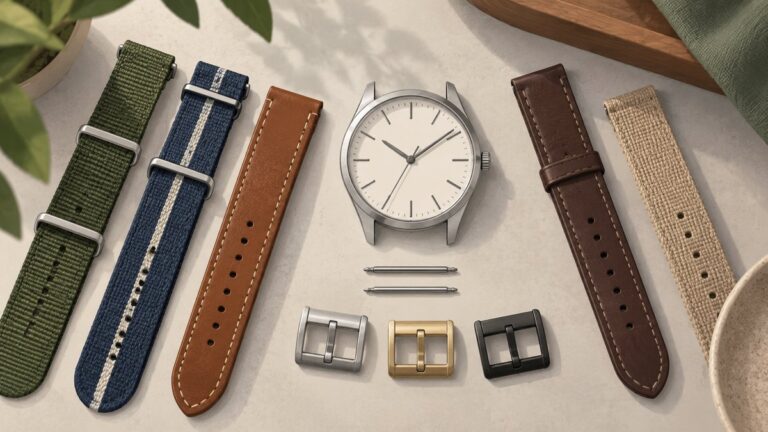
The original or period-style strap is part of the 6105-8000’s visual appeal. Because the lug width is 19 mm, a modern 19mm vintage waffle watch strap can be a practical way to recreate the period look. It should be treated as a modern reproduction, not represented as an original Seiko strap; confirm the actual measured width, lug clearance, material, and return policy before fitting it to a valuable vintage case.
A NATO or other modern 19 mm strap may be more convenient for daily wear, but it can change the watch’s height, fit, and period appearance. Any strap choice is therefore a trade-off between comfort, security, originality, and style rather than a question of one universally correct option.
Should you buy a Seiko 6105-8000?
The 6105-8000 makes the most sense for a buyer who values the history of Seiko’s dive watches but prefers a less imposing case than the 8110. It rewards close examination: the appeal lies in the early case, the four-o’clock crown, the legible dial, and the way the watch connects the 62MAS era to the better-known 6105 and later Seiko divers.
Crashes, No Sound, or Screen Glitches?
Random freezes, missing sound and display glitches usually trace back to one bad driver. Find and replace yours safely.Free scan · under a minutePC Slower Than It Used to Be?
A free scan shows the junk files, broken settings and background clutter dragging Windows down - then fixes them in one click.Free scan · Windows 10 & 11It is less suitable for someone seeking a worry-free modern tool watch, guaranteed water resistance, or inexpensive ownership. A vintage 6105 may require a specialist service, hard-to-source period-correct parts, and careful handling. The purchase price is only one part of the cost, and a bargain watch with an unknown movement and compromised seals can become more expensive than a properly documented example.
If buying remotely, favor sellers who provide high-resolution photographs of the dial, hands, bezel, case back, crown, movement, and serial number. Ask for a written parts disclosure and service history. For a high-value purchase, vintage Seiko authentication or a 6105-8000 service specialist can be worthwhile, especially when the watch combines unusual patina with a strong price. The goal is not merely to prove that some parts are genuine; it is to establish whether the watch is a coherent and correctly represented example.
A vintage-watch auction or specialist dealer may offer better documentation than an anonymous marketplace listing, but the same standards still apply: inspect sold examples, verify provenance, check the return policy, and require disclosure of replacement parts. The venue does not eliminate the need for due diligence.
The case for the underappreciated 8000
The 6105-8000’s lower profile is largely a visibility problem. The 8110 has the larger asymmetric case, the Captain Willard nickname, and the cultural boost of Apocalypse Now. Those advantages made it the instantly recognizable 6105, while the 8000’s restrained silhouette is easier to overlook.
The Tool Desk
Outbyte Driver Updater FREEScan for outdated or missing drivers - takes under a minuteDriver Scan →Outbyte PC Repair FREEClear out junk files and repair common Windows errorsFree Scan →Yet the earlier model has a compelling cumulative case. It is the 1968-origin reference recognized by Seiko as an important design ancestor. It is slimmer-looking and generally easier to wear than the 8110 despite retaining a roughly 48 mm lug-to-lug span. It has the distinctive four-o’clock crown and a period-appropriate diver layout. It is also less frequently encountered than the later 8110/8119 family.
None of that means every 6105-8000 is a museum-grade collectible, or that it should automatically command a premium. Its value depends on whether the individual watch is correctly identified, sufficiently original, honestly preserved, and mechanically serviceable. But a correct example offers a historically earlier and more wearable route into the 6105 story—and that is enough to justify evaluating it on its own terms.
Frequently Asked Questions
Is the Seiko 6105-8000 the Captain Willard?
Not primarily. The Captain Willard nickname is associated with the later 6105-8110, particularly because of its larger asymmetric case and connection with Martin Sheen’s character in Apocalypse Now. The 6105-8000 is the earlier, more symmetrical reference. Some collectors informally call it the Skinny Willard, but that nickname should be explained rather than used as if it were an official model name.
Does the Seiko 6105-8000 have a screw-down crown?
The early 6105-8000 is generally described with a signed, non-screw-down crown at four o’clock. Its case back is screw-down. That construction is historically important, but it does not mean a surviving example remains water-resistant.
What’s actually slowing this PC down?
Pick the symptom - the matching free tool is one click away.
Can I swim or dive with a vintage Seiko 6105-8000?
Not unless a qualified watchmaker has inspected the watch, serviced or verified its seals, and performed an appropriate pressure test. A replacement gasket alone is not proof of water resistance, and a seller’s casual claim should not be treated as a test result.
What is the difference between the 6105-8000 and 6105-8009?
Collectors commonly discuss the 8000 and 8009 as closely related references, with the final 9 generally associated with an international or export-market designation. Because market conventions and surviving markings vary, verify the specific case back, dial, movement, and period configuration rather than relying on the suffix alone.
Is the Seiko 6105-8000 rare or valuable?
It is comparatively less frequently encountered than the 6105-8110/8119 family, but not every example is rare or valuable. Originality, case geometry, dial and hand condition, movement condition, service history, and disclosed replacement parts matter more than the reference name alone. Historical sale prices should not be treated as current valuations.
The Bottom Line
Bottom line: The Seiko 6105-8000 is the earlier, slimmer, and more understated branch of the 6105 family. Its 1968 introduction, curved case, four-o’clock crown, and relative scarcity make it historically significant even without the 8110’s movie-star recognition. Buy the individual watch—not just the reference—and prioritize coherent originality, documented service, and verified water resistance over polished appearance or an attractive seller description.
Quick wins for a faster PC:
Scan for outdated or missing drivers - takes under a minuteDriver Scan →Clear out junk files and repair common Windows errorsFree Scan →Fix the driver behind crashes, sound loss and screen glitchesFind Drivers →Quick Recap
Product prices and availability are accurate as of the date/time indicated and are subject to change. Any price and availability information displayed on Amazon at the time of purchase will apply.