Do these 3 things before closing this tab:
1Fix the driver behind crashes, sound loss and screen glitches2Clear out junk files and repair common Windows errors3Scan for outdated or missing drivers - takes under a minuteYes—but only as a working prototype, not as a finished product. Google’s TED2025 presentation showed Android XR glasses with a display lens using Gemini to understand scenes, retain visual context, translate text, recognize objects and place navigation directions in the wearer’s view. The demonstration was real enough to move the project beyond concept-video territory, but it did not establish a retail product, final specifications or a launch date for display glasses.
Yes—but only in the sense that Google showed a working prototype, not a finished product you can buy. At TED2025, Shahram Izadi demonstrated Android XR running on Google smart-glasses hardware with a display lens, cameras, microphones, phone connectivity, Gemini, visual context, translation and heads-up navigation. The presentation was the first publicly viewable live demonstration that made Google’s glasses concept feel like a functioning system rather than a polished concept reel.
The important qualification is that it was still a staged product demonstration. It did not establish the glasses’ final design, weight, battery life, field of view, latency, privacy indicators, price, release date or reliability outside controlled conditions. The most accurate conclusion is that Google showed the core interaction loop working on a prototype—not that it had solved consumer smart glasses.
What Google demonstrated at TED2025
The demonstration came from Shahram Izadi’s TED2025 presentation, The next computer? Your glasses. A video of the presentation became publicly viewable in 2025, and Chrome Unboxed and 9to5Google treated it as a significant step beyond Google’s earlier concept material because viewers could see a real prototype responding to people, objects and spoken requests in the room.
#1 Best Overall

- 【Biggest. Boldest. Smartest. — A Viewing Experience Like Never Before】This isn't just another pair of XR glasses — it's The Beast. The BIGGEST screen in XR (174″, 58° FOV). The BOLDEST display ever (1250 nits, Powerd by Latest Sony Micro-OLED). And the SMARTEST glasses on the planet — Your Screen, You Rules. Built-in 3DoF, screen customizations, Auto Transparency, and Smart Re-Centering that just work. No software needed. One glance and you'll never go back.
- 【SMARTEST: YOUR SCREEN, YOU RULES — No Software Needed】 Your Screen. You Rules! Built-in VisionPair 3DoF lets you pin, resize, and lock a 174″ screen in mid-air — no software, no dongles, no drift. Full screen customizations built right into the glasses: Anchor, Smooth Follow, 32:9 UltraWide, Side Mode. Auto Transparency switches between immersion and the real world with one tap. Smart Re-Centering snaps your view back instantly.
- 【BIGGEST: THE ULTIMATE IMMERSIVE GIANT — 174″ Screen, 58° FOV, 1200p】The largest virtual display in consumer XR. Period. A 174″ screen powered by Sony's latest-generation Micro-OLED panel pushes 1200p per eye at a class-leading 58° field of view with a 120 Hz refresh rate. Every frame is edge-to-edge sharp, silky-smooth, and jaw-droppingly vivid. It's like strapping an IMAX to your face.
- 【SMARTEST: 9-LEVEL DIMMING + AUTO TRANSPARENCY — No Software Needed】 Another reason The Beast is the smartest XR glasses ever made. One tap shifts between crystal-clear AR and full cinematic blackout across 9+ electrochromic levels — no app, no software, just hardware intelligence. Auto Transparency adapts between immersion and awareness on its own. Bright office, dim plane, pitch-dark bedroom — The Beast reads the moment for you. No glare. No reflections. Just pure immersion.
- 【BOLDEST: NEXT-LEVEL CLARITY & AUDIO — 1250 Nits + HARMAN AudioEFX】1250 nits of peak brightness — over 2× brighter than the competition — means you can actually see your screen outdoors, in sunlight, no squinting required. Pair that with HARMAN AudioEFX: deeper bass, wider soundstage, and crystal-clear highs tuned by the world's leading audio engineers. Other XR glasses make you choose between picture and sound. The Beast gives you both — cranked to eleven.
The glasses had a display lens. Izadi said the lenses could support prescription use, showed that the glasses could provide speaker notes, and explained that they connected to a phone and could use the phone’s apps. That combination is central to Google’s approach: the glasses are intended to be a lightweight interface to Gemini and a connected phone, rather than necessarily a complete standalone computer hidden inside a conventional frame.
The demo, step by step
| Demonstration | What viewers saw | What it reasonably proves |
|---|---|---|
| Generative AI | Gemini generated a haiku at the beginning of the presentation. | The glasses could act as a voice-driven interface to Gemini. |
| Visual context | A participant turned away from a bookshelf. Later, she asked for the title of a white book behind her, and Gemini supplied it. | The system could retain relevant visual context within the interaction instead of treating every question as an isolated request. |
| Object memory | Gemini helped locate a misplaced hotel key card after seeing where it had been left. | The glasses could connect a prior visual observation with a later natural-language question. |
| Scene understanding | The system explained a diagram viewed through the glasses. | Gemini could interpret something in the wearer’s field of view and explain it conversationally. |
| Translation | The glasses translated a sign into English and then into Farsi, also known as Persian. | Translation could be requested in conversation rather than through a manually selected language workflow. |
| Language switching | Izadi conversed in Hindi without manually changing a language setting. | Google was demonstrating automatic multilingual interaction, although the presentation did not establish the final language list or accuracy. |
| Music recognition | The glasses recognized a record and offered to play a song from it. | Visual recognition could connect an object to a phone-based media action. |
| Navigation | The display showed turn-by-turn directions with a three-dimensional map overlay. | The glasses could place navigation information in the wearer’s view rather than requiring a phone screen. |
TED’s own description summarized the promise more simply: the technology could summarize a book, translate languages and remember where keys had been left. Those examples capture the intended shift from asking a device to perform a command to asking an assistant that has some awareness of the wearer’s surroundings.
Why the live prototype mattered
Smart-glasses announcements often rely on rendered interfaces, carefully edited videos or fictionalized concept scenes. This presentation was different in one important respect: an audience could watch a person wearing the glasses interact with a display lens, Gemini and physical objects in the room.
That does not make the demonstration independent testing, but it does provide stronger evidence than a purely scripted concept video. Google showed several parts of the intended system in one sequence:
- the glasses could see through cameras;
- the wearer could communicate naturally by voice;
- Gemini could interpret visual information;
- the system could use context from an earlier moment;
- the phone could provide apps and connectivity; and
- the display could present information without requiring the wearer to look down at a phone.
That is the core interaction loop Google needs for useful everyday eyewear: look, ask, understand, and receive an answer or action without taking out another device.
What the presentation did not prove
The demo showed capability, not a specification sheet. It did not reveal the final industrial design or answer the questions that determine whether smart glasses are pleasant to wear all day.
- Battery life: Google did not say how long the prototype could operate with cameras, microphones, wireless connectivity and a display active.
- Weight and comfort: The presentation did not establish whether the glasses would feel like ordinary eyewear or like a computer mounted on the face.
- Display quality: Field of view, brightness, resolution, refresh rate, outdoor visibility and eye-box were not specified.
- Latency: The demo did not provide measurements for the time between looking at something, asking a question and receiving an answer.
- Reliability: A controlled stage is not the same as a busy street, a noisy restaurant, poor lighting or a crowded airport.
- Privacy controls: The demonstration did not establish how recording is signaled, how bystanders are protected, what is stored or how long visual and audio context is retained.
- Prescription details: Izadi said the lenses could support prescription use, but that is not a final prescription range, fitting policy or guarantee that every retail model will be available with prescription lenses.
- Availability and price: No consumer price or firm retail launch date for the demonstrated Google glasses was established.
- Language support: Hindi, English and Farsi/Persian appeared in the presentation, but the demonstration did not define the complete supported-language list or performance in every language.
There is also an important distinction between contextual recall and permanent personal memory. The book and key-card examples showed Gemini using information seen earlier in the interaction. They did not prove that the final glasses would continuously record everything a wearer sees or maintain an unlimited searchable history of daily life.
Google’s Android XR strategy became clearer after the demo
At Google I/O 2025, Google described Android XR glasses as connected wearables with cameras, microphones, speakers and an optional in-lens display. Gemini could use the wearer’s visual and auditory context, while the phone connection could support messaging, appointments, turn-by-turn directions, photos and live language translation.
Recommended Free Tools
Rank #2
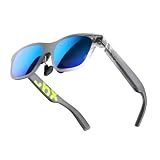
- YOUR PRIVATE 147” BIG SCREEN, ANYWHERE — Plug the a01+ into your phone, tablet, handheld, or laptop and a giant 147” screen appears in front of you—for movies, gaming, or getting work done on the couch, on a flight, or in bed. A true portable display you wear, in a soda-can-sized 210g case that drops in your pocket.
- ALWAYS RIGHT IN FRONT OF YOU — The screen follows your view with smooth, stabilized tracking and stays centered as you look around—nothing to anchor or set up, and no drift to reset. Press play and your big screen is simply there.
- 62G — LIGHT ENOUGH TO FORGET — At just 62g, with three nose-pad sizes and flexible temples, the a01+ stays comfortable through a long movie or flight, even lying down.
- LOOKS LIKE SUNGLASSES, NOT A GADGET — A slim, sunglasses-style frame with a signature semi-transparent chassis and neon logo—light and low-profile enough to actually wear out.
- WORKS WITH YOUR USB-C GEAR — No Battery to Charge — Connects and powers over a single USB-C DisplayPort cable: iPhone 15/16/17, iPad, DP-capable Android phones, Steam Deck, ROG Ally, Mac and PC. Nintendo Switch/Switch 2 and older (Lightning) iPhones need an adapter. For long phone sessions, add the XREAL Hub to charge and watch at once.
This matters because Android XR is not simply a new name for a single Google Glass successor. Google presented it as an ecosystem involving Google software, Gemini, Samsung hardware collaboration, Qualcomm technology, eyewear companies and phone integration. Google also said trusted testers were evaluating prototypes and that developers would eventually be able to build for the reference platform.
The eyewear partnerships are as important as the artificial intelligence. Google said it was working with Gentle Monster and Warby Parker on glasses intended to be wearable throughout the day, and identified Kering Eyewear as a possible future partner. The goal is clearly to make the frames look and feel more like ordinary fashion or prescription eyewear than like a conspicuous piece of laboratory equipment.
Current status: audio glasses first, display glasses later
Google’s May 19, 2026 update divided intelligent eyewear into two categories. That split is the clearest current answer to what happened to the glasses shown in the TED presentation.
| Category | Display | Google’s announced timing | Announced direction |
|---|---|---|---|
| Audio glasses | No necessary visual display. They use speakers, cameras and microphones. | First launch targeted for later in fall 2026. | Gemini assistance, visual questions, calls, texts, message summaries, music, photos and video, translation, navigation and multi-step tasks through a connected phone. |
| Display glasses | Information appears in the wearer’s view through an in-lens display. | Later category; no retail launch date was announced in the cited update. | The direction most closely related to the TED2025 prototype, but still less concrete as a consumer product. |
Google’s Android XR website describes audio glasses as coming in the fall and tells readers to stay tuned for display glasses. In other words, the fall 2026 timing should not be converted into a claim that Google’s display glasses will launch in 2026. The announced schedule applies to the audio-first category.
Do these 3 things before closing this tab:
1Fix the driver behind crashes, sound loss and screen glitches2Repair Windows errors before they cause bigger problems3Scan for outdated or missing drivers - takes under a minuteGoogle has previewed frames created with Gentle Monster and Warby Parker, and its 2026 update says the full collections are expected later in 2026. Google’s I/O 2026 roundup also said the first audio glasses were being made with Gentle Monster, Warby Parker and Samsung and were expected to work with both Android and iOS phones.
Those are announced collaborations, not confirmed retail products with published prices. Google has not established that it will sell every frame itself, nor has it published final model names, battery specifications or a complete display-glasses release plan.
What the announced audio-glasses platform may do
The later platform announcements expand well beyond the TED stage demonstration. Google listed visual questions, navigation, calls, texts, message summaries, music, photos and video, translation and multi-step tasks. It also previewed integrations involving Uber, Mondly and DoorDash, with DoorDash order preparation described as requiring confirmation before an order is placed.
These should be read as platform capabilities and planned experiences, not as evidence that every function was available on the TED prototype or will work identically on every final frame. Actual support may depend on the phone, app, region, language, permissions and the specific eyewear model.
Free tools Windows power users keep installed
One-click scans. No signup required.
Rank #3

- 【AI Real-Time Translation】The INMO GO3 smart glasses is equipped with a powerful AI translation engine that supports real-time translation for two-way conversations. Text display instantly in your eyes, and with rapid response times and ultra-low latency, freeing you from phone so you can focus on natural conversation
- 【98 Languages Covered】Beyond common languages such as English, Spanish, French, and German, these translation glasses also support real-time translation for a wider range of languages, including Kinyarwanda, Tongan, and Icelandic—for a total of 98 languages
- 【Invisible Teleprompter Glasses】Utilizing IMAR optical technology, the downward angle of the waveguide and the forward angle of the frame have been adjusted so that others cannot see the screen content whether you are looking straight ahead, down, or to the side. Perfect for speeches and presentations
- 【Navigation & Hearing Assistance】With built-in HERE Maps, you don’t have to keep looking down at your phone—the navigation arrows are right in front of you through the AR glasses. Plus, the real-time captioning feature provides truly convenient communication assistance for the hearing impaired
- 【8MP HD】The inmo GO3 glasses are equipped with an 8MP HD camera that allows you to take POV videos and images. You can also use the camera for photo translation—simply snap a photo of a menu, street sign, or document, and get an instant translation.
How prescription wearers should read the announcement
Prescription compatibility is one of the most meaningful details in the original demonstration. Izadi said the prototype lenses could support prescriptions, which suggests Google understands that smart glasses cannot become everyday eyewear if users must choose between vision correction and the device.
But “supports prescription use” is not the same as a retail prescription program. Until final frame specifications are published, buyers still need answers about prescription ranges, lens types, pupillary-distance fitting, lens replacement, progressive lenses, coatings and whether the electronics make the glasses thicker or heavier.
Warby Parker’s involvement may be relevant to everyday and prescription-oriented design, but it does not by itself confirm that every Warby Parker Android XR glasses model will be prescription-ready, sold through Warby Parker stores or available at a stated price. The same caution applies to the Gentle Monster Android XR glasses collection: the partnership and previewed frames are real announcements, not yet a complete retail catalog.
Where XREAL AURA fits—and where it does not
Readers looking for a more specifically described Android XR glasses-style device should know about XREAL AURA, but it must not be mistaken for Google’s TED2025 prototype. XREAL describes AURA as a spatial computer in glasses form that is paired with a dedicated compute puck.
According to XREAL’s published product information, AURA is designed with optical see-through displays, a 70-degree field of view, electrochromic dimming, world-facing sensors, a Snapdragon Reality Elite compute platform and an XREAL X1S spatial coprocessor. XREAL positions it for immersive entertainment, spatial productivity, navigation, creation, collaboration and Gemini-assisted contextual help.
XREAL says AURA is expected to launch in fall 2026 and that its final retail price will be capped at no more than US$1,500 before taxes. Those are manufacturer claims and should be treated as announced targets until the hardware is independently tested and retail availability is confirmed. AURA is evidence that the Android XR ecosystem is broadening beyond Samsung’s headset and Google’s fashion-oriented intelligent-eyewear prototypes; it is not evidence that the exact Google glasses from TED are available for purchase.
Independent reader supportYour contribution helps us test, update, and keep practical guides available for everyone.Android XR is broader than glasses
Google’s current Android XR site lists Samsung Galaxy XR as available, making it the first Android XR headset in the company’s product lineup. That is a related product, not the glasses shown by Izadi. Other Android XR devices are expected later in 2026.
The distinction matters for anyone deciding whether to try Android XR now. A headset can offer a much larger visual interface because it does not have to fit into the shape, weight and social expectations of ordinary glasses. Audio glasses can be lighter and more socially acceptable but cannot provide the same visual overlay. Display glasses promise the most direct version of the TED demo, but they also face the hardest engineering problems.
Crashes, No Sound, or Screen Glitches?
Random freezes, missing sound and display glitches usually trace back to one bad driver. Find and replace yours safely.Free scan · under a minutePC Slower Than It Used to Be?
A free scan shows the junk files, broken settings and background clutter dragging Windows down - then fixes them in one click.Free scan · Windows 10 & 11Rank #4

- [Quantum Leap in Image Quality]:RayNeo's latest HueView empowers vision with 98% DCI-P3, ΔE <2 color accuracy, 200,000:1 infinite contrast, and 145% sRGB vibrant colors. Enjoy incredible detail on a 201" mega screen while watching the movies, TV shows, and games you love.
- [Rest-Assured OptiCare️]:Eye comfort is enhanced with RayNeo's exclusive OptiCare, which intelligently utilizes 3840 Hz DC dimming and PWM dimming to eliminate flickering and unstable color displays under varying brightness conditions. Additionally, the stepless brightness control satisfies various needs in different settings. TÜV SÜD Low Blue Light & Flicker-Free Certification guarantees low blue light emission, flicker-free operation, and comfort for long-term use.
- [Game, Movie & Standard: Magic among All]:Feel games come alive with infinite color details and a 120 Hz smooth refresh rate, delivering fluid, lag-free animations. Connect deeply with the movie characters and immerse yourself in captivating storylines. Or swipe to standard mode for everyday use.
- [Better Sound Surrounding]:Stronger bass from drums, clearer mids from vocals, and crisper highs from violin, all achieved through the world's first dual opposing acoustic chamber design like no others. And even more precise audio cues to win in the final moment.
- [Comfort Reminder]:For your comfort and the best viewing experience, we suggest giving your eyes (and yourself) a 10-minute break after every 30 minutes of use.
The practical verdict
The TED2025 presentation deserves to be taken seriously because it showed the most important part of Google’s idea working: a wearer could ask about something seen earlier, identify objects, translate text, switch languages naturally and receive directions in the field of view.
It still deserves skepticism because none of that answers whether the glasses can do it quickly, privately, comfortably and reliably for a full day. A good smart-glasses product has to succeed simultaneously as eyewear, a camera-and-microphone device, a wireless accessory, an AI assistant and—if it has a display—a wearable screen. The demo validated the concept across those layers, but it did not validate the finished product.
As of August 12, 2026, Google’s roadmap is more specific about screenless audio glasses than about the display glasses that made the TED presentation so compelling. Audio glasses have named partners and a fall 2026 target. Display glasses remain a later, less-defined category. The video is therefore best understood as an early proof that Google’s Android XR vision can work in a real interaction—not as a product announcement or a promise that the demonstrated hardware is nearly ready to buy.
Source trail
- Chrome Unboxed’s April 18, 2025 report and 9to5Google’s event coverage provide the chronology and detailed account of the TED2025 demonstration.
- TED’s presentation description summarizes the intended uses: book summaries, translation and remembering where keys were left.
- Google’s May 2025 I/O material describes the Android XR glasses platform, phone connection, Gemini context and eyewear partnerships.
- Google’s May 19, 2026 update and I/O 2026 roundup provide the audio-glasses-first roadmap, partner previews and Android/iOS compatibility claims.
- Google’s Android XR site identifies Galaxy XR as available and distinguishes audio glasses from display glasses.
- XREAL’s official AURA product information supplies the manufacturer-stated specifications, launch target and price cap.
Frequently Asked Questions
Can I buy the Google Android XR glasses shown at TED2025?
No. The TED2025 glasses were a Google prototype shown in a live, staged demonstration. Google has not established that this exact hardware is available to buy. Its later roadmap targets audio glasses for fall 2026, while display glasses have no announced retail launch date in the cited update.
Will Google’s Android XR glasses work with prescription lenses?
The prototype included a display lens, and Shahram Izadi said the lenses could support prescription use. That does not yet confirm the prescription range, fitting process, lens options or availability of any final retail model.
Is XREAL AURA the same as Google’s TED2025 glasses?
No. XREAL AURA is a separate glasses-style Android XR spatial computer paired with a dedicated compute puck. XREAL lists its own display, sensors and processors and expects it to launch in fall 2026. It is not the Google prototype shown at TED2025.
Will Android XR glasses work with an iPhone?
Google said its first audio glasses are expected to work with both Android and iOS phones. Final compatibility may still vary by app, region, language, permissions and the specific eyewear model.
Do the glasses remember everything I see?
The demonstration showed Gemini retaining relevant visual context during the interaction, such as where a key card had been left. It did not prove that final glasses will continuously record everything a wearer sees or keep an unlimited permanent history.
The Tool Desk
Outbyte Driver Updater FREEScan for outdated or missing drivers - takes under a minuteDriver Scan →Outbyte PC Repair FREERepair Windows errors before they cause bigger problemsFix Now →The Bottom Line
Bottom line: Google’s TED2025 video showed a genuine Android XR glasses prototype handling visual context, translation, object recognition, phone-connected actions and heads-up navigation. It was meaningful proof of the concept, but not proof of a finished or purchasable Google product. Google’s current roadmap puts audio glasses first in fall 2026, while display glasses—the category closest to the TED demo—still have no announced retail date.
Quick Recap
Product prices and availability are accurate as of the date/time indicated and are subject to change. Any price and availability information displayed on Amazon at the time of purchase will apply.