Quick wins for a faster PC:
Scan for outdated or missing drivers - takes under a minuteDriver Scan →Clear out junk files and repair common Windows errorsFree Scan →An Omega watch earns the name “Moonwatch” through one documented history: NASA’s flight qualification of the Omega Speedmaster in 1965 and the watch’s use on Apollo missions from Apollo 11 through Apollo 17. The nickname describes a Speedmaster with that record. It is not a certification mark that appears on a current retail box, and it does not by itself tell you how a particular modern model was built or tested.
The short answer
The Speedmaster became the “Moonwatch” because NASA formally approved it for manned spaceflight in 1965 and then flew it on the Moon. Omega dates the approval to March 1, 1965, when NASA declared the Speedmaster “Flight Qualified for all Manned Space Missions.” Omega also says Speedmasters were official equipment on the successful Apollo lunar missions from Apollo 11 through Apollo 17. Those two facts, separated by a few years and kept distinct in the record, are the foundation of the name.
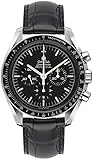
![[Omega] OMEGA Watch [2021 Omega 310.30.42.50.01.002 Speedmaster Moon Watch Professional Hand Winding See Through Back Chronograph Black 5 ATM Waterproof [Parallel Import], Black, Bracelet Type](https://m.media-amazon.com/images/I/41w4a0vIS+S._SL160_.jpg)
What NASA approved in 1965
Two dates from 1965 are often merged into one event. Keeping them apart makes the history clearer.
The March 1, 1965 declaration
In its 2025 anniversary article “60 Years Since NASA Qualification,” OMEGA states: “On the 1st of March 1965, NASA declared the OMEGA Speedmaster to be ‘Flight Qualified for all Manned Space Missions.'” This is the corporate account of the qualification, published by the brand, and it is the date most often cited for the Moonwatch name. OMEGA’s separate historical chronicle adds that the qualification also covered extravehicular activity (EVA), meaning work outside a spacecraft.
Recommended Free Tools
#1 Best Overall

- First Man On The Moon Watch Model 31130423001005
- Famous Manual-winding Chronograph Movement that was Worn on the Moon
- Omega Mechanical Caliber 1861
- Black Dial, 42mm Stainless Steel Case and Stainless Steel Bracelet
- Presentation Box Includes NATO Strap, Velcro Strap and Strap Changing Tools
The June 1965 Gemini certification
The Smithsonian National Air and Space Museum describes NASA certifying the Speedmaster as a chronograph for the Gemini program in June 1965. This is a program-specific certification, recorded by a museum rather than by the brand, and it does not replace the March date. Read the two together: the March date is Omega’s account of the broad manned-missions qualification, and the June date is the museum’s description of certification for Gemini.
Before 1965: the Speedmaster was already in use
March 1965 is a formal qualification milestone, not the first time a Speedmaster went into space. NASA’s Office of Inspector General, in its 2019 report IG-19-002 (“Final Report”), says NASA provided Speedmaster watches to astronauts starting in 1962. Describing 1965 as the year NASA approved the watch for flight is accurate. Describing it as the year the watch first flew would not be.
Rank #2

- Model 310.32.42.50.01.001
The Apollo record
The Apollo program is what turned the Speedmaster into a cultural icon. The sources establish several specific points:
- The Smithsonian’s collection records identify Speedmasters issued to Apollo 11 astronauts Neil Armstrong and Michael Collins, both from the 1969 mission.
- OMEGA says Speedmasters were official equipment on all successful Apollo missions from Apollo 11 through Apollo 17.
- OMEGA’s 2022 Apollo 17 anniversary article describes the Speedmaster as having been on six lunar landings. It also gives approximately 75 hours on the lunar surface during Apollo 17. That figure comes from OMEGA and should be attributed to it.
- OMEGA dates the Apollo 17 landing to December 11, 1972.
Key dates at a glance
| Date | What happened | Who says so |
|---|---|---|
| 1962 | NASA begins providing Speedmasters to astronauts | NASA Office of Inspector General, report IG-19-002 (2019) |
| March 1, 1965 | NASA declares the Speedmaster “Flight Qualified for all Manned Space Missions” | OMEGA, 2025 anniversary article |
| June 1965 | NASA certifies the Speedmaster as a chronograph for the Gemini program | Smithsonian National Air and Space Museum |
| 1969 | Speedmasters issued to Apollo 11 astronauts Armstrong and Collins | Smithsonian collection records |
| Apollo 11 to Apollo 17 | Speedmaster is official equipment on the successful Apollo lunar missions | OMEGA |
| December 11, 1972 | Apollo 17 lands on the Moon | OMEGA |
How the qualification testing is described
The testing story comes from brand and corporate histories, not from an original NASA test report. The accounts differ on counts, and they measure different things.
Four brands invited
OMEGA’s undated historical chronicle says four brands were invited to submit timepieces for NASA’s evaluation.
Three timepieces, 11 trials
Swatch Group’s February 27, 2025 article on the MoonSwatch 1965 says NASA tested three timepieces through 11 successive trials. Swatch Group also reports that NASA testers preferred the Speedmaster for “superior precision, reliability, legibility and ease of use.” These are Swatch Group’s reported words, not a quotation checked against a NASA document.
Rank #4
The four-brand and three-watch figures describe different stages or categories in the corporate accounts. One counts brands invited, the other counts watches tested. They are not contradictory, but neither is an independent record of the test itself.
Independent reader supportYour contribution helps us test, update, and keep practical guides available for everyone.Historical Speedmasters and modern models
The Moonwatch name rests on the 1965 qualification and the Apollo record. How far that extends to a given watch depends on the category you are asking about.
Windows Errors? Fix Them Before They Spread
Repair common Windows errors and clear accumulated junk for a smoother, more stable PC - no reinstall needed.Free scan · no reinstallOutdated Drivers Are Slowing You Down
One free scan finds every outdated or missing driver and matches the right update for your exact hardware.Free scan · exact hardware matchBest Value

- Model 310.30.42.50.01.002
| Question | Historical Apollo-era Speedmaster | Current retail Speedmaster |
|---|---|---|
| Documented mission provenance | Yes for the Apollo watches named in the Smithsonian records and the missions OMEGA lists | Not stated by the sources reviewed |
| NASA qualification documented | Yes, by OMEGA (March 1, 1965) and the Smithsonian (June 1965 for Gemini) | Not established: the sources do not show that a modern model was individually tested or newly qualified |
| Movement generation | Not stated by the sources reviewed | Not stated by the sources reviewed |
| Basis for the Moonwatch name | Qualification and Apollo use | Lineage of the Speedmaster family |
The Swatch Group product named MoonSwatch 1965 is a separate Swatch Group release. The historical claims in this article concern Omega’s Speedmaster.
Checking a claim before you buy
- If a seller says a watch was issued on an Apollo mission, ask for provenance that points to a specific mission record. The Smithsonian records cited here concern particular Armstrong and Collins pieces, not every Speedmaster.
- Treat “Moonwatch” as a family name for the Speedmaster, not as proof that a given reference carries a current NASA approval.
- When a brand cites NASA testing, check whether the claim comes from the brand’s own history or from an archival record such as a museum catalogue.
- Note whether you are looking at a current retail watch or a vintage example. The historical record applies to the Apollo-era pieces; a retail purchase should be judged on its own specifications.
For a current retail Speedmaster, the Omega Speedmaster Moonwatch is the model name to search for, and its published specifications are the place to verify its movement and features.
Quick Recap
Product prices and availability are accurate as of the date/time indicated and are subject to change. Any price and availability information displayed on Amazon at the time of purchase will apply.