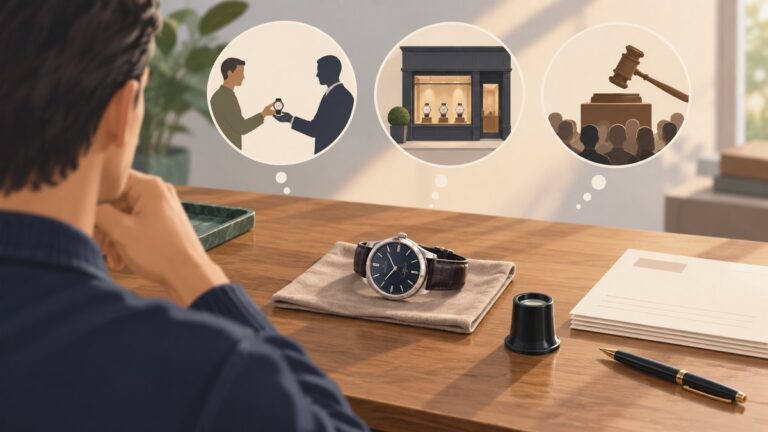
Second-hand watches have become a strategic issue for watch brands—not because every brand should buy and resell inventory, but because consumer interest, younger buyers’ preferences and the growth of resale make it harder to leave the market entirely to third parties. The opportunity is to shape how watches are authenticated, traded and experienced; the right way to do that depends on a brand’s capital, capabilities and relationship with retailers.
Why second-hand watches matter to brands now
Deloitte’s 2024 spotlight reports that consumer interest in buying pre-owned watches doubled between 2020 and 2024. Its evidence comes from annual online surveys conducted from August 2020 to September 2024 across Switzerland and major Swiss-watch export markets, with more than 6,000 consumers surveyed over the five-year study period. These are reported intentions and attitudes, not a count of completed purchases, and they should not be treated as a census of all watch buyers.
Deloitte says the pre-owned market had been growing faster than the primary market in the recent period covered by that report. It also forecasts that the pre-owned market could equal the primary market within ten years. That is Deloitte’s forecast, not an established market-size outcome. Deloitte’s 2024 pre-owned market spotlight provides the underlying study context.
More recent data points in the same strategic direction. Deloitte Switzerland’s 2025 study surveyed 6,500 consumers and 111 senior executives in June and July 2025. Among surveyed Generation Z respondents, 40% said they intended to buy a pre-owned watch in the next 12 months, compared with 20% of baby boomers. Across respondents, 53% cited affordability as a reason to value pre-owned watches, while 36% cited access to unique or no-longer-available models. These findings describe survey responses, not realized sales, and the study’s results should not be generalized automatically to every country or buyer.
#1 Best Overall

- Imported
- Pre-Loved Condition: Very Good; Minor scratches and wear on case and band.
- Case Size/Width: 36mm, Watch Height: 12mm, Band Width: 20mm, Wrist circumference: 7.0"
- Band material: Stainless steel with 18k yellow gold.
- Case material: Stainless Steel
The data supports a strategic case for engagement: resale can bring buyers to a brand through lower-priced entry points or models no longer available new, while also influencing how customers judge authenticity, value and the future resale of a watch. It does not prove that a brand will make more money by owning second-hand stock. Deloitte’s 2025 findings are summarized in its Swiss watch industry study.
What buyers appear to value
Affordability and access
For buyers who find current retail prices out of reach, a pre-owned watch may provide a less expensive route into a brand. Resale also makes discontinued, vintage or otherwise unavailable models accessible. Deloitte Switzerland’s 2025 survey figures—53% citing affordability and 36% citing unique or unavailable models—show these motivations in respondents’ own priorities, without establishing that every buyer is seeking a bargain or a collectible.
Confidence about what they are buying
A second-hand purchase asks a buyer to assess more than a new watch purchase does: whether the watch is authentic, what condition it is in, and what protection or recourse comes with the sale. Brand-backed certification can address part of that uncertainty. It does not, by itself, establish that a particular price is fair or that a watch is the right choice for a buyer.
Rank #2

- Pre-Loved Condition: Excellent; Faint scratching throughout hardware
- 31mm
- Made in Switzerland
- Hidden Crown Clasp
- Signature upon delivery required
Investment expectations need care
Deloitte’s 2024 spotlight found that one in five consumers saw a new or pre-owned watch as an investment. That is a reported perception, not evidence that watches generally appreciate or offer dependable financial returns. A brand’s resale strategy should not rely on implying that buyers can expect investment gains.
Windows Errors? Fix Them Before They Spread
Repair common Windows errors and clear accumulated junk for a smoother, more stable PC - no reinstall needed.Free scan · no reinstallOutdated Drivers Are Slowing You Down
One free scan finds every outdated or missing driver and matches the right update for your exact hardware.Free scan · exact hardware matchHow a watch brand can participate in resale
Deloitte describes three platform structures that clarify who takes on inventory and sales responsibilities. They are possible operating models, not a ranking of which one will work best for every brand.
| Model | Who owns the watch before sale? | Who manages the sale? | Capital and inventory exposure | Examples cited by Deloitte |
|---|---|---|---|---|
| 1P: stock-based retail | The retailer or resale business buys and owns the watch. | The owner sells directly to the buyer. | Highest inventory capital requirement; the owner bears the inventory risk. | Bucherer, Watchfinder & Co, the 1916 Company and Watches of Switzerland. |
| 2P: consignment | The seller retains legal ownership while the intermediary manages the sale. | The intermediary arranges the sale, subject to agreed terms. | Less inventory ownership exposure for the intermediary, though reserve prices and other terms can still create risk. | Christie’s, Sotheby’s, Phillips and Wristcheck. |
| 3P: marketplace | The seller retains responsibility for the watch. | The platform connects buyer and seller without holding or managing the stock; it generally earns a transaction commission. | The seller retains inventory responsibility rather than transferring it to the platform. | Chrono24, eBay and Bezel. |
Beyond these platform structures, brands can offer certified pre-owned (CPO) watches, accept trade-ins, build a vintage business, collaborate with dealers or participate in a marketplace. Each route changes the balance of control, capital and customer access. Buying stock gives a brand or retailer direct control over inventory and sale, but ties up capital and exposes the owner to the risk of holding watches that may take time to sell. Consignment and marketplace approaches can reduce that ownership burden, but leave important parts of the transaction—such as stock, pricing or the buyer relationship—with sellers or intermediaries.
Rank #3

- Pre-Loved Condition: Excellent; Faint scratching to hardware
- 28mm
- Made in Switzerland
- Hidden crown clasp
- Signature upon delivery required
Questions to answer before choosing a model
- Who owns the stock? Decide whether the brand, a retailer, a consignor or an individual seller carries the inventory.
- Who authenticates and services the watch? A resale offer needs a clear, credible standard and a defined responsibility for work required before sale.
- Who sets the price and bears the financial risk? Inventory ownership, reserves and pricing authority can sit with different parties.
- What trust and recourse does the buyer receive? Set out what is verified, what condition is represented and what warranty or remedy applies.
- Who gains the customer relationship and data? A brand-run sale may create more direct contact than a third-party transaction, but a dealer or platform may already own that relationship.
- How will the approach work with authorized retailers? A program that competes with dealer activity may create a different trade-off from one that equips or collaborates with those retailers.
Deloitte documents these business-model distinctions but does not establish a universally best structure. The practical choice depends on a brand’s ability to authenticate and service watches, the capital it is willing to commit, the degree of control it wants, and how it wants to work with its retail network.
What certified pre-owned does—and does not—solve
CPO can add a brand-backed layer of assurance to a second-hand transaction. Rolex offers a prominent example: WatchCharts reports that Rolex launched its CPO program on December 1, 2022. Eligible watches are at least three years old at resale, sold through participating Rolex authorized retailers, and accompanied by a new two-year international guarantee. A participating retailer may service a watch if it considers that necessary. Those terms describe the Rolex program reported by WatchCharts; they should not be assumed to apply to another brand’s CPO offer.
The Tool Desk
Outbyte PC Repair FREERepair Windows errors before they cause bigger problemsFix Now →Outbyte Driver Updater FREEScan for outdated or missing drivers - takes under a minuteDriver Scan →WatchCharts says participating authorized dealers source their own CPO inventory and Rolex does not dictate their prices. CPO therefore does not mean that every eligible watch is offered at one brand-set price. Nor does certification on its own answer every question about condition, value or the buyer’s preferred model: buyers should understand what the retailer has checked, what service was performed, and what the guarantee covers.
Rank #4

- 42mm Stainless Steel Case
- Stainless Steel Bracelet
- Blue Sunray Dial
- 5 ATM
- MSRP: 1250.00
WatchCharts estimates global Rolex CPO sales at $90 million in 2023 and $300 million in 2024. These are third-party estimates, not financial results disclosed by Rolex. The same source describes an expected premium over uncertified resale watches as part of CPO’s value proposition; that does not establish the size of a premium for any particular watch or sale. For program mechanics and the status of those estimates, see WatchCharts’ Rolex CPO analysis.
Certification can help a brand participate in resale without making a claim about the entire market. It offers a way to place the brand’s name and standards behind eligible transactions, but it does not remove the need to decide who owns inventory, who sets prices, or how the program fits with retailers.
Independent reader supportYour contribution helps us test, update, and keep practical guides available for everyone.Read market reports for what they actually measure
There is no single, fully transparent dataset in the figures cited here. Each report describes a particular survey, platform or tracked universe, so market claims need to stay tied to that evidence.
Best Value

- Excellent condition - Minimal signs of wear consistent with pre-owned use.
- Wrist Size (in): 7.25, Case Height (mm): 14.00, Case Width (mm): 43.00
- This item is pre-owned and may show light signs of wear. Please refer to the condition and photos.
- Comes with a myGemma Certificate Of Authenticity.
- Deloitte’s surveys measure consumer and executive responses in specified markets and periods. The 2024 spotlight covers Switzerland and major export markets; the 2025 study expanded its consumer sample to Mexico. Intent to buy is not the same as a completed purchase.
- Chrono24’s H1 2025 market-share observations are based on transactions on Chrono24. Its report identifies Rolex as the leading brand in its dataset and discusses activity for Omega and Cartier as well as a more normalized high-end segment. Those observations describe that platform’s transaction mix, not global market share. Chrono24’s H1 2025 report sets out its scope.
- WatchCharts’ 1Q26 report says its secondary-market index rose 1.9% for a fifth consecutive quarter and 71% of brands in its tracked universe were positive. Those figures apply to the brands and watches WatchCharts tracks, not to every second-hand watch or a comprehensive global census. See WatchCharts’ market reports.
These sources provide useful signals, but they measure different things: survey intentions, one platform’s transactions, or the performance of a defined watch-tracking universe. Combining them as though they were one audited global market series would overstate what the evidence shows.
The strategic decision is whether—and how—to take part
Second-hand watches matter to brands because customers are already responding to their price, availability and trust advantages, while resale activity can shape the broader experience of owning a watch. A brand that stays outside the market leaves authentication, customer contact and much of the resale experience to other participants. A brand that enters has to choose what it is prepared to control and what it is prepared to fund.
The relevant question is not simply whether resale is growing. It is whether a particular brand can add meaningful value through certification, trade-ins, vintage expertise, dealer partnerships or a platform—and whether that value justifies the associated capital, inventory exposure and channel trade-offs. The evidence makes second-hand a strategic consideration; it does not prescribe direct ownership of resale stock.
Quick Recap
Product prices and availability are accurate as of the date/time indicated and are subject to change. Any price and availability information displayed on Amazon at the time of purchase will apply.
Do these 3 things before closing this tab:
1Scan for outdated or missing drivers - takes under a minute2Clear out junk files and repair common Windows errors3Fix the driver behind crashes, sound loss and screen glitches