Free tools Windows power users keep installed
One-click scans. No signup required.
Apple Watch sleep tracking is useful for following sleep duration, bedtime consistency, interruptions, and broad sleep-versus-wake patterns over time. It can also estimate Awake, REM, Core, and Deep sleep, show overnight respiratory rate and other Vitals, measure wrist-temperature changes on supported models, and notify eligible users about patterns associated with possible moderate-to-severe sleep apnea.
It is not a replacement for polysomnography or a diagnosis. Apple Watch infers sleep stages from wrist movement rather than measuring brain waves with EEG, and the absence of an alert does not rule out sleep apnea. Treat individual stage readings and Sleep Score as wellness feedback; trust repeated trends, symptoms, and clinical testing more than a single night.
What Apple Watch actually tracks while you sleep
Apple Watch sleep tracking is not one measurement. The Sleep app, Health app, Vitals, wrist-temperature feature, and Sleep Apnea Notification Feature use different data and answer different questions.
| Data | What it tells you | How to interpret it |
|---|---|---|
| Sleep duration | Estimated time asleep and the period spent in bed | One of the most useful metrics for personal trends |
| Awake, REM, Core, and Deep | Estimated sleep states throughout the night | Algorithmic estimates, not EEG-derived clinical staging |
| Sleep Score | A 0–100 summary of duration, bedtime consistency, and interruptions | A behavioral summary, not a medical assessment |
| Heart rate and respiratory rate | Overnight physiological observations | Useful context, but not automatically evidence of a disorder |
| Wrist temperature | Nightly change from your personal wrist-temperature baseline | Not core body temperature and not a fever test |
| Vitals | Whether several overnight measurements are within your typical range | An unusual reading means unusual for you, not necessarily dangerous |
| Breathing Disturbances and sleep-apnea notifications | Movement patterns associated with breathing interruptions | A screening notification, not an apnea-hypopnea index or diagnosis |
| Blood oxygen, where available | Overnight blood-oxygen information on eligible models and regions | Availability and functionality vary, particularly for U.S. models |
Apple’s sleep-tracking documentation covers the ordinary sleep view, while its documentation for Vitals and sleep-apnea notifications describes separate systems. Keeping those distinctions clear prevents the watch from sounding more medically capable than it is.
The Tool Desk
Outbyte Driver Updater FREEScan for outdated or missing drivers - takes under a minuteDriver Scan →Outbyte PC Repair FREEClear out junk files and repair common Windows errorsFree Scan →#1 Best Overall

- 【Compatibility】: The replacement silicone watch strap is compatible with watches that use a standard 20mm spring bar. PLEASE confirm the watch lugs' width before purchasing. Just choose the strap with the appropriate width, and it will fit your watch.
- 【Quick Installation】The quick-release strap has a quick-release function, the quick-release spring bar allows you to change the watch strap in seconds without tools.
- 【High-quality material】: The watch strap is made of high-strength and environmentally friendly silicone rubber with a black matte stainless steel buckle. Simple fashion and durable.
- 【Soft and skin-friendly】: The watch accessory watch straps have no sharp edges, feel soft, are light, flexible to use, and very strong. The bracelet can be washed repeatedly without fading.
- 【Wide Application】: The watch strap for men and women is suitable for creating your unique daily style. Ideal for outdoor sports such as running, fitness, hiking, climbing, camping, fishing, golf and more.
Apple Watch sleep-tracking compatibility
Sleep tracking became available as a watchOS 8 feature. That does not mean every Apple Watch supports every current sleep feature. As of the watchOS 26 generation, current hardware compatibility and feature support are different:
| Feature | Current requirement | Important limitation |
|---|---|---|
| Basic sleep tracking | Apple Watch Series 6 or later, Apple Watch SE 2 or later, and all Apple Watch Ultra models running watchOS 26. Older watches may support older sleep-tracking software. | Older hardware cannot run the current watchOS 26 experience. |
| Sleep stages | Supported watchOS versions and compatible current hardware | Awake, REM, Core, and Deep are estimates from wrist movement. |
| Sleep Score | Series 6 or later, SE 2 or later, all Ultra models, and a paired iPhone 11 or later running iOS 26 | The published score formula does not give separate points for REM or Deep sleep. |
| Wrist temperature | Series 8 or later, all Ultra models, and SE 3 | Requires sleep tracking, Sleep Focus, about four hours of data per night, and roughly five nights to establish a baseline. |
| Sleep-apnea notifications | Series 9 or later, Ultra 2 or later, or SE 3, with current watchOS and iOS | For eligible adults 18 or older without an existing sleep-apnea diagnosis; availability varies by region. |
| Vitals | Compatible current models and software | Individual metrics and notifications vary by model, region, and regulatory status. |
| Sleep with Apple Watch for Kids | Not supported | Sleep tracking is not available on a watch configured through Apple Watch For Your Kids or Family Setup. |
Check Apple’s Apple Watch and iPhone compatibility list before assuming a feature will work on an older watch. Apple also documents the current model and regional limitations for Apple Watch models and Blood Oxygen.
A U.S. Blood Oxygen qualification to know
Apple Watch models purchased in the United States on or after January 18, 2024, with part numbers ending in LW/A, have a different Blood Oxygen arrangement: blood-oxygen data analysis is performed on the paired iPhone, and the feature is not available in the same way as on unaffected models. Do not assume that every recent U.S. Apple Watch presents identical overnight blood-oxygen data. See Apple’s Blood Oxygen support page for the model-specific qualification.
How to set up Apple Watch sleep tracking
The most reliable setup starts on the iPhone, then enables overnight tracking on the watch.
What’s actually slowing this PC down?
Pick the symptom - the matching free tool is one click away.
Set up a sleep schedule on iPhone
- Open the Health app.
- Tap Search, then tap Sleep.
- Tap Get Started under Set Up Sleep.
- Create a sleep goal and at least one schedule.
- Choose your bedtime and wake time, then configure the alarm and haptic wake-up.
- Set a wind-down period if you want Sleep Focus to begin before bedtime.
- Add additional schedules for weekdays, weekends, travel, or other recurring patterns if needed.
Apple explains the current setup in its guides for setting up a sleep schedule and editing multiple sleep schedules.
Turn on sleep tracking with the watch
- Open the Watch app on your iPhone.
- Tap My Watch.
- Tap Sleep.
- Turn on Track Sleep with Apple Watch.
- Turn on Charging Reminders.
You can also begin setup from the Sleep app on the Apple Watch. The important switch is Track Sleep with Apple Watch; Sleep Focus helps create the intended low-distraction overnight environment but should not be confused with the sensor or sleep-stage classifier.
Sleep Focus: what it does and does not do
Sleep Focus reduces notifications, simplifies the watch and iPhone screens, can follow a schedule and wind-down period, and provides the configured alarm and haptic wake-up. It also helps keep recording conditions consistent.
Sleep Focus is not itself a sleep sensor. Apple’s documentation describes Sleep Focus separately from the setting that adds sleep data to Health. Therefore, do not assume that a fixed bedtime schedule is required for every sleep reading. However, Sleep Focus is important for some features: wrist-temperature tracking specifically requires it, and using it is sensible if you want the native overnight experience to run consistently.
Recommended Free Tools
What to do before bed for a complete night
- Charge first: Apple recommends at least 30% battery before bed. If the battery dies, recording stops at that point.
- Wear it securely: The back sensors need continuous skin contact. A band that is too loose allows excess movement and can reduce data quality.
- Keep tracking enabled: Confirm that Track Sleep with Apple Watch is still on after changing schedules or Focus settings.
- Use Sleep Focus: This reduces distractions and is required for wrist-temperature measurements.
- Use Charging Reminders: They help warn you if the watch is not charged before wind-down.
- Wear it for the whole period: Apple says at least one hour of wear is needed for sleep data to appear. That is a minimum for data to appear, not a guarantee of useful stage data or a reliable Sleep Score.
- Keep the watch in skin contact: Avoid wearing it over clothing or leaving it on a bedside charger during part of the night.
For people who dislike sleeping in a watch, a practical routine is to charge it while showering, getting dressed, or having breakfast, then top it up again before bedtime if necessary.
How Apple Watch detects sleep stages
Apple Watch does not directly see dreams, brain waves, or the stages of sleep. Apple’s current technical paper, Estimating Sleep Stages from Apple Watch, describes an accelerometer-based classifier. It examines subtle wrist movement, including movement associated with respiration, and assigns each 30-second period—or epoch—to one of four states:
- Awake: the algorithm believes you were awake.
- REM: an estimated period corresponding broadly to clinical rapid-eye-movement sleep.
- Core: Apple’s name for estimated clinical N1 and N2 non-REM sleep. This is broadly what many consumer trackers call light sleep.
- Deep: an estimate corresponding broadly to clinical N3 or slow-wave sleep.
Apple uses Core rather than simply Light because N2 is normal, important sleep and is usually the largest part of non-REM sleep. These labels are useful for understanding the watch’s own trends, but they are not interchangeable with another device’s stage labels.
Clinical polysomnography scores stages using EEG and other signals. The watch lacks those brain-activity measurements, so its stage display is an inference from sensor patterns. Overnight heart rate, respiratory rate, and wrist temperature may appear beside the stages in Health, but Apple’s current sleep-stage paper describes the stage classifier as accelerometer-based. It should not be described as using heart rate to directly determine your stages.
Rank #2
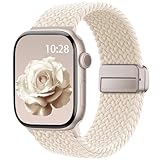
- Compatible Models: The HEARTBOOM magnetic nylon sport bands compatible for iWatch all versions. Suitable for Apple Watch Series 3/2/1 (38mm), Series 4/5/6/SE/SE 2/SE 3 (40mm), Series 7/8/9 (41mm), Series 12/11/10 (42mm). Pls check the model on the back of your watch to select the correct size
- Comfortable & Fit: HEARTBOOM stretchy apple watch band is made of recycled polyamide with a fabric weave, which is skin-friendly, breathable, lightweight, washable, sweat-resistant and quick-drying. Perfect for Fitness, Running, Yoga and daily wear, as it ensures that your wrist remains comfy and gentle feeling
- Multi Colors & Freely Adjustable: Our iwatch bands come with Various rich & muted colors for your choices, personalize your smartwatch to fit your outfit in daily life and easy change for every occasion. Suitable for women and men with 5.5"-9.6"(140mm~244mm) wrists. One size fit for most people,no need to measure your wrist to choose the size like the traditional braided bands
- Confidently Secure with Upgraded Magnets: Experience the perfect blend of style and security with our braided stretch band for Apple Watch. The enhanced magnetic Closure creates a strong, reliable connection that is easily adjustable for a flawless custom fit. Designed for all-day comfort and peace of mind, it stays put during any activity. Tool-free installation and one-click removal make it incredibly easy to use
- Perfect Gift: This apple watch bands blend fashion with functionality, look more fashionable and youthful. It's a a thoughtful and well-made gift. Suitable for Christmas, New Year's, Father's Day, Mother's Day and birthdays as a surprise for your parents, loved ones, and friends.We offer 24/7 friendly support
How to read the sleep stages
A typical night naturally moves through repeating non-REM and REM cycles, with brief awakenings that you may not remember. The watch can show those transitions as a timeline, but the most useful question is usually whether your sleep duration, timing, and interruptions are changing—not whether one night contains the exact expected percentage of every stage.
- Awake
- Short awake periods are normal. A watch may also miss quiet wakefulness and label it as sleep.
- Core
- Estimated N1/N2 non-REM sleep. A large Core number is not automatically a bad result; it is generally the largest sleep category.
- Deep
- Estimated N3 slow-wave sleep. A low number on one night is not proof that you have a disorder or that the night was unsafe.
- REM
- Estimated REM sleep, a state associated with distinctive brain and physiological activity. The watch infers it rather than measuring those brain signals.
Use stage data as a clue. If an unusual pattern persists for weeks and comes with daytime sleepiness, repeated awakenings, or other symptoms, discuss it with a clinician. Do not diagnose yourself from one unusually low Deep or REM reading.
How Sleep Score works in watchOS 26
Sleep Score is Apple’s native 0–100 summary. The documented formula is transparent:
| Component | Maximum | What Apple considers |
|---|---|---|
| Sleep duration | 50 points | How much sleep you obtained |
| Bedtime consistency | 30 points | How consistently you went to bed, using the previous 13 nights |
| Interruptions | 20 points | How often you woke and how long you remained awake |
The score bands are:
- Very Low: 0–40
- Low: 41–60
- OK: 61–80
- High: 81–95
- Very High: 96–100
Apple’s wider sleep materials discuss sleep stages when describing sleep quality, but the published Sleep Score formula does not assign a separate REM or Deep-sleep weighting. A low REM or Deep estimate should not be presented as the direct cause of a particular score unless Apple documents a future formula change. See Apple’s Sleep Score support guide for the current breakdown.
The right way to use the score is as a prompt to examine your schedule, sleep opportunity, and interruptions. It is not an objective measure of restorative sleep, a health grade, or a number that can be compared directly with an Oura, Fitbit, Garmin, or WHOOP score.
Respiratory rate, wrist temperature, and Vitals
Respiratory rate
Apple Watch can estimate your overnight breathing rate and show a range in Health. To find it:
- Open Health.
- Tap Search.
- Tap Respiratory.
- Tap Respiratory Rate.
- Tap Show More Respiratory Rate Data.
Sleeping respiratory rate is an ordinary overnight measurement, not the same as the sleep-apnea algorithm. Apple explicitly says these measurements are not intended for medical use. A change can be worth noting alongside illness, altitude, medication, alcohol, or exercise, but it is not a diagnosis by itself. See Apple’s respiratory-rate guidance for the current feature description.
Wrist temperature
Supported Apple Watches measure changes in wrist temperature during sleep relative to your personal baseline. They do not measure core body temperature and should not be used as a fever thermometer.
Do these 3 things before closing this tab:
1Fix the driver behind crashes, sound loss and screen glitches2Clear out junk files and repair common Windows errors3Scan for outdated or missing drivers - takes under a minuteWrist-temperature tracking requires a supported watch, Track Sleep with Apple Watch, Sleep Focus, about four hours of data per night, and approximately five nights to establish a baseline. Results can be influenced by illness, exercise, alcohol, diet, the sleep environment, and menstrual-cycle-related physiology. Apple’s wrist-temperature documentation explains the limitations and setup requirements.
Vitals
The Vitals app builds a typical overnight range from recent measurements and can notify you when multiple metrics fall outside that range. Listed metrics include overnight heart rate, respiratory rate, sleep duration, wrist temperature, and—where supported—blood oxygen.
Typical means typical for your recent personal baseline. An outside-range notification is not automatically dangerous, and a normal result is not a medical clearance. Medication, elevation changes, illness, and other circumstances can affect the measurements. Use Vitals as context and seek medical advice when the readings match symptoms or remain concerning.
Sleep-apnea notifications: useful screening, not diagnosis
Sleep-apnea notifications deserve separate treatment because they are not simply another sleep-stage chart. Apple’s feature looks for patterns associated with breathing disturbances and may notify eligible users about signs of possible moderate-to-severe sleep apnea.
What’s actually slowing this PC down?
Pick the symptom - the matching free tool is one click away.
Rank #3

- 【Fit All Models】SuperNaNa Sport silicone watch band compatible with apple watch bands 40mm 38mm 42mm 44mm 41mm 45mm 46mm 49mm women men,Soft breathable replacement sport strap for iwatch bands series 12 series 11 series 10 series 9 series 8 series 7 series 6 series 5 series 4 series 3 series 2 series 1. and iwatch Ultra 3 2, Ultra, SE(2nd Gen). All iwatch versions can attach perfectly and seamlessl.
- 【Soft Silicone Material】apple watch bands for women men are made of premium soft silicone, prevents skin from irritation, lightweight, persistent, skin-friendly, touch comfortable, water-resistant and sweat-proof; iphone watch bands for women perfectly fit for runs, hiking, rides, camping, climbing, swims, workouts, traveling and more outdoor activities. iWatch bands 40mm womens completely unburdened to wear on the wrist, perfect for all day.
- 【Adjustable size for all wrist】Our Sport apple watch strap compatible for 38mm/40mm/41mm/42mm(series 12 11 10), this size fits for 5.1"-7.1" (130mm-180mm) wrist; soft silicone iwatch strap compatible for 42mm(series 3 2 1)/44mm/45mm/46mm/49mm, this size fits for 5.9" - 7.9" (150mm-200mm) wrist. Please check the size on the back of your watch to choose the right size.
- 【Easy installation & removal】Our watch bands for women come with Innovative pin-and-tuck closure design, which locks onto smart watch interface precisely and securely. No tool needed,easy to install and remove,provides a secure and comfortable fit for extended wear.
- 【20+ Colors Choice】Silicone iwatch bands for women come with 20+ different cute colors available for women men. black starlight apple watch band etc colors personalize your Apple Watch and fit your daily mood and outfit. A idear option for your smartwatch accessories.
What the feature measures
The watch uses the accelerometer to detect small wrist movements associated with interruptions in normal breathing patterns. It summarizes the result as Breathing Disturbances, classified as elevated or not elevated. This is not the same as the clinical apnea-hypopnea index, or AHI, and it does not directly measure every apnea or hypopnea.
Apple’s technical report, Estimating Breathing Disturbances and Sleep Apnea Risk from Apple Watch, describes a 30-day, non-rolling evaluation window. When there are at least 10 nights with usable Breathing Disturbances values and at least half of those nights are elevated, the algorithm may generate a possible sleep-apnea notification.
Eligibility
Apple currently lists these requirements:
- Apple Watch Series 9 or later, Apple Watch Ultra 2 or later, or Apple Watch SE 3.
- Current watchOS and iOS.
- The user must be at least 18 years old.
- The user must not already have a sleep-apnea diagnosis.
- At least 10 nights of wear within a 30-day period.
- Availability in the user’s country or region.
Hardware compatibility alone does not guarantee availability. Regulatory approval and regional rollout matter.
How accurate is the notification feature?
In Apple’s published clinical-validation results, the feature reported a weighted sensitivity of 66.3% and weighted specificity of 98.5%. The testing dataset reported 66.6% sensitivity and 95.9% specificity. Sensitivity describes how often the system identifies people in the defined target group; specificity describes how often it avoids notifying people outside that group. These are performance figures for Apple’s defined notification task and study population, not a guarantee for an individual wearer.
The FDA cleared the feature on September 13, 2024 as an over-the-counter, software-only mobile medical application intended to identify patterns suggestive of moderate-to-severe sleep apnea. The FDA clearance documentation makes the critical limitation clear: the feature is not intended to diagnose, treat, or manage sleep apnea, and the absence of a notification is not intended to indicate that sleep apnea is absent.
What to do after a notification
- Arrange a conversation with a healthcare professional, particularly if you snore loudly, gasp during sleep, or feel excessively sleepy during the day.
- Show or export the available report and explain how many nights you wore the watch.
- Let the clinician decide whether a home sleep-apnea test, polysomnography, or another evaluation is appropriate.
- Do not self-diagnose or begin treatment solely from the watch notification.
Conversely, seek care for concerning symptoms even if the watch never sends an alert.
How accurate is Apple Watch sleep tracking?
The fairest answer is task-specific: Apple Watch is generally better at recognizing that you are asleep than at identifying the exact stage of sleep, and it is more useful for multi-week trends than for interpreting one night.
Apple’s reported validation
Apple’s current technical paper describes the original 2020 feature as a two-state asleep/awake classifier, the 2022 expansion to Awake, REM, Core, and Deep, and later improvements in 2024 and 2025, including better detection of quiet-wake periods. A 2025 update used foundation models developed with data from the Apple Heart and Movement Study.
Quick wins for a faster PC:
Clear out junk files and repair common Windows errorsFree Scan →Scan for outdated or missing drivers - takes under a minuteDriver Scan →Repair Windows errors before they cause bigger problemsFix Now →For the updated algorithm, Apple reports a median binary sleep sensitivity of 96.8%, specificity of 78.9%, and four-stage kappa of 0.68 in its validation set. In a separate clinical polysomnography holdout cohort, Apple reports median binary sensitivity of 95.0%, specificity of 86.5%, and four-stage kappa of 0.66. Kappa is a measure of agreement with the reference classification; it is useful here because it reflects more than simple raw agreement.
These are Apple-reported validation results. They are informative, but they are not the same as independent confirmation across every watch model, population, sleep disorder, and sleeping environment.
What independent studies find
| Study and comparison | Result | What it means |
|---|---|---|
| 2024 study comparing Apple Watch Series 8 with polysomnography in 35 healthy adults | Stage sensitivities ranged from 50.5% to 86.1%; precision ranged from 72.7% to 87.8%. | Stage performance varied substantially by stage and should not be treated as laboratory-equivalent. |
| 2025 six-device polysomnography study | Apple Watch Series 8 sleep sensitivity was 96.27%, specificity 52.15%, and kappa 0.53. Deep-sleep sensitivity was about 50.66% and REM sensitivity about 68.57% in that study. | The watch was good at finding sleep but often less reliable at recognizing wake and particular stages. |
| 2023 Apple Watch and polysomnography study | It found high sleep sensitivity, low wake specificity, and an average overestimate of total sleep of about 39 minutes in that sample. | Quiet wakefulness can be mistaken for sleep, inflating apparent sleep time. |
Study results are not contradictory when the tasks differ. A device can be highly sensitive to sleep, yet weak at detecting quiet wake; it can estimate broad stage patterns reasonably while still misclassifying individual 30-second epochs. Results also depend on watch generation, algorithm version, healthy versus clinical participants, and whether the comparison is with PSG.
The practical accuracy verdict
- Trust most: repeated changes in sleep duration, approximate bed and wake times, and broad sleep-versus-wake patterns.
- Trust with caution: multi-week trends in stage distribution and interruptions.
- Trust least: a single night’s REM or Deep total, exact wake-after-sleep-onset, and any conclusion about whether sleep was medically restorative.
- Never use it to rule out: sleep apnea, insomnia, narcolepsy, parasomnias, or another sleep disorder.
How to view your sleep data
On Apple Watch
- Open the Sleep app.
- Scroll with the Digital Crown.
- Review Sleep Score, stages, time asleep, and recent averages.
The watch presents recent information, including a 14-day view. It is convenient for a quick check, but the iPhone Health app provides the fuller history.
The Tool Desk
Outbyte PC Repair FREEClear out junk files and repair common Windows errorsFree Scan →Outbyte Driver Updater FREEFix the driver behind crashes, sound loss and screen glitchesFind Drivers →Rank #4

- Water Resistant: Our innovative splash-proof stretchy apple watch band allows droplets slides away which makes it handle sweat, light rain, and even accidental splashes without any issues. For some types of spills on this apple watch strap, like coffee, just a quick rinse under water within 1 minute and you will get a clean band
- Variety of Colors: With 10 colors in one pack to match any outfit, these apple watch bands for women and men offers a fashionable touch to iWatch. With a range of color options, you can easily switch up your look to suit any occasion, from professional meetings to casual outings. Enjoy the versatility of a band that complements your lifestyle and personal style effortlessly
- Comfort & Durability: Enjoy all-day comfort with our iwatch bands for women, designed to fit your wrist without any constriction. Crafted from soft, skin-friendly and durable sweat-wicking nylon, this apple watch se band is lightweight and breathable, preventing irritation and ensuring your wrist stays comfortable and cool, even during workouts
- Customizable Fit: Find your perfect fit with these iphone watch bands for women. Featuring a reinforced stainless steel buckle, these wristbands are fully adjustable to your desired length. The stretchable design ensures a snug and comfortable fit, suitable for both women and men with wrist sizes from 4.5" to 8.7"
- Compatible Models: Butifacion elastic apple watch sport band compatible with Apple Watch 38mm 40mm 41mm 42mm 44mm 45mm 46mm 49mm, iWatch Series Ultra/Ultra 2//Ultra 3/Ultra 4 & Series 12/11/10/9/8/7/6/5/4/3/2/1/SE 3. The Water-Resistant design and comfortable material makes it suitable for everyday activities and outdoor fun, also ideal as a surprise for Birthdays, Mother's Day, Father's Day, Valentine's Day, Christmas and Thanksgiving Day
On iPhone
- Open Health.
- Tap Search, then Sleep.
- Review daily, weekly, monthly, or six-month views.
- Tap Show More Sleep Data for stages, amounts, and comparisons with heart rate, respiratory rate, and wrist temperature where supported.
Look for patterns across several weeks. For example, a recurring shift from a 10:30 p.m. bedtime to 1 a.m. is more actionable than debating whether one short night’s Deep estimate was exact.
Naps, shift work, and irregular sleep
Apple’s native experience is organized around schedules, wind-down periods, and overnight results. It supports multiple schedules, but Apple’s public consumer documentation does not promise robust handling of every nap, split-sleep pattern, or night-shift routine.
Apple Watch should not be described as categorically unable to track naps, nor should it be assumed to capture every nap perfectly. If you sleep in several blocks, work nights, or depend on naps, test the native system for several days:
- Compare each actual sleep block with the timeline in Health.
- Check whether a nap is recorded separately, omitted, or merged into another period.
- Look for duplicate or conflicting entries from third-party apps.
- If the results remain unreliable, try an Apple Health-compatible app with explicit nap or shift-work support, or manually correct the Health record.
A third-party app may offer better custom handling, but it brings a different algorithm, possible subscription fees, battery impact, and its own privacy policy.
Outdated Drivers Are Slowing You Down
One free scan finds every outdated or missing driver and matches the right update for your exact hardware.Free scan · exact hardware matchPC Slower Than It Used to Be?
A free scan shows the junk files, broken settings and background clutter dragging Windows down - then fixes them in one click.Free scan · Windows 10 & 11Fix missing, incomplete, or implausible sleep data
If no sleep data appears
Work through this checklist in order:
- In Watch app → My Watch → Sleep, confirm Track Sleep with Apple Watch is enabled.
- Confirm that you actually wore the watch to bed and that the back sensors remained against your skin.
- Check that you wore it for at least one hour. Longer, continuous wear is necessary for a useful full-night record.
- Check the battery. A watch that powered off cannot record the rest of the night.
- Tighten a loose band enough for reliable contact without making it uncomfortable.
- Confirm Wrist Detection is enabled in the Watch app’s passcode settings.
- Check whether the watch is configured through Family Setup or Apple Watch For Your Kids; native sleep tracking is not available in that configuration.
- Verify Health permissions and Fitness Tracking are enabled on the iPhone. Fitness Tracking is found under Settings → Privacy & Security → Motion & Fitness on current iPhone software.
- Update and restart the watch and iPhone if they are behind on software, then leave them paired to the intended Apple Account long enough to synchronize.
- Open Health again and allow time for the watch data to sync.
Apple’s troubleshooting guidance specifically identifies insufficient wear, a dead battery, loose fit, and Family Setup as common reasons for missing sleep information. See Apple’s sleep support article for the current requirements.
If sleep duration is much too long
Check for four common causes:
- An evening doze or nap may have been included.
- Quiet wakefulness may have been classified as sleep.
- The band may have been loose or the watch may have lost good sensor contact.
- Another app, device, or manual entry may have written a competing sleep record.
In Health, inspect the detailed entries and their data sources. Manually entered data is prioritized above Apple Watch and iPhone data by default; Apple Watch and iPhone data are prioritized above compatible apps and Bluetooth devices. A third-party app can therefore change what the summary displays even though the watch itself recorded something different.
If sleep stages are missing
Possible causes include too little recorded sleep, poor sensor contact, a battery shutdown, a tracking or Focus configuration problem, an irregular or short sleep period, or a synchronization delay. Apple does not provide a universal minimum sleep duration for stage classification in the current consumer documentation, so do not rely on an unofficial minimum number of hours.
First confirm the watch recorded the sleep period at all. Then check its fit, battery, software, and synchronization. If duration appears but stages repeatedly do not, remove competing data sources temporarily and test another night.
If the timeline looks implausible
- Compare it with your actual bedtime and wake time.
- Open the detailed Health entries rather than relying only on the summary card.
- Check heart rate and respiratory-rate context for the same period.
- Review whether another app wrote sleep data.
- Confirm that the watch was worn on the intended wrist and stayed in skin contact.
Different third-party scores do not necessarily mean one app is broken. They may use different definitions of sleep, different data sources, or different stage algorithms.
Edit, delete, or export Apple Health sleep data
Correct an incorrect entry
- Open Health.
- Tap Search and select the relevant category and subcategory.
- Open Show All Data.
- Tap Edit to delete an incorrect record.
You can also review Data Sources & Access for the category and change which source has priority. Be careful when manually correcting records: a manual entry may take precedence over a watch-generated entry in the Health summary.
Export your Health data
- Open Health.
- Tap Summary.
- Tap your profile picture or initials.
- Tap Export All Health Data.
- Choose how to share or save the export.
Apple exports Health data in XML format. This can be useful for personal analysis or sharing with a clinician, but it may contain much more health information than sleep alone. Apple’s Health data management guide and sharing and export guide explain the current controls.
Privacy and sharing
Apple says Health data is encrypted with the device passcode when the iPhone is locked. Health data stored in iCloud uses end-to-end encryption when the required account-security conditions are enabled. You control which apps can read or write individual Health categories.
Best Value

- Compatible Models: The HEARTBOOM magnetic nylon sport bands compatible for iWatch all versions. Suitable for Apple Watch Series 3/2/1 (38mm), Series 4/5/6/SE/SE 2/SE 3 (40mm), Series 7/8/9 (41mm), Series 12/11/10 (42mm). Pls check the model on the back of your watch to select the correct size
- Comfortable & Fit: HEARTBOOM stretchy apple watch band is made of recycled polyamide with a fabric weave, which is skin-friendly, breathable, lightweight, washable, sweat-resistant and quick-drying. Perfect for Fitness, Running, Yoga and daily wear, as it ensures that your wrist remains comfy and gentle feeling
- Multi Colors & Freely Adjustable: Our iwatch bands come with Various rich & muted colors for your choices, personalize your smartwatch to fit your outfit in daily life and easy change for every occasion. Suitable for women and men with 5.5"-9.6"(140mm~244mm) wrists. One size fit for most people,no need to measure your wrist to choose the size like the traditional braided bands
- Confidently Secure with Upgraded Magnets: Experience the perfect blend of style and security with our braided stretch band for Apple Watch. The enhanced magnetic Closure creates a strong, reliable connection that is easily adjustable for a flawless custom fit. Designed for all-day comfort and peace of mind, it stays put during any activity. Tool-free installation and one-click removal make it incredibly easy to use
- Perfect Gift: This apple watch bands blend fashion with functionality, look more fashionable and youthful. It's a a thoughtful and well-made gift. Suitable for Christmas, New Year's, Father's Day, Mother's Day and birthdays as a surprise for your parents, loved ones, and friends.We offer 24/7 friendly support
Health lets you share selected sleep data with contacts and, where supported, selected Health data with participating U.S. healthcare providers. You can grant or revoke third-party app access, reorder data sources, export your data, and delete Health data from iCloud through Apple’s documented process.
That does not make every Health-compatible sleep app equivalent to Apple. Third-party apps may have separate storage, analytics, advertising, subscription, and privacy practices. Before granting access, check whether the app can write data, what it retains, whether it supports export, and how it handles data after you cancel a subscription.
Should you use a third-party sleep app?
| Native Apple Sleep is a better fit when… | A third-party app may be worth considering when… |
|---|---|
| You want free, integrated, low-maintenance tracking. | You want detailed charts, custom scores, sleep notes, or sound recordings. |
| You mainly care about sleep duration and schedule consistency. | You need explicit support for naps, split sleep, or shift work. |
| You want Sleep Score, Vitals, wrist temperature, and Apple’s sleep-apnea feature in one ecosystem. | You want smart alarms or a different style of trend analysis. |
| You prefer Apple Health’s permissions, source controls, and clinician-sharing options. | You accept another privacy policy, subscription, battery cost, or algorithm. |
| You want a simple record that works without maintaining another app. | You need cross-platform or multi-device comparisons. |
Do not choose an app because it claims to be the most accurate without checking current comparative evidence. The useful criteria are transparent scoring, nap and shift-work handling, Apple Health integration, data ownership, export capability, subscription cost, privacy terms, and battery impact.
What about a smart ring?
A smart ring may be more comfortable for some sleepers and typically offers longer battery life. Apple Watch, however, provides deeper Apple Health, smartwatch, safety, workout, and notification integration. Neither device’s stage labels or sleep score should be treated as interchangeable with another brand’s. Accuracy depends on the device generation, algorithm, study population, and reference method.
Apple Watch versus a clinical sleep study
Polysomnography remains the clinical reference method because it records signals such as EEG, ECG, oxygen saturation, airflow, and leg movements, with sleep stages scored by trained professionals. Apple Watch does not collect the full set of signals required for clinical staging.
Use Apple Watch for longitudinal self-observation. Seek a healthcare professional when the purpose is diagnosis or treatment planning. A clinician may recommend an appropriate home sleep-apnea test or an in-lab polysomnogram depending on the symptoms and question.
When to speak with a healthcare professional
Do not wait for the watch to validate a concern. Arrange medical advice if you have persistent or troublesome:
- Loud habitual snoring.
- Witnessed pauses in breathing.
- Gasping or choking during sleep.
- Excessive daytime sleepiness or falling asleep unintentionally.
- Morning headaches.
- Repeated insomnia or prolonged nighttime wakefulness.
- Unusual movements, injuries, or complex behaviors during sleep.
- Ongoing sleep concerns despite apparently normal watch data.
A normal-looking Apple Watch night cannot rule out a sleep disorder, and an unusual stage chart cannot diagnose one. Bring several weeks of trends, the Sleep Apnea notification report if you have one, and a description of your symptoms to the appointment.
Do these 3 things before closing this tab:
1Repair Windows errors before they cause bigger problems2Fix the driver behind crashes, sound loss and screen glitches3Clear out junk files and repair common Windows errorsBottom-line accuracy table
| Task | Evidence-based conclusion |
|---|---|
| Sleep versus wake | Generally strong sensitivity, but quiet wakefulness can be mistaken for sleep. |
| Total sleep time | Useful for trends; individual-night errors can be substantial. |
| REM, Core, and Deep | Moderate and variable agreement; not equivalent to PSG. |
| Sleep-apnea notification | High specificity and moderate sensitivity in Apple’s validation, but it is not a diagnosis. |
| Long-term self-monitoring | More useful than isolated stage totals, especially when combined with symptoms and schedule information. |
Frequently Asked Questions
Does Apple Watch actually measure REM and Deep sleep?
No. It estimates Awake, REM, Core, and Deep sleep from accelerometer-based wrist-motion patterns in 30-second intervals. Clinical sleep staging uses EEG and other signals, so Apple Watch stage results are useful estimates rather than direct measurements.
Do I need Sleep Focus for Apple Watch to track sleep?
Track Sleep with Apple Watch is the key setting for adding sleep data to Health. Sleep Focus helps provide the intended overnight experience and is required for wrist-temperature tracking, but Apple’s documentation does not say that every sleep reading requires a fixed schedule or Sleep Focus.
Can Apple Watch diagnose sleep apnea?
No. On eligible models and in supported regions, the Sleep Apnea Notification Feature identifies patterns suggestive of possible moderate-to-severe sleep apnea. A notification should prompt medical follow-up, while no notification does not rule out sleep apnea.
Why is my Apple Watch sleep time longer than I remember?
Quiet wakefulness may be classified as sleep, or a nap, evening doze, manual entry, or another app’s data may have been included. Check the detailed Health records and Data Sources & Access, and make sure the watch fit securely throughout the night.
Recommended Free Tools
Is Apple Watch Sleep Score a medical or restorative-sleep score?
No. In watchOS 26, Apple’s documented score uses sleep duration for 50 points, bedtime consistency for 30, and interruptions for 20. It does not publish separate REM or Deep-sleep points, and the score is not a medical assessment.
The Bottom Line
Apple Watch is a good mainstream sleep-trend tracker, not a sleep laboratory. Use it to monitor how long and when you sleep, whether your schedule is becoming more consistent, and whether changes persist over time. Treat Core, Deep, REM, respiratory rate, wrist temperature, Vitals, and Sleep Score as context—not definitive judgments about your health.
Sleep-apnea notifications can be valuable when available, but they are screening notifications rather than diagnoses. If you have symptoms or persistent concerns, talk to a healthcare professional even when the watch reports a normal night.