Do these 3 things before closing this tab:
1Clear out junk files and repair common Windows errors2Scan for outdated or missing drivers - takes under a minute3Repair Windows errors before they cause bigger problemsA chronometer is a precision timekeeper that has passed a defined performance test. It is not a stopwatch complication, and it is not simply a flattering synonym for an expensive watch. For buyers, the designation is meaningful evidence of regulated mechanical performance—but it is not a promise of perfect accuracy in every situation.
What is a chronometer?
A chronometer is a watch or clock whose timekeeping performance has passed a defined test. In modern wristwatch use, it is primarily a precision designation—not a complication, not another name for a chronograph, and not automatically a synonym for an expensive watch.
For wristwatches with spring-balance mechanical movements, the relevant international reference is ISO 3159:2009. It defines the term “wrist-chronometer” and specifies categories, a test programme, and minimum requirements. ISO lists the standard as current after review and confirmation in 2021, although it is under systematic review in 2026.
The practical answer is nuanced: chronometer certification is useful evidence that a mechanical movement met an independent performance benchmark. It does not guarantee perfect accuracy in every wearing condition or for the life of the watch. Whether you should care depends on what you want from a watch.
The Tool Desk
Outbyte PC Repair FREERepair Windows errors before they cause bigger problemsFix Now →Outbyte Driver Updater FREEScan for outdated or missing drivers - takes under a minuteDriver Scan →#1 Best Overall

- Time, Date And Alarm Function: Switch between 3 display modes to check the time, date and set your alarm. On the clock mode, hit the two outer buttons at the same time to turn off the alarm.
- 1/100 Second Split Timing, Measure time at an accuracy of one hundredth of a second. Use the split time feature to precisely measure multiple events.
- Color:Black
- Light Weight and included lanyard this sports stopwatch is the ideal time measurement device for athletes - especially runners - coaches and referees.
- 5 Pack
Chronometer versus chronograph
These two words are often printed close together, but they describe entirely different things:
| Term | What it describes |
|---|---|
| Chronometer | Timekeeping performance that has passed a specified test. |
| Chronograph | A stopwatch function for measuring elapsed time. |
A watch can be a chronograph without being a chronometer. It can also be a chronometer without having stopwatch pushers or sub-dials. Some watches are both: the chronograph describes what the watch can measure, while the chronometer designation describes how its timekeeping performed during testing.
How chronometer certification works
The important idea is controlled measurement over multiple conditions—not a single reading taken from a timing machine. Testing can account for factors such as different positions and temperatures, which affect the rate of a mechanical movement.
The exact requirements depend on the certifying body, category, and certification level. The best-known Swiss implementation is testing by COSC, the Official Swiss Chronometer Testing Institute. The familiar COSC mechanical benchmark is commonly expressed as a mean daily rate between −4 and +6 seconds per day. The movement is tested in several positions and at different temperatures.
That number needs careful interpretation. It is a stated test criterion under specified conditions; it is not a promise that every watch will gain or lose no more than six seconds during every day of real-world wear. Wearing position, how much power remains in the mainspring, temperature, shocks, magnetism, and the movement’s condition can all affect actual performance.
Movement testing is not always complete-watch testing
Traditional COSC mechanical certification is associated with testing the movement, before or separately from its final installation in the case. Once cased, a watch can behave somewhat differently. Assembly, regulation, the case, the wearer’s habits, and the watch’s eventual environment all matter.
Rank #2

- 🌻【Stopwatch function】-- 400 Lap memory and 0.01 second accuracy, multi-functional stopwatch, three row display, two sets of record memory ( Normal timing -- Stopwatch mode and cumulative timing -- Stopwatch L mode ) . Looking up records up and down, read the Fastest / Average / Slow time is available .
- 🌻【Calendar Display】-- Time and date & year 、month and week display .12 hour and 24 hour display settings are optional . Also setting alarm time is avalable .
- 🌻【Countdown Timer】-- Countdown timer up to 9 hours, 59 minutes, 59 seconds.
- 🌻【Pacer】-- Pacer frequency setting range is from 10 to 320 times per minute .
- 🌻【Rowing】-- Measure rowing time for each time period.
Some manufacturers add their own complete-watch testing. Rolex, for example, states a “Superlative Chronometer” tolerance of −2/+2 seconds per day for the fully cased watch and contrasts it with the COSC movement requirement of −4/+6 seconds per day. That is a brand-specific standard and should not be treated as the definition of every chronometer.
Certification systems are also evolving. In 2026, the Federation of the Swiss Watch Industry reported an additional COSC “Excellence Chronometer Certified” level intended to complement, rather than replace, the established certified-chronometer standard. The reported tier adds semi-dynamic testing of the fully assembled watch and a tighter stated rate requirement. If you are comparing a newer certification, check precisely what was tested, by whom, and against which tolerance.
Free tools Windows power users keep installed
One-click scans. No signup required.
The original marine chronometer solved a navigation problem
The word has a much older and more consequential history than modern watch marketing suggests. A marine chronometer was a highly stable portable clock designed for navigation at sea.
Before reliable chronometers, sailors could estimate latitude reasonably well from celestial observations, but longitude—position east or west—was much harder. The solution was to compare the local solar time observed aboard ship with a known reference time, traditionally Greenwich time. The time difference could then be converted into a longitude difference: roughly, every hour of difference represented 15 degrees of longitude.
That calculation only worked if the reference clock kept a dependable rate during a long voyage. A marine chronometer was therefore a navigation instrument, not merely a decorative luxury object. Museum records document chronometers used with astronomical observations, surveying, and voyages. One notable example is John Arnold’s No. 14, used during George Vancouver’s 1791–1795 voyage to establish longitude while surveying the Pacific coast of North America.
Why marine chronometers looked different
Shipboard conditions created unusual engineering challenges. Historical instruments could include combinations of:
Quick wins for a faster PC:
Fix the driver behind crashes, sound loss and screen glitchesFind Drivers →Clear out junk files and repair common Windows errorsFree Scan →Scan for outdated or missing drivers - takes under a minuteDriver Scan →Rank #3

- BACKLIGHT: Digital stopwatch large display.Backlight design support the stopwatch to work in weak light or night.
- MULTI-FUNCTION: Stopwatch mode and soccer stopwatch modes;Displays hour, minute, second, month, day and date with alarm feature.
- SPLIT RECALLABLE MEMORY: 2 lap memory with 1/100th second precision.
- ALARM CLOCK & KEEP SILENT: it's optional to turn off the BEEP and alarm clock.
- POWER OFF: Turning off the soccer referee stop watch to extend battery life is available; Daily water resistant.
- Temperature-compensated balances to reduce rate changes caused by heat and cold.
- Spring-detent escapements designed to interfere as little as possible with the balance’s motion.
- Fusees or maintaining power to help manage changes in driving force as the mainspring unwound.
- Gimbal suspension to keep the clock level despite the vessel’s movement.
- Protective cases to shield the mechanism during transport and use.
These features varied by maker and period, so they are not a universal checklist for every marine chronometer. Together, however, they show the practical purpose behind the historical term: stable timekeeping in an environment where an error could compromise navigation and surveying.
What chronometer status tells you
1. The movement met an external benchmark
The strongest benefit is independent evidence. A named testing body or standard makes the claim more meaningful than vague descriptions such as “precision movement” or “high accuracy.” The value is greatest when the manufacturer identifies the certifier, the tolerance, and whether the test applied to the movement or the complete watch.
2. The movement received demanding regulation
Mechanical watches are sensitive instruments. Their rate can change with position, temperature, friction, power reserve, shock, magnetism, and wear. Passing a multi-position and temperature test indicates that the movement was adjusted and selected to perform within a controlled range.
It does not make the movement immune to those influences. Certification is evidence of regulated performance under defined conditions—not a permanent immunity certificate.
3. It connects the watch to a technical tradition
For collectors, the designation also has historical meaning. Modern wrist chronometers belong to a lineage that includes marine navigation, observatory testing, precision regulation, and mechanical engineering. That connection may be part of the appeal even when a phone, quartz watch, or other electronic timekeeper is more accurate in daily life.
Why you might not need a chronometer
If your only objective is to know the exact time with as little maintenance as possible, a mechanical chronometer is not automatically the rational choice. Chronometer testing evaluates a mechanical timekeeper against a defined standard; it does not make a mechanical watch more accurate than every quartz or electronic alternative.
Rank #4

- 【Backlight Stopwatch】-- LED Backlight clearly display screen information in weak light conditions . And a Plastic film on screen , protect led screen .
- 【Stopwatch function】-- 400 dual-split memory and 1/100 accuracy with the ability to review both cumulative and lap splits, multi-functional milliseconds stopwatch, three row display, two sets of record memory ( Normal timing--Stopwatch mode and cumulative timing--Stopwatch L mode ) . Looking up records up and down, read the Fastest/Average/Slow time is available .
- 【Smart power saving】-- Automatically shut down if no operation within 10 minutes. Battery could be replaced when the power is run out .
- 【Time and date display】-- 12h and 24h settings are optional . And read the time, calendar, minutes, seconds, and 1/100th seconds .
- 【Timer】-- Countdown timer up to 9 hours, 59 minutes, 59 seconds. Also with Pacer ,Alarm clock, Boating stopwatch functions .
Quartz, radio-controlled, and connected timekeeping technologies can be better suited to someone who prioritizes convenience, low day-to-day rate variation, or automatic synchronization. A buyer may reasonably choose a chronometer instead for independently verified mechanical performance, craftsmanship, collectability, provenance, or the pleasure of owning a tested precision instrument.
Certification also does not eliminate normal ownership requirements. A mechanical chronometer still needs appropriate care and eventual servicing. Severe shocks and magnetic fields can affect it, and an older watch may no longer perform as it did when it was tested. Those limitations follow from the difference between a controlled certification programme and the constantly changing conditions of daily wear.
Recommended Free Tools
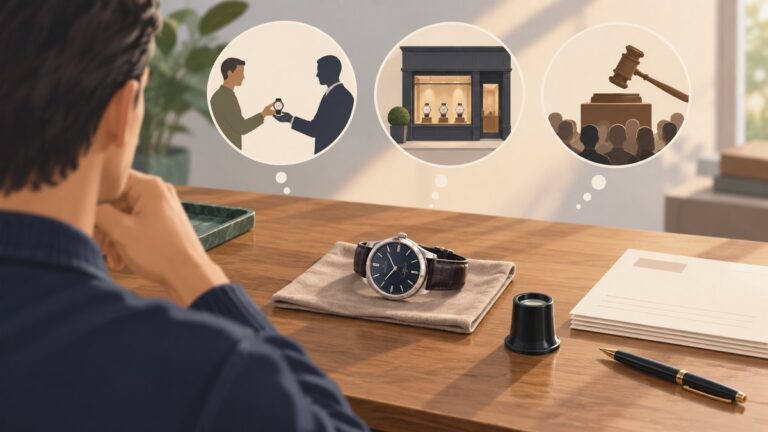
Should you buy a chronometer?
Use the label as one piece of evidence, not as the entire buying decision. Ask these questions before paying a premium.
- Who certified it? Look for a named authority or standard, such as COSC, ISO-related testing, METAS, or a clearly described manufacturer programme. “Chronometer” without supporting detail deserves further questions.
- What was tested? Determine whether the certificate applies to the bare movement, the cased movement, or the complete finished watch. These are not interchangeable claims.
- What tolerance is claimed? Find the stated daily-rate range and whether it is an average, a maximum, or another type of limit. Also look for information about positions, temperatures, test duration, and test conditions.
- Does the standard match your use? A traveler may care about magnetic resistance and service support; a diver may care more about water resistance and legibility; a collector may value documentation and provenance; an office wearer may prioritize comfort and appearance.
- What else are you getting? Compare the case, movement architecture, power reserve, water resistance, magnetic and shock resistance, warranty, service network, bracelet or strap, and long-term serviceability. A certificate alone does not make an otherwise unsuitable watch a good purchase.
Buying a mechanical chronometer
If you are comparing an automatic chronometer watch, treat the product description as a starting point rather than proof. Verify the named certifier, the certificate or documentation, whether the claim applies to the movement or complete watch, and the seller’s warranty and return terms. Broad marketplace listings can use “chronometer” loosely, so the certification details matter more than the word on the dial.
Be especially cautious with claims that quote a daily rate without naming the testing regime. A manufacturer’s internal accuracy target may be worthwhile, but it is not necessarily the same thing as independent chronometer certification.
Independent reader supportYour contribution helps us test, update, and keep practical guides available for everyone.What to expect after purchase
- A certified watch may still gain or lose time in normal use.
- Its rate can vary depending on whether it is dial-up, crown-down, or in another position.
- Temperature changes, shocks, magnetism, and low mainspring power can influence performance.
- A watch that has been dropped, magnetized, or left unserviced should not be assumed to retain its original certified performance.
- If accuracy changes noticeably, have the watch assessed by the manufacturer or a qualified watchmaker rather than attempting casual regulation.
For experienced hobbyists, a watch timing or regulation tool can measure a movement’s rate, but measuring rate at home is not the same as reproducing certification testing. It also does not replace safe servicing or prove that a watch meets a formal standard.
Best Value

- Daily normal time, daytime hours, minutes, seconds, calendar with date, month and date, can replace your phone or watch to display daytime time
- 1/100 Second split timing, suitable for swimming, running, tracking match, training, competition, athletics, etc
- Large screen display, large display numbers
- Alarm function, it is easy to set an alarm with this stopwatch
- Small size and light weight, can be grasped with one hand. A lanyard is included, which is convenient whether it is hung on the body or held in the hand
The verdict: should you care?
Care about chronometer certification if you value independently verified mechanical accuracy, precision watchmaking, documentation, or the history and status associated with tested timekeepers. It is a useful quality signal and a sensible differentiator between otherwise similar mechanical watches.
Care less if maximum everyday accuracy, convenience, and low maintenance are your only goals. A chronometer is not a guarantee of perfect timekeeping, and it is not automatically a better practical timekeeper than quartz or other electronic technologies.
The most accurate way to think about the label is this: a chronometer is a mechanical watch that has demonstrated defined performance in a defined test. That is meaningful—but it is one factor in choosing the entire watch, not a substitute for evaluating the watch itself.
Frequently Asked Questions
Is a chronometer the same as a chronograph?
No. A chronometer is defined by tested timekeeping performance, while a chronograph is a stopwatch function. A watch can be either one, or both.
The Tool Desk
Outbyte Driver Updater FREEFix the driver behind crashes, sound loss and screen glitchesFind Drivers →Outbyte PC Repair FREEClear out junk files and repair common Windows errorsFree Scan →Does a chronometer guarantee perfect accuracy?
No. Certification applies to specified test conditions and may concern the movement or the complete watch, depending on the certifier. Daily wear introduces position changes, temperature, shocks, magnetism, and varying mainspring power.
Are chronometer watches worth buying?
It can be worth it if you value independent testing, mechanical watchmaking, documentation, or collecting. If your only goal is the most accurate and convenient timekeeping, quartz or electronic options may be more practical.
How can I verify a chronometer claim?
Check the named certifier, whether the movement or complete watch was tested, the stated tolerance and conditions, and the warranty and service support. Do not rely on the word “chronometer” alone.
The Bottom Line
Bottom line: Chronometer certification is credible evidence that a mechanical movement or watch passed a specified accuracy test. It is worth paying attention to when independently verified mechanical performance matters to you, but check the certifier, test scope, tolerance, and real-world ownership factors before treating the word as a guarantee.
Quick Recap
Product prices and availability are accurate as of the date/time indicated and are subject to change. Any price and availability information displayed on Amazon at the time of purchase will apply.