Quick wins for a faster PC:
Clear out junk files and repair common Windows errorsFree Scan →Scan for outdated or missing drivers - takes under a minuteDriver Scan →AI glasses combine eyewear with microphones, cameras or other sensors, a connection to a phone or network, and software that interprets requests. A typical interaction runs from a spoken question or button press, to captured audio or an image, to processing on the glasses, phone, or cloud, and back to the wearer as audio, a display, or haptic feedback. Many current pairs have no screen at all; they are closer to voice assistants and cameras built into glasses than to miniature augmented-reality headsets.
What are AI glasses?
AI glasses are eyewear with sensors and computing or connectivity systems that use machine-learning software to interpret speech, images, surroundings, or user activity, then respond through sound, visuals, or haptics. The name describes a broad category, not one standard design.
- Smart glasses is the broad term for eyewear with electronic features, such as notifications, audio, cameras, or voice control. They do not necessarily use generative AI.
- AI glasses use AI features to interpret a request or input, such as answering a spoken question about a captured image.
- Camera glasses prioritize taking photos or video, whether or not they include an AI assistant.
- Audio glasses put speakers and microphones in the frames, often for calls, music, or voice assistants. They may have no camera or display.
- AR glasses add digital information to the wearer’s view, typically through a near-eye display. Some also use AI.
- XR glasses and headsets are part of the broader extended-reality category. Headsets generally offer more immersive displays and interaction than ordinary-looking glasses.
- Assistive glasses are designed or used to support tasks such as reading text aloud, scene description, captions, or translation. AI glasses may help with these tasks, but are not automatically a substitute for specialized or professional accessibility equipment.
For example, Ray-Ban Meta is a displayless camera-and-audio product. Meta’s 2025 announcement of Meta Ray-Ban Display describes a different, display-equipped product, while its 2026 Meta Glasses announcement describes displayless glasses. These products should not be treated as having the same hardware or capabilities (Meta Ray-Ban Display announcement; Meta Glasses announcement).
What is inside a pair of AI glasses?
Components vary by model, but a pair may contain cameras, microphones, speakers, wireless radios, a processor, a battery, sensors, physical controls, and privacy indicators. Display-equipped models add optical hardware; some newer systems also support gesture, eye, or wrist-based input.
#1 Best Overall

- 【8MP HD Camera & 4K Ultra HD】Experience authentic first-person perspectives with an upgraded 8MP ultra HD camera. 4K resolution delivers clear, detailed imagery, while multi-frame noise reduction and advanced anti-shake technology help enhance image clarity for travel, cycling, outdoor sports, family gatherings and everyday adventures.
- 【AI Voice Assistant & Intelligent Object Recognition】Powered by the advanced ChatGPT model, the AI assistant supports real-time Q&A, daily planning and intelligent recommendations. These smart glasses also feature AI object recognition, which can instantly identify landmarks, plants, animals and everyday items, making them an ideal smart companion for travel, shopping, learning and exploring the world.
- 【139 Languages Real-Time AI Translation】Break down language barriers effortlessly with AI translation across 139 languages. Ideal for international travel, business communication, academic exchanges and cross-border socializing, these smart glasses help make multilingual conversations more natural, convenient and efficient.
- 【Open-Ear Hi-Fi Audio & Dual-Mic ENC Noise Cancellation】Enjoy immersive premium sound while staying fully aware of your surroundings with our open-ear headphone design. These bluetooth smart glasses are built with advanced dual-microphone ENC noise reduction technology, which effectively suppresses wind and ambient noise, ensuring crystal-clear hands-free calls and stable music playback even in noisy outdoor, cycling and commuting scenarios.
- 【Photochromic Lenses, Suitable for Any Scenes】Designed for all-day comfortable wear, AI glasses feature an ultra-lightweight frame and integrated photochromic lenses. The lenses automatically darken in sunlight for UV protection and return to a clear state indoors. A built-in 290mAh battery delivers long-lasting power for full-day use, fitting perfectly with all scenes of daily life, work and outdoor adventures.
Camera
A camera can capture first-person photos and video, frame a view for sharing, or provide an image for visual AI. A wearer might ask what a sign says or what object is in front of them; the camera supplies visual context for the question. Some products also support live video calls or visual features tied to a display. Cameras are not universal: audio-only or camera-free smart glasses cannot analyze a scene visually.
Ray-Ban’s US product page lists an ultrawide 12-megapixel camera for its Ray-Ban Meta glasses. That specification belongs to the product information on that page; camera hardware can differ by generation and model (Ray-Ban Meta product information).
Microphones and speakers
Microphones pick up wake words, spoken requests, calls, and recordings. Multiple microphones can help a device handle voice input and reduce some background noise, but they do not guarantee accurate recognition in wind, traffic, crowds, or restaurants.
Many displayless glasses use open-ear speakers, which let ambient sound reach the wearer while delivering calls or AI answers. This can help preserve awareness of the surroundings, but it does not make the audio private: people nearby may hear it. Meta describes its glasses’ open-ear speakers as designed to leave the wearer aware of the environment (Meta Glasses announcement).
Display, sensors, and controls
A display-equipped pair may show short messages, captions, translations, directions, camera previews, or answers. A display changes the experience: instead of hearing information, the wearer can see it in or near their field of view. The added optical system can also bring trade-offs in power use, weight, cost, fit, and distraction.
Depending on the device, sensors may include accelerometers, gyroscopes, ambient-light or proximity sensors, compasses, depth sensors, eye tracking, or hand tracking. They can help detect movement, orientation, gestures, or whether the glasses are being worn. Controls can include a wake word, capture button, power switch, temple touchpad, phone app, or gestures. Voice is convenient, but physical controls matter when speaking aloud is awkward, noisy, or inappropriate.
How do AI glasses work, step by step?
A representative interaction shows how the frame, phone, network, and AI service can work together. The precise sequence depends on the product and feature.
- You invoke the assistant. You say a wake word or press a button. Some actions, such as taking a photo, may use a dedicated control.
- The glasses capture input. Microphones pick up your request. If the question is visual, the camera may take a still image or selected frame; sensors may supply other context.
- Speech is interpreted. Speech-recognition software converts spoken words into text or another representation the system can process.
- The request is routed. Depending on the device, the phone, cloud service, or glasses themselves handle parts of the request. Visual questions may send both the image and the user’s words to a multimodal AI model.
- The AI produces a result. The model interprets the inputs and generates an answer or action. It may also use connected services, if available and permitted.
- The result returns to the wearer. The glasses play a spoken response, show information on a display, or provide a signal through a control or haptic system.
Meta’s description of multimodal systems explains how speech, text, and images can be processed together. In its documented Ray-Ban Meta example, a wearer asks about something in view; a photo and spoken prompt are interpreted by an AI model, and the answer is returned as audio (Meta multimodal AI system card; Meta engineering explanation).
Recommended Free Tools
Rank #2

- #1 SELLING AI GLASSES - Tap into iconic style for men and women, and advanced technology with the newest generation of Ray-Ban Meta smart AI glasses. Capture photos and video recordings, listen to music, make hands-free calls or ask Meta AI questions on-the-go.
- UP TO 8 HOURS OF BATTERY LIFE - On a full charge, these smart AI glasses can last 2x longer than previous generations, up to 8 hours with moderate use. Plus, each pair comes with a charging case that provides up to 48 hours of charging on-the-go.
- 3K ULTRA HD: RECORD SHARP VIDEOS WITH RICH DETAIL — Hands-free video recording with an ultra-wide 12 MP camera in up to 3K resolution. Record clips up to 3 minutes per session. Capture sharp, vibrant memories while staying in the moment.
- LISTEN WITH OPEN-EAR AUDIO — Listen to music and more with discreet open-ear speakers that deliver rich, quality audio without blocking out conversations or the ambient noises around you.
- ASK YOUR GLASSES ANYTHING WITH META AI — Get real-time suggestions, answers, object identification, and reminders hands-free. Requires Bluetooth connection to your smartphone and the Meta AI app. Ensure your phone has internet connectivity.
Where does the computing happen?
AI glasses are often one part of a system rather than self-contained computers. Work can be split among the frame, a smartphone, and cloud servers.
On the glasses
Local processing may handle wake-word detection, sensor input, image capture, basic device functions, or some privacy checks. Processing locally can reduce delay and dependence on the internet for those functions, but small batteries and limited space constrain computing power. A complex AI feature may still need a phone or cloud service.
On the phone
A companion phone can provide internet access, location, account authentication, setup, app integrations, media transfer, updates, and some processing. The glasses may feel self-contained while in use, but advanced functions can depend on the phone, app, account, and permissions.
Ray-Ban’s US support FAQ lists a compatible Android or iOS phone, the Meta AI app, wireless internet access, and a Meta account among Ray-Ban Meta requirements. Its stated software requirements are Android 10 or newer with location services enabled, or iOS 14.4 or newer. Check the support page for the exact model and region because requirements and availability can change (Ray-Ban Meta FAQ).
Windows Errors? Fix Them Before They Spread
Repair common Windows errors and clear accumulated junk for a smoother, more stable PC - no reinstall needed.Free scan · no reinstallCrashes, No Sound, or Screen Glitches?
Random freezes, missing sound and display glitches usually trace back to one bad driver. Find and replace yours safely.Free scan · under a minuteIn the cloud
Cloud services can handle more demanding tasks such as image interpretation, language reasoning, translation, or web-connected answers. This can enable more capable models than a small frame can run, but it also means the feature may need a connection and may add latency. It raises questions about what information is transmitted, how the provider handles it, and which features are supported in a particular region or language.
Local, phone, and cloud processing are not mutually exclusive. A single request can pass through more than one of them.
How do AI glasses understand what you see?
Visual AI typically works from an image captured in response to an action or request; it should not be assumed that the glasses continuously understand everything in the wearer’s field of view. In a common visual-question workflow, you ask a question, the camera captures an image, speech recognition interprets your words, and a multimodal model relates the image to the question.
Examples include asking, “What does this sign say?”, “Translate this menu,” “What color is this shirt?” or “Describe the object in front of me.” Results depend on the quality and relevance of the input. Blurry framing, low light, glare, occlusion, small text, unusual viewpoints, and similar-looking objects can all produce errors. A model can also give a confident-sounding guess rather than a correct identification, and its broader knowledge may be incomplete or out of date.
Do these 3 things before closing this tab:
1Scan for outdated or missing drivers - takes under a minute2Repair Windows errors before they cause bigger problems3Fix the driver behind crashes, sound loss and screen glitchesRank #3

- 【AI Smart Translation Glasses】 - These smart glasses(No Camera) with built-in ChatGPT voice assistant, support real-time translation over 160 languages, simultaneous interpretation, meeting audio recording transcription. Helps you to suit any scenario and effortlessly break language barriers. Note: This model has no camera, all functions run via audio.
- 【Bluetooth Audio & Hands-Free Calling 】 - With Bluetooth 5.4 stable connection and open-ear design, our AI smart glasses features 3D surround sound music, delivering immersive audio directly to your ears. Built-in HD microphone ensures crystal-clear hands-free calls.
- 【Ultra-Lightweight Design with Gradient Lenses】 - Our smart glasses using medical-grade skin-friendly material, featured ergonomic design, 3D facial fitting, C-shaped wrap-around temples, and apple-arc nose pads that reduce pressure by 50% for all-day comfort up to 8 hours. The lenses will turn gray when exposed to sunlight, instantly transforming into stylish sunglasses, shielding eyes from harsh light and keeping us comfortable at all times.
- 【Extra-long Battery Life】 - AI bluetooth audio glasses equipped with 220mAh high-quality battery that takes only 1 hour to fully charge and can play continuously for up to 11 hours, solving battery anxiety. IP65 waterproof protection against sweat, rain, and dust, ideal for daily use and travel.
- 【Practical Flashlight & All-in-one Button】 - The integrated flashlight in AI glasses provides hands-free illumination, supports long-time walking and reading in dark. While the all-in-one button enables seamless control of power/flashlight/answering/hanging up/playing/pausing and wake-up the voice assistant —all with intuitive presses.
Do not rely on visual AI as the sole basis for medical, legal, emergency, or safety-critical decisions. It can be useful for orientation and everyday questions, but its answer is not proof that it has correctly identified an object, person, sign, or hazard.
Do AI glasses have screens?
No. Many AI glasses have cameras, microphones, and speakers but no display. A screen is a category-defining difference because it lets the wearer see captions, directions, or answers rather than only hearing them.
| Feature | Displayless AI glasses | Display-equipped AR/XR glasses |
|---|---|---|
| Main output | Audio, sometimes controls or haptics | Visual overlays, often alongside audio |
| AI answers | Usually spoken | May be spoken, visual, or both |
| Navigation and captions | May use voice prompts or a phone screen | Can potentially show directions or captions in view |
| Hardware trade-off | Can avoid the added optics of a display | Needs near-eye display hardware, which can add complexity, power demand, weight, and cost |
| Typical fit | Hands-free audio, calls, capture, and voice AI | Information visible without looking down at a phone |
Meta’s announcement for Meta Ray-Ban Display describes visual AI answers, live captions, translation, camera preview, messages, music controls, and pedestrian navigation. These are features of that announced display-equipped product, not a guarantee for every AI-glasses model (Meta Ray-Ban Display announcement). Google describes Android XR as a platform for extended-reality devices, including glasses and headsets, with Gemini and app access; its page says the glasses product is under development and that specifications may change (Google Android XR).
What can AI glasses do today?
Feature sets vary by model, generation, region, language, phone platform, account, firmware, app version, connection, and whether the glasses have a display. Common or announced uses include:
- Communication: make or receive calls, read or announce messages, and use hands-free voice controls.
- Capture: take photos or video from the wearer’s point of view and share media through supported apps.
- Audio: play music or podcasts and hear spoken assistant responses through built-in speakers.
- Voice assistance: ask questions, request reminders, or get information using a supported assistant.
- Visual help: ask about a captured scene, read text, or translate selected content where the product supports it.
- Accessibility: use scene descriptions, text reading, translation, or hands-free interaction as supplementary assistance.
- Display features: on selected display-equipped products, view captions, translations, short messages, camera previews, or directions.
Meta’s June 2026 announcement describes its Meta Glasses line as displayless, with AI, open-ear audio, multi-microphone voice control, hands-free capture, prescription compatibility, and a manufacturer-claimed battery life of more than eight hours for that announced line. Those are vendor claims for a named product line, not standardized test results for all AI glasses (Meta and EssilorLuxottica announcement).
What can AI glasses not do reliably?
- They are not necessarily standalone devices; advanced functions may need a compatible phone, app, account, or internet connection.
- They do not automatically understand everything the wearer sees, and visual analysis should not be confused with continuous perception.
- They cannot guarantee accurate answers, speech recognition, object identification, translation, or navigation.
- They may lose AI, sharing, or update features when offline, depending on the model.
- Open-ear audio is not private in the way sealed earbuds can be.
- A camera indicator is not a complete privacy guarantee, and recording rules still apply.
- Not every product has a display, projects overlays, or offers full augmented reality.
- Small frames constrain battery capacity, heat management, durability, and computing power.
How do AI glasses connect to a phone and the internet?
Bluetooth commonly supports pairing, audio, and controls. Wi-Fi may be used for media transfer, updates, or direct device connections. A phone’s cellular or Wi-Fi connection can provide the internet access needed for cloud AI, while the companion app manages setup, permissions, accounts, and sharing. Location features may rely on the phone’s location services.
Ray-Ban’s support documentation says Ray-Ban Meta uses Wi-Fi through its app for normal use and can connect to a temporary direct Wi-Fi network when importing captures or installing firmware updates. If the phone is out of battery, out of range, offline, logged out, or incompatible, the glasses may retain basic functions such as Bluetooth audio but lose some AI, capture, update, or sharing features. The exact fallback depends on the product (Ray-Ban Meta FAQ).
Privacy: are AI glasses recording you?
Privacy involves more than whether a camera is active. Consider when capture starts, whether audio is buffered for wake-word detection, what leaves the glasses, how an account stores media, and whether a service uses data to improve its systems. Policies and controls differ by manufacturer and feature, so read the terms for the particular product before enabling visual AI or cloud processing.
Rank #4
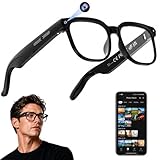
- 【AI Real-Time Translation & ChatGPT Assistant】AI glasses break language barriers instantly with AI real-time translation. The built-in ChatGPT voice assistant helps you communicate, learn, and handle travel or business conversations smoothly—ideal for conferences, overseas trips, and daily use.
- 【4K Ultra HD】 Smart glasses feature 4K resolution for clear, detailed visuals, making them suitable for travel, outdoor activities, everyday moments, and daily use.
- 【Bluetooth Music & Hands-Free Calls 】Smart glasses provide Bluetooth music and crystal-clear hands-free calls with an open-ear design. Stay aware of your surroundings while listening—comfortable for long wear and safer for commuting, cycling, and outdoor use.
- 【IP65 Waterproof & Long Battery Life】 AI glasses are designed for daily wear with IP65 waterproof protection against sweat, rain, and dust. The built-in 290mAh battery provides reliable performance for workdays and travel—no anxiety when you’re on the go.
- 【Smart App Control & Object Recognition】Smart glasses connect to the companion app for easy setup, file management, and feature control. They support AI object recognition to help identify items and improve your daily efficiency—perfect for travel exploration and a smart lifestyle.
Indicators and controls
Some camera glasses have a visible capture indicator. Meta says its AI glasses use a white capture LED that blinks when content is captured for the wearer’s gallery, and that covering or disabling the LED automatically disables the camera. This is a vendor description of its safeguard; it does not resolve every question about audio, data handling, account security, or what bystanders can tell from a distance (Meta AI glasses privacy FAQ).
Before buying, check the camera and microphone controls, app permissions, cloud-processing disclosures, media storage settings, and account-security options. A physical capture button can make intentional use clearer, but features and controls vary.
Recording etiquette and account handling
- Tell people when recording is relevant, and respect requests not to be recorded.
- Avoid recording in private workplaces, schools, medical settings, restricted venues, or other sensitive places unless you have permission and recording is allowed.
- Do not aim cameras at private documents, screens, children, or strangers without an appropriate reason and consent.
- Treat a capture light as a minimum signal, not proof that everyone nearby understands what the glasses are doing.
- Secure the account linked to captured media, and use the manufacturer’s reset process before selling or giving away the glasses.
Ray-Ban’s FAQ says a factory reset erases captures and associations with the previous Meta account. Follow the instructions for your exact model before transferring ownership (Ray-Ban Meta FAQ).
Independent reader supportYour contribution helps us test, update, and keep practical guides available for everyone.How do AI glasses deliver answers?
Audio
Audio works well for brief answers, calls, navigation prompts, translation, and accessibility descriptions. It can be difficult to review or scan, may compete with environmental sound, and may be audible to nearby people. Avoid relying on audio prompts when they distract from walking, driving, or another safety-critical task.
What’s actually slowing this PC down?
Pick the symptom - the matching free tool is one click away.
Visual displays
A display can put short captions, directions, messages, translations, or answers within the wearer’s view. This may reduce the need to look at a phone, but a small field of view, optical fit, eye fatigue, distraction, and battery demand can limit the experience.
Haptics and gesture input
Haptic signals can provide discreet confirmation or navigation cues. Meta’s Neural Band, announced alongside Meta Ray-Ban Display, uses surface electromyography to detect wrist muscle signals for gesture-based control. This is an emerging input approach, not a feature standard across AI glasses (Meta Ray-Ban Display and Neural Band announcement).
Battery, comfort, and durability
Camera use, wireless connections, AI features, and especially displays draw power. Small frames limit battery size, so a charging case may be part of everyday use. Real battery life depends on the model and how it is used; a manufacturer’s claim should not be treated as a standardized result unless test conditions are provided.
Fit matters as much as electronics. Frame shape affects comfort, camera angle, and microphone position. Prescription lenses can change cost, weight, and availability. Check whether the frame fits your face, whether lens options suit your prescription, and whether the camera points where you expect. Transition or tinted lenses and dim indoor lighting can also affect what the wearer sees or what a camera captures.
Best Value
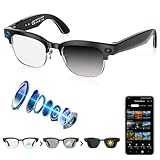
- 【4K Camera with EIS Stabilization】Smart glasses with camera feature a built-in 4K camera with EIS stabilization for clearer and steadier image performance during sports, cycling, travel, outdoor activities, and everyday use.
- 【Open-Ear Speakers & Clear Bluetooth Calling】Camera glasses feature built-in open-ear speakers for music and clear Bluetooth calls while helping you stay aware of your surroundings. Noise-reduction microphones provide clearer voice pickup and a comfortable listening experience for everyday use.
- 【AI Real-Time Translation & Voice Assistant】AI glasses support real-time translation in 139+ languages to make communication easier across different languages. The built-in AI voice assistant helps you access information and interact more efficiently—ideal for work, study, travel, and daily use.
- 【Photochromic Lenses & Lightweight Comfort】Smart sunglasses with camera feature photochromic lenses that respond to changing sunlight conditions for comfortable indoor and outdoor use while helping reduce UV exposure. The lightweight 35g frame provides a comfortable fit for extended everyday wear.
- 【IP66 Water Resistance & 290mAh Battery】AI sunglasses with camera feature IP66 water resistance for added protection against sweat, rain, and dust during active daily use. The built-in 290mAh battery provides convenient power for travel, outdoor activities, work, and everyday use.
Water resistance is not the same as waterproofing. Ray-Ban’s FAQ rates Ray-Ban Meta at IPX4, a rating for water resistance rather than suitability for submersion or prolonged liquid exposure (Ray-Ban Meta FAQ).
Can AI glasses help with accessibility?
Depending on the model and supported region, AI glasses may read printed text aloud, describe a scene, identify colors or objects, translate signs, provide captions, or let someone interact hands-free. They can reduce the need to hold a phone and may support remote assistance or communication in particular situations.
These features are best treated as supplementary tools. A description or identification can be wrong, cloud-dependent features can stop working when connectivity fails, and audio can mask environmental hazards. Language coverage also varies. Keep a backup for navigation, communication, and emergencies, and do not assume a consumer AI feature offers medical-grade interpretation or replaces specialized accessibility equipment.
Are AI glasses safe to use?
- Do not rely on an AI answer while driving, operating machinery, or responding to an emergency.
- Avoid looking at a display while crossing a road or doing a task that requires full attention.
- Do not treat identification, navigation, or generated instructions as infallible; verify important information.
- Keep situational awareness when listening to open-ear audio, particularly near traffic or other hazards.
- Respect recording restrictions and people’s privacy.
- Protect the account connected to the glasses, especially if it contains captured media or grants access to device features.
How much do AI glasses cost?
As announced in 2026, Meta Glasses were priced starting at $299 in the United States and Canada, before prescription-lens costs. Meta Ray-Ban Display was announced starting at $799, including the glasses and Meta Neural Band. These are announced starting prices, not guaranteed current retail prices in every market; taxes, prescription lenses, availability, accessories, and later price changes can affect the final cost (Meta Glasses announcement; Meta Ray-Ban Display announcement).
Free tools Windows power users keep installed
One-click scans. No signup required.
Google’s Android XR is an emerging platform rather than a single universally available pair of glasses. Google says its glasses product is under development and subject to change, so the platform should not be treated as an available retail model with a settled price or specification (Google Android XR).
How to choose the right AI glasses
Start with the task you want to make easier. The display, camera, phone requirements, privacy controls, fit, and regional feature availability matter more than the label “AI.”
Choose displayless glasses for audio and capture
Consider this category if you mainly want calls, music, hands-free photos, voice AI, or ordinary-looking frames without a heads-up display. It is a poor match if you need visual overlays, want to avoid a camera, or expect full AI functionality without a phone or network.
Choose display-equipped glasses for information in view
Consider a display if captions, visual directions, camera previews, or short answers in your field of view are central to your use. Weigh those benefits against added complexity, potential distraction, fit requirements, and likely power demands.
The Tool Desk
Outbyte PC Repair FREERepair Windows errors before they cause bigger problemsFix Now →Outbyte Driver Updater FREEFix the driver behind crashes, sound loss and screen glitchesFind Drivers →Choose camera-free glasses for fewer recording concerns
If your priorities are audio, notifications, or voice control with less potential social friction, look for a model without a camera. It cannot analyze a scene visually, but avoids that particular capture capability.
Check these details before buying
- Phone compatibility, operating-system version, and whether the companion app is required.
- Whether the assistant works in your country and language, and which features need internet access or an account.
- Whether the desired feature is available on the exact generation and firmware you are considering.
- Camera and microphone controls, capture-indicator behavior, and cloud-data policies.
- Prescription-lens availability, frame fit, return terms, repair options, and replacement policy.
- Battery behavior for your intended use, not only the headline manufacturer claim.
- Water-resistance rating and whether it suits your use.
- Whether you need private listening: open-ear speakers may be heard by others.
- Whether visual navigation, captions, translation, or other display features are supported in your region.
- Any recurring subscription, accessory, or service requirement.
Where AI glasses are headed
Developments in smaller multimodal models, on-device processing, displays, and gesture input could make glasses more capable without relying as heavily on a phone or cloud service. Better captions, translation, and contextual assistance are plausible directions, but capabilities and safeguards will depend on the products that actually ship. Google’s Android XR page, for example, presents a platform direction while noting that its glasses product remains under development (Google Android XR).
The central design challenge will remain a balance: useful input and output in a frame light enough to wear, with adequate battery life, clear privacy signals, dependable performance, and controls that fit social settings.
Quick Recap
Product prices and availability are accurate as of the date/time indicated and are subject to change. Any price and availability information displayed on Amazon at the time of purchase will apply.
The Tool Desk
Outbyte Driver Updater FREEFix the driver behind crashes, sound loss and screen glitchesFind Drivers →Outbyte PC Repair FREEClear out junk files and repair common Windows errorsFree Scan →