Grand Seiko Spring Drive is powered by a wound mainspring, like a mechanical watch, but it uses electronic control to regulate the mainspring’s release. The spring turns the gear train and hands while also driving a small generator. That electricity powers a quartz oscillator and integrated circuit; together, they control an electromagnetic brake that regulates the gear train’s speed. Spring Drive is therefore mechanically powered but electronically regulated—not a conventional battery-powered quartz watch.
How Spring Drive turns mainspring power into regulated time
The system Grand Seiko calls the Tri-Synchro Regulator combines three forms of operation: mechanical power from the mainspring, electrical power for the oscillator and integrated circuit (IC), and electromagnetic braking. The sequence is:
| # | Preview | Product | Price | |
|---|---|---|---|---|
| 1 |
|
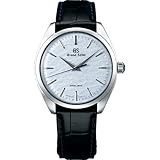
Grand Seiko Lake Suwa Omiwatari Elegance Watch SBGY007 | $8,750.00 | Buy on Amazon |
| 2 |

|
SEIKO SRPB41 Automatic Watch for Men - Presage Cocktail Time - Patterned Blue Dial with Date... | $399.00 | Buy on Amazon |
As an Amazon Associate I earn from qualifying purchases.
- The mainspring supplies the energy. Winding stores energy in the spring. As it unwinds, it drives the gear train, which moves the hands.
- The gear train turns a glide wheel. At the end of the train, the glide wheel and a coil generate a small electric current.
- The current powers the timing electronics. It supplies the quartz oscillator and IC; there is no battery or secondary battery.
- The oscillator provides a timing reference. The IC compares that reference with the glide wheel’s speed.
- An electromagnetic brake regulates the wheel. The IC applies or releases braking as needed, controlling the glide wheel and, through the gear train, the hands.
In Grand Seiko’s explanation, the quartz oscillator vibrates at 32,768 Hz and the glide wheel rotates eight times per second. These are details of the brand’s description, not a specification to assume for every internal design feature or caliber. See Grand Seiko’s Spring Drive movement explanation.
The Tool Desk
Outbyte PC Repair FREERepair Windows errors before they cause bigger problemsFix Now →Outbyte Driver Updater FREEScan for outdated or missing drivers - takes under a minuteDriver Scan →Is Spring Drive mechanical or quartz?
It has a mechanical energy source and hand drive, but an electronic regulator. Calling it simply “mechanical” misses the quartz-referenced control; calling it “quartz” can wrongly suggest that a battery and motor power the hands. Grand Seiko’s 9R manual puts the distinction this way: “The power of the mainspring is regulated by electronic control. That is the essence of the Spring Drive.” The 9R instruction manual says the gear train moves the hands and specifies no battery, motor, or secondary battery.
#1 Best Overall
- Three-fold clasp with push button release
- Dual-curved sapphire crystal
- Power reserve display on the back
- Power resrve Approx. 72 hours(3 days)
How it differs from a conventional mechanical or quartz movement
| Feature | Traditional mechanical watch | Grand Seiko Spring Drive | Conventional battery quartz watch |
|---|---|---|---|
| Energy source | Wound mainspring | Wound mainspring; it also drives the glide-wheel generator | Battery |
| Rate regulator | Balance and hairspring with an escapement | Quartz oscillator and IC regulate speed through electromagnetic braking; no escapement | Quartz timekeeping circuit; the exact arrangement varies by watch |
| What moves the hands | Mainspring-driven gear train | Mainspring-driven gear train | Typically a battery-powered motor and gear train |
| Rate and reserve | Depends on the movement | Depends on the Spring Drive caliber | Depends on the watch and movement |
The key difference from a conventional mechanical movement is not the source of motive power: both use a mainspring. It is the regulating system. A traditional mechanical movement uses a balance-and-hairspring and escapement to control energy release; Spring Drive uses a generator, quartz oscillator, IC, and electromagnetic brake instead. Seiko describes Spring Drive as mainspring-powered and regulated without an escapement in its customer FAQ.
Accuracy and power reserve depend on the caliber
There is no single accuracy or reserve figure that applies to every Spring Drive watch. These are manufacturer specifications, not independent comparative test results. Grand Seiko’s 9R manual gives a general rate of ±15 seconds per month (daily rate ±1 second); it lists ±10 seconds per month (±0.5 second per day) for calibers 9R96, 9R16, and 9R15. The current movement specifications give these examples:
Rank #2
- STUNNING BLUE DIAL: this automatic men's watch features a deep blue, pressed pattern and gloss finish surrounded by a stainless steel watch case
- AUTOMATIC: these self-winding, automatic men's watches are powered by your movement, with a power reserve of 41 hours
- STAINLESS STEEL: features a durable stainless steel watch case and bracelet with see through caseback
- WATER-RESISTANT: these men's wrist watches are water-resistant down to 50 meters
- 4R35 CALIBER: equipped with the reliable caliber 4R35 automatic movement, this accurate men's watch keeps precise time
| Caliber | Manufacturer-listed rate | Approximate power reserve | Winding |
|---|---|---|---|
| 9RB1 / 9RB2 | ±20 seconds per year (±3 seconds per month) | 72 hours | Automatic with manual winding |
| 9RA2 / 9RA5 | ±10 seconds per month | 120 hours (five days) | Automatic with manual winding |
| 9R01 | ±10 seconds per month | 192 hours (eight days) | Manual winding |
| 9R96 | ±10 seconds per month | 72 hours | Automatic with manual winding |
Grand Seiko’s current movement specifications list the 9RB and 9RA examples above; the 9R manual supplies the general rate and 9R96 rate. Check the exact watch’s caliber and current specification before relying on a figure: a model name alone is not enough to identify its rate or reserve.
Recommended Free Tools
What the distinction means for an owner
Spring Drive does not need a battery change to power its timing electronics: the mainspring-driven generator supplies the small current for the oscillator and IC. The hands are moved by the gear train, not by a motor driven by that current. For inspection and overhaul, follow the manual for the particular caliber. For example, the 9RB2 manual recommends inspection and overhaul approximately every three to four years for long-term performance, noting that oil condition, worn parts, and water resistance can change. That is guidance for the 9RB2, not a universal service interval for every Spring Drive; consult the watch’s manual or an authorized service channel. See the Grand Seiko instruction manuals.
Quick Recap
Product prices and availability are accurate as of the date/time indicated and are subject to change. Any price and availability information displayed on Amazon at the time of purchase will apply.