The Galaxy Watch4 estimates body composition using bioelectrical impedance analysis (BIA): it sends a very small current through an electrical pathway that runs mainly across your upper body, then uses that reading and your profile information to estimate metrics such as body-fat percentage and skeletal muscle. It is a convenient way to follow trends when you measure consistently, not a miniature DEXA scanner or a diagnostic tool.
What body composition means
Body composition describes what your body weight is made up of, including fat mass, fat-free mass, skeletal muscle, body water, bone and other tissues. The Watch4 does not directly weigh or inspect those compartments. It estimates several of them from an electrical measurement and information such as your height, weight and the sex/gender selection used by its calculation model.
Samsung lists weight, skeletal muscle, fat mass, body-fat percentage, BMI, body water and basal metabolic rate (BMR) among the results. These are not seven independent laboratory measurements: some are profile inputs or arithmetic calculations, while others are model-based estimates. Samsung’s feature guide describes the displayed metrics and measurement process.
How the Watch4 estimates your measurements
BIA and the BioActive Sensor
Bioelectrical impedance analysis passes a low electrical current through the body and measures the resistance, or impedance, encountered. Water-rich fat-free tissue conducts electricity differently from fat tissue. The device combines the impedance reading with prediction equations and body information to estimate composition; it does not directly identify fat or muscle.
#1 Best Overall
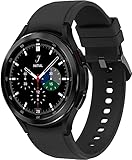
- Rotating Bezel Navigation: Physical rotating bezel allows precise and intuitive control of apps and menus.
The Watch4’s BioActive Sensor combines optical heart-rate sensing, electrical heart-signal sensing and BIA. For a body-composition reading, the watch stays on your wrist while you touch its two physical buttons with fingers of your opposite hand. That completes an electrical pathway primarily through the upper body. Samsung’s sensor overview describes the BioActive Sensor, while its measurement guide shows the contact procedure.
From an upper-body reading to a whole-body estimate
The Watch4 measures impedance along that pathway and uses it alongside profile inputs, including height, weight and a sex/gender selection, to estimate whole-body results. Samsung’s user manual notes that professional analyzers divide the body into multiple sections, while the watch’s pathway is limited; the watch therefore estimates rather than measures the body segment by segment. That distinction can matter when someone’s upper- and lower-body fat or muscle distribution differs substantially. Samsung’s BIA user manual explains this limitation.
How to take a Watch4 body-composition reading
- Wear the watch snugly on your wrist. Remove jewelry and metal accessories, and make sure the watch is not loose or over clothing.
- On the watch, open Samsung Health, swipe to Body composition, then tap Measure.
- Confirm or enter the requested profile details, including sex/gender selection, height and weight. Check that the weight is current.
- Tap How to measure if you need the on-screen demonstration, then tap Start.
- Touch the Power/Home and Back buttons with the middle and index fingers of your opposite hand, following the watch’s on-screen prompts. Touch the buttons without pressing them.
- Raise both arms so your armpits are open and your arms do not touch your torso. Stay still until the measurement completes, then review the results on the watch or in Samsung Health.
Button labels, screen names and availability can vary with software version and region. Samsung’s support instructions provide the current button-contact method. Samsung described Watch4 readings as taking about 15 seconds at launch, but its current support guidance does not promise a fixed duration; allow the watch to finish rather than relying on a precise timer. Samsung’s Watch4 preparation guidance also recommends conditions that help make comparisons more consistent.
Rank #2

- Rotating Bezel Navigation: Physical rotating bezel allows precise and intuitive control of apps and menus.
What the numbers mean
- Weight: A body-weight value used by the calculation; the result depends in part on the accuracy and recency of the weight information supplied.
- Fat mass: An estimate of the total mass of body fat, derived from the body-composition model and weight.
- Body-fat percentage: An estimate of the share of body weight that is fat. It can shift with hydration and measurement conditions even when fat tissue has not materially changed.
- Skeletal muscle: An estimate of skeletal-muscle mass, not a direct measurement of muscle tissue. Treat it as a broad trend rather than a precise tally of muscle gained or lost.
- Body water: An estimate of total body water, making it particularly sensitive to hydration status.
- BMI: A calculation using weight and height. BMI does not distinguish muscle from fat and is not a BIA measurement.
- BMR: An algorithmic estimate of basal metabolic rate, not a laboratory measurement or a personalized nutrition prescription.
Samsung’s listed results include these metrics, but the estimates should not be interpreted as diagnoses or as precise measurements of each tissue.
How accurate is the Galaxy Watch4?
What Samsung’s “98% correlation” means
Samsung says the feature has a 98% correlation with DEXA scans. Correlation describes how closely two sets of results move together; it does not mean every reading is 98% accurate, falls within 2% of a DEXA result, or is interchangeable with one. Results also depend on the population, body type, hydration, protocol and reference method. Samsung’s statement should therefore be read as a correlation claim, not a guarantee of individual accuracy.
What independent Watch4 testing found
A peer-reviewed study compared Galaxy Watch4 and Watch4 Classic devices with DXA and laboratory-grade eight-electrode BIA. Of 109 participants recruited, 75 completed the full manufacturer-recommended protocol. The study found systematic differences in fat-free-mass estimates compared with DXA. After statistical correction, the watches showed useful stability and agreement, but they were less precise than DXA, so repeated readings were needed to detect change with comparable confidence. The study’s findings apply to the devices and protocol it tested, not automatically to every person or software version. See the study record and its full text.
Rank #3
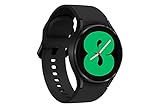
- BODY COMPOSITION ANALYSIS: Galaxy Watch4 is the first smartwatch to off body composition data right on your wrist, On your own schedule, now you can get readings on body fat, skeletal muscle, body water, basal metabolic rate, and Body Mass Index.Supported Application:Heart Rate Monitor,Sleep Monitor,Fitness Tracker. Connectivity technology:LTE,Bluetooth,GPS. Wireless comm standard:Bluetooth
- BETTER SLEEP STARTS HERE: Wake up feeling refreshed and recharged with advanced sleep tracking; When you go to bed, your Galaxy Watch4 sleep tracker starts monitoring your sleep and SpO2 levels continuously
- BE SMART ABOUT YOUR HEART: Take care of your heart with accurate ECG monitoring and keep an eye on possible atrial fibrillation, a common form of irregular heart rhythm; Share personalized readings with your doctor using the Samsung Health Monitor app on your compatible Galaxy phone
- MAKE EVERY WORKOUT COUNT: Get the most out of every exercise session with advanced workout tracking that recognizes 6 popular activities, from running to rowing to swimming, automatically in just 3 minutes; Stay motivated by connecting to live coaching sessions via your smartphone or to dynamic Group Challenges with your friends
- GO THE EXTRA MILE: Improve your runs with advanced running coaching technology; VO2 Max readings assess your oxygen levels to manage and track your heart and lung endurance
A later study tested a Galaxy Watch5, not a Watch4, against DXA and an InBody 770. It found stronger correlations for body-fat percentage than for skeletal-muscle estimates, with proportional bias and greater variability among people with higher body-fat percentages. This provides context for wearable BIA, but it is not direct evidence of Watch4 performance. The Watch5 study record and full text identify the tested model.
Why readings can change from day to day
BIA is affected by body water and measurement conditions. Food and drink, exercise, heat, a shower or sauna, posture, skin temperature and hydration can all influence a reading. Menstruation can also affect reliability because hormonal and body-water changes may alter results. A difference between two readings does not, by itself, show that you gained fat, lost muscle or became dehydrated.
Do these 3 things before closing this tab:
1Fix the driver behind crashes, sound loss and screen glitches2Clear out junk files and repair common Windows errors3Scan for outdated or missing drivers - takes under a minuteHow to make readings more comparable
Use a repeatable routine rather than trying to correct an individual reading after the fact. Samsung recommends measuring in the morning, before eating, after using the bathroom, and before exercise or exposure to heat. Keep the watch position, snugness, posture and arm position consistent; remove metal accessories; and avoid comparing a fasted morning reading with an evening or post-workout one. Record results over several weeks and look for a trend rather than reacting to one measurement. Samsung’s series guidance and user manual give preparation advice.
Rank #4

- Rotating Bezel Navigation: Physical rotating bezel allows precise and intuitive control of apps and menus.
Who should avoid the measurement or interpret it cautiously
- Implanted electronic medical devices: Samsung instructs people with an implanted pacemaker or other implanted electronic medical device not to use the feature. Follow the device maker’s and clinician’s instructions rather than assuming a particular implant is safe. Samsung’s manual gives the warning.
- Pregnancy: Samsung advises against using the feature during pregnancy. Do not infer safety from the fact that the current is not normally perceptible. Samsung’s support page includes this caution.
- People under 20: Samsung warns that results may be less accurate because growth and changing body composition affect estimates. See Samsung’s guidance.
- Menstruation: Samsung warns that readings may be inaccurate during menstruation because body-water changes can affect results. This is a reliability caveat, not a medical judgment. Samsung’s series guidance covers this point.
- Unusual body composition or fat distribution: Samsung’s manual cautions that results may differ substantially from professional analyzers for people with pronounced upper/lower-body differences, very high body fat, or unusually high muscle mass compared with the general population. The manual describes these cases.
When a different method makes more sense
| Method | Best suited to | Trade-off |
|---|---|---|
| Galaxy Watch4 BIA | Convenient, repeated personal trend tracking | Upper-body pathway and model-based whole-body estimates; sensitive to measurement conditions |
| DEXA | A more formal clinical or research assessment | Requires access to a facility and professional interpretation; it is a different method, not an infallible answer |
| Professional multi-electrode BIA | Segment-based assessment in a gym or clinical setting | Still an estimate and influenced by hydration and protocol; its figures may not match the watch |
| Smart scale | Convenient home measurements over time | Uses a different electrical pathway, hardware and equations, so results can disagree with the Watch4 |
| Weight, waist, photos and performance | A broader view of practical fitness progress | These indicators answer different questions and do not produce a body-fat percentage |
A DEXA scan and BIA do not measure composition in the same way, so a difference between them does not automatically mean one device is broken. For many fitness users, combining weight and waist trends with progress photos, clothing fit and training performance offers more useful context than relying on one estimated percentage. The Watch4 is a reasonable option if you already own it and can measure consistently; it is a poor choice when you need clinical assessment or exact tissue measurements.
When a measurement fails or looks implausible
If the reading will not start
Check that the watch is snug, the fingers touch the correct two buttons without pressing them, and the arms are raised and separated from the torso. Remove jewelry and metal accessories, stay still, and make sure the watch is not loose or over clothing. Samsung’s troubleshooting guidance covers the measurement procedure.
If a result seems implausible or varies widely
Check that height, sex/gender selection and weight inputs are correct, then repeat the reading under your usual standardized conditions. Consider whether the original reading followed exercise, a meal, a shower or sauna, or a change in hydration or posture. If day-to-day values continue to vary, compare measurements across weeks rather than treating each fluctuation as a real change in fat or muscle.
What’s actually slowing this PC down?
Pick the symptom - the matching free tool is one click away.
Best Value
- Rotating Bezel Navigation: Physical rotating bezel allows precise and intuitive control of apps and menus.
If results appear in different places
The watch may present a summary while Samsung Health keeps a detailed history. Sync timing, account settings, software versions and app changes can affect where a result appears, so there is no single phone menu path that applies to every setup. Samsung documents access to body-composition data through its health-data ecosystem, including Health Connect integrations, for readers using connected apps: Samsung’s developer guide.
What to expect if you are buying a watch
The Watch4 is an older generation. Availability may be limited to remaining, refurbished or third-party stock, and no current official Samsung price is established here. If buying a later Galaxy Watch instead, check the exact model and regional feature support: Samsung lists body-composition support for later generations, while noting that software and availability can vary by market. Do not assume that a newer model is more accurate without model-specific evidence. Samsung’s compatibility guidance covers the series.
Quick Recap
Product prices and availability are accurate as of the date/time indicated and are subject to change. Any price and availability information displayed on Amazon at the time of purchase will apply.