Crashes, No Sound, or Screen Glitches?
Random freezes, missing sound and display glitches usually trace back to one bad driver. Find and replace yours safely.Free scan · under a minutePC Slower Than It Used to Be?
A free scan shows the junk files, broken settings and background clutter dragging Windows down - then fixes them in one click.Free scan · Windows 10 & 11Researchers at the University of Windsor and the University of Ottawa have demonstrated a flexible organic transistor built with collagen, a semiconducting polymer and a degradable polyester substrate. It is a promising materials platform for future wearable electronics, not a finished watch, fitness tracker or medical monitor.
What the researchers built
The team reported an organic field-effect transistor (OFET), a thin-film component that uses an organic semiconductor to control current flowing between electrodes. OFETs can serve as building blocks for sensors and electronic circuits; this device is not, by itself, a complete sensing system. The study appeared online in ACS Applied Materials & Interfaces on May 23, 2025, and in the journal’s June 4, 2025, issue. Read the paper.


Its three central materials have distinct jobs: collagen acts as an insulating dielectric, a conjugated semiconducting polymer transports charge, and poly(glycerol sebacate), or PGS, provides a soft, degradable substrate. The PGS identification comes from an interview with researcher Simon Rondeau-Gagné; the paper describes the broader architecture as a degradable substrate combined with a semiconductor and collagen. EE Times’ interview discusses the material choices.
Collagen is an electrical insulator here
Collagen is a structural protein found abundantly in human skin, but in this transistor it is not the charge-carrying semiconductor. It serves as the dielectric: the insulating layer between the gate electrode and the semiconductor. The gate’s electric field changes the charge in the semiconductor, controlling current through the transistor. Using collagen is therefore a materials and interface choice, not simply a way to make the device look or feel more like skin.
Do these 3 things before closing this tab:
1Clear out junk files and repair common Windows errors2Fix the driver behind crashes, sound loss and screen glitches3Repair Windows errors before they cause bigger problems#1 Best Overall
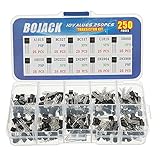
- BOJACK High Quality Power Transistors Assortment Kit.
- Product Name: Power Transistors
- Transistor Type: PNP & NPN
- Transistor Model: 10 Values, Include: A1015 PNP, BC327 PNP, BC337NPN, C1815 NPN, S8050 NPN, S8550 PNP, 2N2222 NPN, 2N2907 PNP, 2N3904 NPN, 2N3906 PNP.
- Package Quantity: 250pcs (Each model 25pcs), Packed in A Rugged Convenient Re-sealable Plastic Storage Case.
The polymer carries charge
The semiconducting layer is identified in the study context as P(DPP-TVT), a conjugated organic polymer. “Semiconducting” does not mean ordinary plastic behaves like metal wire: the polymer’s molecular structure allows charge to move through it, though its electrical behavior differs from that of conventional silicon electronics. Organic semiconductors are attractive when low weight, flexibility and potentially broad-area processing matter; they do not generally replace silicon for high-performance computing. A review of wearable and transparent electronics outlines these trade-offs. Read the review.
What the tests showed—and what they did not
The researchers reported that the transistor retained its electrical characteristics during bending tests and after repeated bending cycles. That supports describing the device as flexible or bendable. It does not, on the evidence summarized in the paper’s abstract, establish a highly stretchable complete device; bending and stretching are different mechanical demands.
In controlled degradation experiments, the device lost approximately 48% of its mass within a few days. The study examined degradation in phosphate-buffered saline and lipase-containing conditions. Mass loss is not the same as complete disappearance, and this result does not establish how quickly the device would break down in a person, in ordinary outdoor conditions, or in municipal compost. Moisture, enzymes, temperature, pH, material composition and device construction can all affect degradation.
Cell-viability testing used human embryonic kidney cells and indicated compatibility for the device and its individual components under the reported laboratory conditions. That is an in-vitro result—not a human trial, proof of long-term implant safety, or evidence about immune response or whole-body effects. The paper and its supporting information are available through ACS and the supporting-information repository.
Rank #3

- Colour:black
- 840Pcs TO-92 Transistor Kit 24Value x 35Pcs Lead Transistors Assorted (2N2222A-BC558) Low Power Transistor Storage Box
- Material:ABS
Why this could matter for wearables
Most watches and fitness trackers depend on rigid electronic components housed in a comparatively stiff enclosure. Flexible organic electronics offer another route for components that need to bend or conform to skin, clothing or irregular surfaces. A transistor is one useful building block: a future system would still need an actual sensing element, readout circuitry, power, communications and a way to protect the electronics during use.
The materials combination also addresses a difficult design balance. The device must conduct and switch reliably while remaining mechanically compliant and, if intended for transient use, breaking down after its useful operating life. The paper’s result matters because it brings electrical function, flexibility and a degradation pathway together in one laboratory device—not because it resolves every material or product-design challenge.
Independent reader supportYour contribution helps us test, update, and keep practical guides available for everyone.What remains before a wearable or implant
The study does not demonstrate a market-ready wearable, an implanted device, mass-manufacturing capability or clinical performance. The reported cell tests cover an early biological screen, while bending and degradation tests address specific laboratory conditions. A product would need evidence matched to its intended setting and service life.
- Reliable operation in use: Sweat, water, humidity, body fluids and repeated movement could affect collagen, electrical interfaces or the semiconductor. A device would need to stay functional for its intended period before any planned degradation begins.
- Robust construction: Thin layers must adhere and remain uniform; electrodes must withstand deformation; and electrical properties must remain suitable as the materials age. Packaging may protect a device during operation, but packaging that does not degrade could also remain after the active layers break down.
- Complete system design: A transistor alone does not supply power, wireless communication, sensor integration or a finished readout system.
- Safety and manufacturing evidence: Medical use would require substantially more biological and regulatory evaluation than cell viability alone. Reproducible fabrication, shelf-life and operating-life specifications would also be needed.
- End-of-life evidence: The mass-loss result does not establish complete or environmentally harmless degradation across disposal settings; that would require testing of the finished device and its products under relevant conditions.
The researchers and EE Times describe wearable, agricultural and implantable electronics as possible application areas. Those are future directions, not demonstrated products; an eye-related implant concept mentioned in the interview is likewise speculative. The paper’s contribution is narrower and more concrete: a flexible collagen-based OFET that retained electrical characteristics through reported bending tests and showed partial mass loss under controlled degradation conditions.
Quick Recap
Product prices and availability are accurate as of the date/time indicated and are subject to change. Any price and availability information displayed on Amazon at the time of purchase will apply.