Recommended Free Tools
The Casio Edifice EFK-100 is Edifice’s first automatic mechanical watch collection, according to Casio. Its key differences are the forged-carbon dial on the EFK-100CD, electroformed carbon-look dials on the EFK-100D models, and an all-black EFK-100XPB with a forged-carbon case and urethane band in the regional lineups reviewed.
Across the collection, Casio specifies an automatic movement with manual winding, about 40 hours of power reserve, a date, hacking seconds, sapphire crystal, and 10-bar water resistance. Check the full reference and regional listing before buying, since specifications and availability vary by market.
| # | Preview | Product | Price | |
|---|---|---|---|---|
| 1 |
|
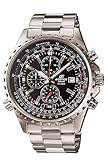
Casio Men's EF527D-1AV "Edifice" Stainless Steel Multi-Function Watch | $144.99 | Buy on Amazon |
Why the EFK-100 is notable
Casio describes the EFK-100 as the first automatic watch in the Edifice line; its international launch release calls it the first mechanical movement in EDIFICE. Those claims concern Edifice, not every Casio watch. The collection brings a visible mechanical movement into Edifice’s motorsport-inspired design language.
The EFK-100 is a three-hand watch with a date display, rather than a chronograph or racing timer. Its appeal lies in the mechanical movement, dial treatments, sapphire crystal, steel bracelet on the CD and D models, and 10-bar water resistance.
The Tool Desk
Outbyte PC Repair FREERepair Windows errors before they cause bigger problemsFix Now →Outbyte Driver Updater FREEFix the driver behind crashes, sound loss and screen glitchesFind Drivers →#1 Best Overall
- Silver-tone watch featuring left-handed crown and black dial with 1/20-second chronograph function, slide-rotating inner bezel, and date window
- 45.5 mm stainless steel case with mineral dial window
- Quartz movement with analog display
- Stainless steel band featuring fold-over push-button clasp with safety
- Water resistant to 100 m (330 ft): In general, suitable for swimming and snorkeling, but not scuba diving
What’s the difference between the Casio Edifice EFK-100 models?
The suffixes identify meaningful differences in dial treatment, case and band materials, and regional availability. The table summarizes the references and details documented in Casio’s launch and regional product information.
| Reference | Documented distinction | Market context |
|---|---|---|
| EFK-100CD-1A | Black model with a forged-carbon dial | Named in Casio’s international launch material and US collection information |
| EFK-100D-2A | Blue dial with electroformed carbon-look texture | Named in Casio’s international launch material |
| EFK-100D-3A | Green dial with electroformed carbon-look texture | Named in Casio’s international launch material |
| EFK-100D-7A | White dial with electroformed carbon-look texture; stainless-steel case and bracelet | Casio lists full dimensions and weight for this reference |
| EFK-100XPB | Regional all-black model with forged-carbon case and matte black resin/urethane band | Documented in Casio Europe and Singapore regional information; check the exact suffix |
The CD and D dial descriptions are not interchangeable. Casio identifies the CD dial as forged carbon, while the D models use electroforming to reproduce a forged-carbon-inspired texture. The XPB distinction documented in the regional pages is its forged-carbon case and urethane band; do not assume it has the CD’s forged-carbon dial.
Movement and functions
Casio specifies an automatic mechanical movement that can also be wound manually. The movement and functions are described in Casio’s official EFK-100 collection specifications.
| Specification | Casio-listed detail |
|---|---|
| Power reserve | Approximately 40 hours when fully wound |
| Mean daily rate | −35 to +45 seconds |
| Jewels | 24 |
| Frequency | 21,600 vibrations per hour |
| Display and functions | Three hands, date display, and hacking seconds |
| Caseback | See-through screw-lock caseback |
These are maker specifications, not independent test results. The stated daily rate is a mechanical movement specification, not chronometer certification or a promise that every watch will run at the midpoint. Casio’s comparison of the movement to a car’s engine and suspension is a design analogy, not a claim of racing-grade timing performance.
Case size and everyday specifications
Casio Europe lists 39 mm diameters for the CD and D models and 40 mm for the XPB. For the EFK-100D-7A, Casio’s official product page lists full case dimensions of 43.5 × 39 × 12.5 mm and a weight of 148 g. The 39 mm figure is the diameter, not the full case dimensions.
| Model or feature | Casio-listed detail | Source context |
|---|---|---|
| EFK-100CD and EFK-100D | 39 mm diameter | Casio Europe |
| EFK-100XPB | 40 mm diameter | Casio Europe |
| EFK-100D-7A | 43.5 × 39 × 12.5 mm; 148 g | Casio official specification page |
| Crystal and water resistance | Sapphire crystal; 10 bar/100 meters | Casio official collection specifications |
Casio also lists a stainless-steel case and bracelet for the EFK-100D-7A. A 10-bar rating is not a claim of professional dive-watch capability. Sapphire crystal offers scratch resistance but does not make a watch indestructible.
Launch pricing and availability
Casio announced the collection internationally on June 16, 2025. Casio Europe’s July 15, 2025 announcement said sales would begin August 1, 2025, through its site and selected specialist dealers. The European launch recommended retail prices were:
| Model group | European launch RRP | Date context |
|---|---|---|
| EFK-100D models | EUR 279 | Casio Europe, 2025 launch |
| EFK-100CD | EUR 299 | Casio Europe, 2025 launch |
| EFK-100XPB | EUR 449 | Casio Europe, 2025 launch |
These are dated European launch prices, not current prices or universal global MSRP. Current stock and pricing were not checked. Availability, local pricing, and warranty arrangements can vary by market, so consult the regional Casio listing and seller.
Who should consider the EFK-100?
It may suit you if you want
- An automatic mechanical watch from Edifice’s first mechanical collection.
- A visible movement, manual winding, and a mechanical seconds display.
- A choice between a forged-carbon dial on the CD and an electroformed carbon-look dial on the D references.
- The regional XPB’s documented forged-carbon case and urethane band.
- Sapphire crystal, a date display, and 10-bar water resistance.
Consider another watch if you prioritize
- Quartz-like accuracy or a chronometer-certified movement.
- A dive watch, chronograph, or racing timer.
- A uniform lineup available in every market.
Buying checklist
- Confirm the complete reference. Check the suffix, not just “EFK-100,” because the materials and color differ by model.
- Verify the material you want. The CD has a forged-carbon dial; the D models use an electroformed carbon-look treatment; the documented XPB has a forged-carbon case and urethane band.
- Check dimensions for the exact model. Casio Europe lists 39 mm for CD and D and 40 mm for XPB. The EFK-100D-7A page lists 43.5 × 39 × 12.5 mm and 148 g.
- Check your regional listing. Stock, price, suffixes, and warranty can vary by market.
- Treat launch prices as historical. The euro amounts above are 2025 European launch RRPs, not current or global prices.
Verdict
The EFK-100 is best understood as Edifice’s first automatic mechanical collection, not a racing instrument or complication showcase. Its main distinctions are the CD’s forged-carbon dial, the D models’ electroformed carbon-look dials, and the regional XPB’s forged-carbon case and urethane band.
Casio’s specifications include about 40 hours of power reserve, manual winding, hacking seconds, sapphire crystal, a date, and 10-bar water resistance. Before buying, verify the full reference and regional product page so the material, dimensions, price, and warranty match what you expect.
FAQ
What is the difference between the EFK-100CD and EFK-100D?
Casio identifies the EFK-100CD dial as forged carbon. The EFK-100D models use electroforming to reproduce a forged-carbon-inspired texture.
Does the EFK-100XPB have a forged-carbon dial?
The regional information reviewed describes the XPB as an all-black model with a forged-carbon case and matte black resin/urethane band. It should not be described as having the CD’s forged-carbon dial unless the specific regional listing confirms that detail.
Free tools Windows power users keep installed
One-click scans. No signup required.
How long is the EFK-100’s power reserve?
Casio specifies approximately 40 hours when fully wound. The movement is automatic and can also be wound manually.
How accurate is the Casio EFK-100?
Casio lists a mean daily rate of −35 to +45 seconds. This is a manufacturer specification, not chronometer certification or an independent test result.
What are the EFK-100D-7A’s dimensions and weight?
Casio lists the EFK-100D-7A at 43.5 × 39 × 12.5 mm and 148 g. Casio Europe separately gives 39 mm as the diameter for CD and D models.
What were the EFK-100’s European launch prices?
Casio Europe gave 2025 launch RRPs of EUR 279 for D models, EUR 299 for the CD, and EUR 449 for the XPB. These are historical European prices, not current or universal prices.
PC Slower Than It Used to Be?
A free scan shows the junk files, broken settings and background clutter dragging Windows down - then fixes them in one click.Free scan · Windows 10 & 11Outdated Drivers Are Slowing You Down
One free scan finds every outdated or missing driver and matches the right update for your exact hardware.Free scan · exact hardware matchQuick Recap
Product prices and availability are accurate as of the date/time indicated and are subject to change. Any price and availability information displayed on Amazon at the time of purchase will apply.