As of August 18, 2026, Garmin has not confirmed a Forerunner 275 or 975. Instead, it announced the Forerunner 570 and 970 on May 15, 2025. Those watches show that Garmin still has new ideas for its running lineup—but whether they justify an upgrade depends on whether their additions change how you train.
Status as of August 18, 2026: Garmin’s newer running-watch generation is the Forerunner 570 and 970, not the rumored 275 and 975. Garmin’s May 15, 2025 announcement identifies the 570 and 970 as its newest GPS running and triathlon smartwatches. No official 275 or 975 announcement or product page had been located by this date.
What the “gas left in the tank” question was really asking
The phrase was about Garmin’s remaining product ideas, not battery life. In March 2025, an opinion column asked whether future Forerunners could deliver genuinely useful advances or would mostly offer hardware refinements and incremental features. The 265 and 965 had launched in March 2023, and the suggested 275 and 975 names were speculation—not confirmed products. (Android Central, March 16, 2025.)
The useful test is not whether a new watch has more features. It is whether those features help a runner make a better decision about pace, recovery, workout selection or race preparation. Garmin’s 570/970 generation gives that question a real product to examine.
#1 Best Overall

- Our brightest AMOLED touchscreen display with button controls, a lightweight titanium bezel and sapphire lens, plus a built-in LED flashlight for greater awareness in the dark during early morning or late-night runs
- Up to 15 days of battery life in smartwatch mode and up to 26 hours in GPS mode for a more complete picture of your training and recovery
- Understand your overall energy efficiency with running economy, and see how much you’re slowing down when your foot hits the ground with step speed loss (HRM 600 monitor required; sold separately); running tolerance helps you understand the real impact running has on your body so you can adjust your training to avoid overload and improve
- Train for an event, achieve a milestone, or improve your fitness with Garmin Coach training plans; these running and triathlon plans are personalized to you and adapt based on your performance and recovery
- Built-in microphone and speaker let you make and take phone calls from your wrist when your watch is paired to your smartphone — and you can even use your smartphone’s voice assistant to respond to text messages and more
How the rumored names gave way to the 570 and 970
- March 1, 2023: The Forerunner 265 and 965 launched.
- March 16, 2025: Coverage speculated about 275 and 975 successors, while questioning whether Garmin had meaningful new ideas.
- April 2025: A leak report suggested a 970 could arrive before a 975; neither rumored model name was officially confirmed. (Notebookcheck.)
- May 15, 2025: Garmin announced the Forerunner 570 and 970. By June, these were the practical newer options in its performance-running lineup.
The numbering change is real; its rationale is not established by Garmin’s announcement. The 970 occupies the newer premium position associated with the 965, while the 570 is a newer option for runners considering the 265 class. That is a reading of product positioning, not an official explanation that one model directly replaces another. Garmin’s newsroom is the appropriate place to check for later official announcements; as of the date above, it had not confirmed either rumored name.
What Garmin added in the 570 and 970
The launch announcement describes brighter AMOLED displays, a built-in speaker and microphone, Garmin Triathlon Coach plans, Evening Report, and additional training and recovery insights across the new generation. It also lists connected functions such as notifications, music, incident detection, Assistance, LiveTrack and Garmin Pay. These features broaden the watches’ daily and training roles, but their presence alone does not show that every runner will benefit.
The 970 adds a built-in LED flashlight, sapphire glass, and the running metrics running tolerance, running economy and step speed loss. It is positioned as the more premium model, with more hardware and training features. Garmin says its new performance metrics are backed by its data scientists and sports physiologists; that is the manufacturer’s description, not independent proof that using the metrics improves performance.
Rank #2

- Our brightest AMOLED touchscreen display with button controls, a lightweight titanium bezel and sapphire lens, plus a built-in LED flashlight for greater awareness in the dark during early morning or late-night runs
- Up to 15 days of battery life in smartwatch mode and up to 26 hours in GPS mode for a more complete picture of your training and recovery
- Understand your overall energy efficiency with running economy, and see how much you’re slowing down when your foot hits the ground with step speed loss (HRM 600 monitor required; sold separately); running tolerance helps you understand the real impact running has on your body so you can adjust your training to avoid overload and improve
- Train for an event, achieve a milestone, or improve your fitness with Garmin Coach training plans; these running and triathlon plans are personalized to you and adapt based on your performance and recovery
- Built-in microphone and speaker let you make and take phone calls from your wrist when your watch is paired to your smartphone — and you can even use your smartphone’s voice assistant to respond to text messages and more
Do the 970’s new running metrics change training?
The three metrics are potentially more consequential than a cosmetic refresh because they aim to describe how a runner is handling or producing effort. But a metric is useful only if its estimate is understandable, dependable enough for its intended use and connected to a decision. The launch announcement identifies the features but does not establish independent validation, exact prerequisites for every use case, or a quantified training benefit.
Running tolerance
Running tolerance is presented as a way to understand the load running places on the body. That could help an athlete contextualize training stress rather than looking at a single workout in isolation. Its practical value depends on whether the watch’s estimate leads to a sensible adjustment—such as easing back or progressing gradually—and on the user understanding what the score does and does not represent. Treat it as an additional signal, not a diagnosis or a substitute for how you feel.
Running economy
Running economy concerns the cost of sustaining a given running effort. A trend may interest experienced runners who already track training consistently, but the name alone does not tell you how to change a workout or prove that the watch’s estimate is accurate for your individual running. Garmin’s announcement does not provide independent evidence that following this metric improves race results.
Rank #3

- Our brightest AMOLED touchscreen display with button controls, a lightweight titanium bezel and sapphire lens, plus a built-in LED flashlight for greater awareness in the dark during early morning or late-night runs
- Up to 15 days of battery life in smartwatch mode and up to 26 hours in GPS mode for a more complete picture of your training and recovery
- Understand your overall energy efficiency with running economy, and see how much you’re slowing down when your foot hits the ground with step speed loss (HRM 600 monitor required; sold separately); running tolerance helps you understand the real impact running has on your body so you can adjust your training to avoid overload and improve
- Train for an event, achieve a milestone, or improve your fitness with Garmin Coach training plans; these running and triathlon plans are personalized to you and adapt based on your performance and recovery
- Built-in microphone and speaker let you make and take phone calls from your wrist when your watch is paired to your smartphone — and you can even use your smartphone’s voice assistant to respond to text messages and more
Step speed loss
Step speed loss is a running-dynamics measure intended to describe changes in speed around foot contact. It may help a data-focused athlete examine mechanics, especially alongside other context such as pace and fatigue. A number that changes from run to run is descriptive until it has a clear interpretation and informs a specific training choice.
For all three, verify the watch’s on-device prerequisites and compatible accessories for the activity you plan to record; the launch announcement alone does not establish every requirement. The distinction is simple: a metric that changes your training plan is actionable; one that explains a run without changing what you do is descriptive; and one whose meaning or guidance is unclear risks being novelty. Existing 265/965 owners should check their own Garmin feature lists rather than assume every new metric is or is not available through a software update.
The literal battery question: 970 estimates by mode
Battery life is separate from the “gas in the tank” metaphor. Garmin’s Forerunner 970 manual, updated in June 2026, gives the following maximum estimates. They are manufacturer estimates, not guaranteed runtimes; Garmin says actual life varies with settings and connected hardware. (Forerunner 970 owner’s manual.)
Rank #4
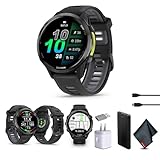
- Bundle Includes: Garmin Forerunner 970 Running Smartwatch, GPS Fitness Smart Watch For Men And Women, Carbon Gray DLC Titanium with Black Case and Black/Translucent Whitestone Band + USB Wall Plug Charging Adapter Cube + USB3.0 to type-c female adapter Space Gray + Microfiber Cleaning Cloth + P-Bank
- Precision Navigation with Built-In Maps and SatIQ: Run city streets or mountain switchbacks confidently with full-color built-in maps and multi-band GPS enhanced by SatIQ technology. Whether you’re exploring new routes or racing unfamiliar terrain, get pinpoint accuracy and turn-by-turn directions—ideal for trail runners, cyclists, and multisport athletes who train off-grid.
- Advanced Training, Recovery, and Readiness Tools: Train smarter with premium metrics like running economy, endurance score, and training readiness. Get adaptive coaching, recovery time, and workout suggestions —perfect for high-performance runners and triathletes looking to optimize every session and minimize risk of burnout or injury.
- Durable, Lightweight Design with Smart Safety Tools: Built with a titanium bezel, sapphire lens, and a built-in LED flashlight, this watch is rugged yet light for ultra comfort during long workouts. Stay connected with phone calls, smart notifications, and safety tracking—all from your wrist. Designed for committed athletes who value performance, safety, and real-world utility.
- Vivid AMOLED Display with Long Battery Life: Train harder, longer, and in any light with the 1.4-inch AMOLED display—bright, responsive, and crystal clear even in direct sun. With up to 26 hours of battery in GPS mode, it’s built for endurance athletes who demand visibility and reliability through every mile, from early morning long runs to all-day trail adventures.
| Forerunner 970 mode | Garmin’s maximum estimate |
|---|---|
| Smartwatch | Up to 15 days |
| GPS Only GNSS | Up to 26 hours |
| Auto Select GNSS | Up to 23 hours |
| All + Multi-Band GNSS | Up to 21 hours |
| GPS Only GNSS with music | Up to 14 hours |
| Auto Select GNSS with music | Up to 13 hours |
| All + Multi-Band GNSS with music | Up to 12 hours |
Choose the figure that resembles your actual use, not the most flattering number in the table. A marathoner using multi-band GPS and music should focus on that 12-hour estimate, not smartwatch days; someone running indoors may have little use for multi-band GPS endurance. Notifications, wrist heart rate, connected sensors, maps, pulse oximetry, display settings and frequent screen activation can also affect runtime. Garmin support lists software version 17.37 in July 2026, including a fix for an issue that could cause shorter-than-expected battery life. That is a specific firmware fix, not a blanket guarantee for every device or configuration. (Garmin support.)
Independent reader supportYour contribution helps us test, update, and keep practical guides available for everyone.Should Forerunner 265 or 965 owners upgrade?
Start with the feature or limitation you actually encounter. A newer release is a weak reason by itself; an upgrade is easier to justify when a specific addition addresses a need your current watch does not meet.
Forerunner 265 owners
- Consider the 570 if you want the newer training and recovery features, speaker and microphone, or brighter display and expect to use them.
- Keep the 265 if its GPS, training tools, battery and display already work for you, particularly if you value a lower-cost or lighter option.
- Compare the 265 with the 570 at current local prices. The 570 is a practical newer alternative, but Garmin’s announcement does not call it an official 265 replacement. Check Garmin’s running-watch store for the relevant region; no current August 2026 street-price comparison is established here.
Forerunner 965 owners
- Consider the 970 if you specifically want its flashlight, sapphire glass, newer running metrics or other additions, and those features fit your training.
- Keep the 965 if its established flagship feature set meets your needs and the new metrics would be data you rarely consult.
- Consider a discounted 965 if it offers the functions you need at a meaningfully lower local price. Compare live prices rather than an old launch price with today’s sale price.
Triathletes, marathoners and other edge cases
- Triathletes: Confirm the exact multisport, transition, pool and open-water workflows you rely on; do not assume every Forerunner behaves identically because both new models were marketed for running and triathlon.
- Marathoners: Check expected race duration against the GPS mode you will actually use, especially if you combine multi-band GPS with music.
- Runners using external sensors: Check compatibility with your heart-rate strap, running-dynamics accessories, cycling sensors or foot pod before upgrading for a metric.
- Trail runners and hikers: If rugged construction and broader outdoor functions matter more than a lightweight running-watch design, compare Garmin’s outdoor and multisport watches as well.
Price, comfort and display preference also matter. The 970’s premium materials may appeal to someone who wants sapphire protection, while a runner satisfied with a lighter or less costly watch may see little reason to move. For anyone choosing between an older model and its newer counterpart, use current regional pricing and the difference in features—not a rumored 275/975 preorder or an unverified price.
What’s actually slowing this PC down?
Pick the symptom - the matching free tool is one click away.
Best Value

- Bundle Includes: Garmin Forerunner 970 Running Smartwatch, GPS Fitness Smart Watch For Men And Women, Soft Gold Titanium with French Gray Case and French Gray/Translucent Indigo Band + USB Wall Plug Charging Adapter Cube + USB3.0 to type-c female adapter Space Gray + Microfiber Cleaning Cloth + P-Bank
- Precision Navigation with Built-In Maps and SatIQ: Run city streets or mountain switchbacks confidently with full-color built-in maps and multi-band GPS enhanced by SatIQ technology. Whether you’re exploring new routes or racing unfamiliar terrain, get pinpoint accuracy and turn-by-turn directions—ideal for trail runners, cyclists, and multisport athletes who train off-grid.
- Advanced Training, Recovery, and Readiness Tools: Train smarter with premium metrics like running economy, endurance score, and training readiness. Get adaptive coaching, recovery time, and workout suggestions —perfect for high-performance runners and triathletes looking to optimize every session and minimize risk of burnout or injury.
- Durable, Lightweight Design with Smart Safety Tools: Built with a titanium bezel, sapphire lens, and a built-in LED flashlight, this watch is rugged yet light for ultra comfort during long workouts. Stay connected with phone calls, smart notifications, and safety tracking—all from your wrist. Designed for committed athletes who value performance, safety, and real-world utility.
- Vivid AMOLED Display with Long Battery Life: Train harder, longer, and in any light with the 1.4-inch AMOLED display—bright, responsive, and crystal clear even in direct sun. With up to 26 hours of battery in GPS mode, it’s built for endurance athletes who demand visibility and reliability through every mile, from early morning long runs to all-day trail adventures.
What Garmin still needs to prove
The 570/970 generation is evidence that Garmin has not simply stopped adding ideas: the 970 combines new running metrics and a flashlight with premium materials, while both watches bring display and voice-hardware changes alongside training features. The harder question is whether those additions produce clearer, more useful coaching rather than a longer list of numbers.
- Training recommendations should make the link between a metric and a practical action clear.
- Metric explanations should make prerequisites, limitations and intended use easy to understand.
- Battery improvements matter most when they hold up in demanding GPS modes, not only in smartwatch mode.
- Future hardware should make a meaningful difference to training or use, rather than relying on novelty alone.
That is why the original “gas left” question remains useful as analysis, even though its product names did not become reality. The 570 and 970 answer it partially: Garmin still has features to add, but their value is uneven and user-dependent. For an owner of a 265 or 965, the decisive question is whether an actual new capability changes your training or solves a problem you have—not whether the next model number sounds overdue.
Quick Recap
Product prices and availability are accurate as of the date/time indicated and are subject to change. Any price and availability information displayed on Amazon at the time of purchase will apply.