Quartz watches accelerated a crisis in Swiss watchmaking, but they did not create all the conditions behind it. A fragmented production system, limited coordination, rising costs, a stronger Swiss franc and Japan’s growing export strength had already left the industry vulnerable. The turning point was not simply who understood quartz first: Swiss and Japanese teams presented prototypes in 1967, but Japan brought the first commercial analog quartz wristwatch to market in 1969 and built production and marketing around the new technology.
What was the Quartz Crisis—and when did it happen?
The Quartz Crisis refers to the severe disruption of the traditional Swiss watch industry, centered on the 1970s and early 1980s. Battery-powered electronic watches, especially quartz models, offered a different mix of accuracy, cost and manufacturing scale from mechanical watches. Japanese producers were particularly effective at turning that shift into a commercial challenge for Swiss makers.
Calling it a crisis caused by quartz alone misses the longer story. Switzerland still made a large share of the world’s watches in the 1960s: Régis Huguenin-Dumittan, director and curator of the Musée international d’horlogerie, is quoted by Presence Switzerland as saying the country produced 60% of the world’s watchmaking products during that decade. But the industry’s organization and external economic conditions made it harder to adapt when electronics changed the competitive landscape.
Why was Swiss watchmaking vulnerable before quartz took off?
A fragmented production network made coordinated change harder
Much Swiss watchmaking relied on a horizontal system: specialist suppliers and subcontractors made components or movements, while assemblers finished and sold watches. It was not the only Swiss model; some firms operated as integrated manufactures. But a network of many independent businesses could make it difficult to coordinate investment, production changes and marketing across the sector.
#1 Best Overall

- MANUAL WINDING: Designed for precision, this hand-wound watch is powered by the exclusive H-50 movement, offering an extended 80-hour power reserve for reliable performance.
- WATER RESISTANT TO 50M: Withstands 5 bar (50 meters), ideal for swimming and outdoor pursuits. Perfect for those who demand resilient accessories that accompany them confidently on their explorative journeys.
- BUILT FOR ADVENTURE: Featuring a 38mm stainless steel case, a black dial and textile strap, this watch combines durability and functionality. With Super-LumiNova and sapphire crystal, it’s ready to tackle your outdoor challenges.
- PREMIUM MATERIALS: Textile strap with pin buckle offers day-long comfort. The clean lines and sophisticated design make it the perfect accessory for both casual wear and formal attire, merging functionality with fashion.
- RICH HERITAGE: Over a century of Hamilton's legacy in field watches, admired for precision. Originally designed for WWI soldiers, these timepieces combine rugged durability with history, showcasing Hamilton's commitment to quality and innovation.
The Federation of the Swiss Watch Industry describes both horizontal and vertical forms of production in its industry overview. The Seiko Museum Ginza’s history identifies limited cohesion in production and marketing, along with the absence of a leading corporate group, as factors that slowed the Swiss response. The problem was not that specialization was inherently bad; it was that coordination became especially important as competition shifted toward electronics, larger production runs and concentrated marketing.
Old protections and a changing market left little room for complacency
Switzerland had faced structural challenges well before quartz. A historical account from Presence Switzerland describes a watchmaking cartel in the 1930s and says US industrial methods undercut the country’s many uncoordinated factories. Later, cartel-guaranteed prices could offer protection but also reduce pressure to adjust quickly as competitors and consumer expectations changed. Fondation de la Haute Horlogerie names cartel-era price guarantees among the factors behind the loss of competitiveness; that is its interpretation of the crisis, not a single-cause explanation accepted by every account.
Japan was building export strength before quartz became mainstream
Japanese watchmaking’s rise did not begin with quartz. The Japan Clock & Watch Association reports that Japanese makers improved quality and expanded export markets, with international recognition boosted by the use of Japanese timing equipment at the 1964 Tokyo Olympics. Its historical series puts the export rate at 23% in 1963, 31% in 1970 and 42% in 1974. These figures show that export capability was growing before quartz watches dominated production.
Rank #2
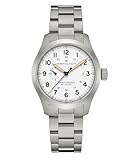
- MANUAL WINDING: Designed for precision, this hand-wound watch is powered by the exclusive H-23 movement, offering an extended power reserve for reliable performance.
- WATER RESISTANT TO 100M: Withstands 10 bar (100 meters), ideal for swimming and outdoor pursuits. Perfect for those who demand resilient accessories that accompany them confidently on their explorative journeys.
- BUILT FOR ADVENTURE: Featuring a 40mm stainless steel case, a white dial and stainless steel bracelet, this watch combines durability and functionality. With Super-LumiNova and sapphire crystal, it’s ready to tackle your outdoor challenges.
- PREMIUM MATERIALS: Stainless steel bracelet with folding clasp offers day-long comfort. The clean lines and sophisticated design make it the perfect accessory for both casual wear and formal attire, merging functionality with fashion.
- RICH HERITAGE: Over a century of Hamilton's legacy in field watches, admired for precision. Originally designed for WWI soldiers, these timepieces combine rugged durability with history, showcasing Hamilton's commitment to quality and innovation.
Did Switzerland invent quartz watches?
Yes, Swiss teams understood and developed quartz technology; the key distinction is between developing a technology and commercializing it at scale. Both Seiko and Switzerland’s Centre Electronique Horloger (CEH) submitted quartz wristwatch prototypes at the 1967 Neuchâtel Observatory competition, according to the Seiko Museum Ginza. The Japan Clock & Watch Association likewise records simultaneous Japanese and Swiss prototypes in 1967.
Seiko released the Astron in December 1969, which the Seiko Museum identifies as the first commercial quartz wristwatch. The Japan Clock & Watch Association also dates commercialization to 1969 and reports a daily variance of ±0.2 seconds for the watch. The important historical contrast is therefore not “Japan invented quartz and Switzerland did not.” It is that Japanese firms moved quickly from prototypes to commercial products and subsequently built production, marketing and export strategies around electronic watches.
How did quartz change the competitive equation?
Quartz altered more than timekeeping accuracy. Electronic components enabled watches that could be produced at lower prices than many Swiss mechanical watches, while large-scale production and coordinated marketing helped Japanese firms reach more consumers. The Japan Clock & Watch Association’s series shows quartz watches rising to 40% of Japanese watch production in 1978 and 57% in 1979.
Rank #3

- MANUAL WINDING: Designed for precision, this hand-wound watch is powered by the exclusive H-23 movement, offering an extended power reserve for reliable performance.
- WATER RESISTANT TO 100M: Withstands 10 bar (100 meters), ideal for swimming and outdoor pursuits. Perfect for those who demand resilient accessories that accompany them confidently on their explorative journeys.
- BUILT FOR ADVENTURE: Featuring a 40mm stainless steel case, a white dial and green textile strap, this watch combines durability and functionality. With Super-LumiNova and sapphire crystal, it’s ready to tackle your outdoor challenges.
- PREMIUM MATERIALS: Textile strap with pin buckle offers day-long comfort. The clean lines and sophisticated design make it the perfect accessory for both casual wear and formal attire, merging functionality with fashion.
- RICH HERITAGE: Over a century of Hamilton's legacy in field watches, admired for precision. Originally designed for WWI soldiers, these timepieces combine rugged durability with history, showcasing Hamilton's commitment to quality and innovation.
The Seiko Museum Ginza describes concentrated marketing and mass production among Japanese watchmakers, as well as component production moving to Hong Kong, Taiwan and China. That shift contributed to price pressure across both quartz and mechanical watches. Japan’s success was not a simple consequence of quartz alone: export networks, quality improvements, branding, production organization and distribution also mattered.
Independent reader supportYour contribution helps us test, update, and keep practical guides available for everyone.What economic pressures deepened the downturn?
Swiss manufacturers faced headwinds beyond the technology transition. Fondation de la Haute Horlogerie reports that the Swiss franc rose 58% against the US dollar from 1970 to 1974, while oil and labor costs also increased. Currency appreciation made Swiss products more expensive in international markets, weakening competitiveness even where the quality of the watches had not changed.
Free tools Windows power users keep installed
One-click scans. No signup required.
The foundation summarizes the imbalance this way: “The quality of Swiss watches was unchanged but their ability to compete on international markets was all but wiped out.” This is its account of the period; it captures the difference between product quality and the ability to compete on price and in export markets, rather than proving that every Swiss maker or watch was affected in exactly the same way.
Rank #4

- AUTOMATIC MOVEMENT: Swiss H-10 movement with 80-hour reserve ensures consistent performance. Experience precision that matches both daily tasks and adventures, a testament to Swiss craftsmanship in automatic timekeeping.
- WATER RESISTANT TO 100M: Withstands 10 bar (100 meters), ideal for swimming and outdoor pursuits. Perfect for those who demand resilient accessories that accompany them confidently on their explorative journeys.
- BUILT FOR ADVENTURE: Featuring a 42mm stainless steel case, a black dial and leather strap, this watch combines durability and functionality. With Super-LumiNova and sapphire crystal, it’s ready to tackle your outdoor challenges.
- PREMIUM MATERIALS: Leather strap with pin buckle offers day-long comfort. The clean lines and sophisticated design make it the perfect accessory for both casual wear and formal attire, merging functionality with fashion.
- RICH HERITAGE: Over a century of Hamilton's legacy in field watches, admired for precision. Originally designed for WWI soldiers, these timepieces combine rugged durability with history, showcasing Hamilton's commitment to quality and innovation.
How severe was the contraction?
The industry’s decline was dramatic in both employment and the number of firms, although published figures use different endpoint years and should not be collapsed into one count.
| Measure | Reported change | Source and date context |
|---|---|---|
| Swiss watch-industry employment | About 90,000 in 1970 to just over 30,000 in 1984 | Federation of the Swiss Watch Industry, historical figures in its industry overview |
| Swiss watch companies | 1,618 in 1970 to 634 in 1985 | Fondation de la Haute Horlogerie, historical account |
The employment figures come from the Federation’s overview; the company counts come from the foundation’s historical account. A separate Federation overview gives 1,600 companies in 1970 and 572 in its page context, so that figure should not be treated as a directly interchangeable 1985 count.
How did Swiss watchmaking recover?
Recovery involved structural consolidation and a change in product strategy, not a return to the pre-crisis market unchanged. Nicolas Hayek was commissioned to analyze how to save the industry, and banks intervened as the two major groups ASSUAG and SSIH merged. Presence Switzerland describes the merger as helping keep Swiss watchmaking afloat; the Seiko Museum dates the formation of SMH through the merger to 1983.
That same year, the Swatch arrived as a colorful, fashionable, inexpensive Swiss quartz watch designed for mass production. It helped Swiss watchmaking compete in a market that electronics had reshaped. The later revival of mechanical watches as luxury products added another path to recovery: Swiss makers increasingly competed on craftsmanship, heritage and prestige, rather than trying to win every segment through low prices.
Quick Recap
Product prices and availability are accurate as of the date/time indicated and are subject to change. Any price and availability information displayed on Amazon at the time of purchase will apply.