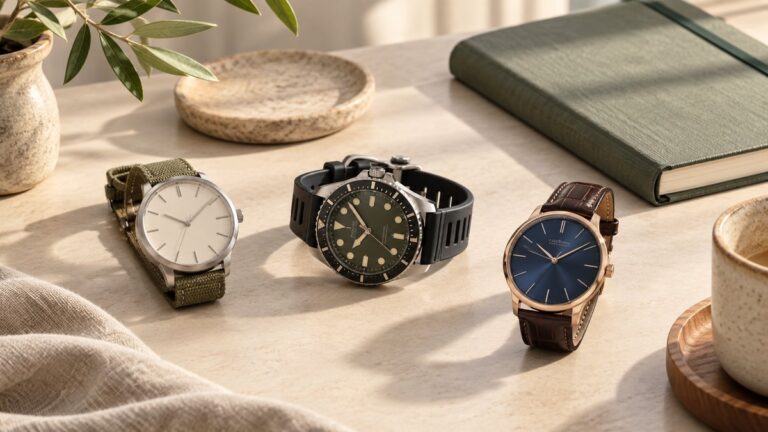
A chronometer is a precision watch whose movement has been regulated for different positions and conditions of use and has passed an applicable independent certification test. For wristwatches with spring-balance oscillators, the relevant international standard is ISO 3159:2009. Its familiar average daily-rate tolerance is from four seconds slow to six seconds fast per day under the stated test measure.
What “chronometer” means on a watch
ISO’s definition, reproduced by the Slovenian Institute for Standardization, is a “precision wristwatch regulated for different positions and for various conditions of use.” The designation is about tested precision: it is not established merely because a manufacturer describes a watch as accurate.
ISO 3159:2009 applies to wrist-chronometers with spring-balance oscillators. The standard defines the term and sets out categories, a test programme and minimum requirements. ISO lists the edition as published in December 2009 and reviewed and confirmed in 2021; its lifecycle record also shows review activity in 2026. See the ISO 3159:2009 record for its current status.
How accurate is a certified chronometer?
METAS summarizes the ISO 3159 average daily-rate criterion as −4 to +6 seconds per day: on that measure, the movement may run up to four seconds slow or six seconds fast. This is a controlled-test tolerance, not a guarantee that a watch will gain or lose exactly that amount on every owner’s wrist. Wear, position, temperature and other conditions in everyday use differ from a certification test. METAS explains the criterion on its chronometer certification page.
#1 Best Overall

- Used Book in Good Condition
What does the certification test measure?
Testing is designed to assess performance across more than one position or condition, rather than relying on a single rate reading. The Geneva Chronometric Observatory describes its ISO 3159 procedure as a 15-day protocol conducted in five positions and at three temperatures: 8°C, 23°C and 38°C. Its account lists seven criteria:
- Average daily rate: −4 to +6 seconds per day.
- Average rate variation: 2 seconds per day.
- Maximum daily rate variation: 5 seconds per day.
- Horizontal/vertical difference: −6 to +8 seconds per day.
- Largest step deviation: 10 seconds per day.
- Temperature-related step variation: ±0.6 seconds per day per °C.
- Resumption of operation: ±5 seconds per day.
These details describe the procedure reported by the Geneva Chronometric Observatory; they should not be taken to mean that every certification programme uses the same protocol. The Observatory’s chronometer certification description provides its account of the test.
Rank #2

- Swiss Made Watch
- Movement: Automatic Mido Caliber - Power reserve 80 hours - COSC Certified
- Case Size: 40mm - Band Width: 21mm - Case Thickness: 11.3mm
- Case Type: Stainless steel - See-through case back - Crystal: Sapphire crystal
- Strap: Stainless steel bracelet - Folding clasp with push-buttons
Chronometer, chronograph and Master Chronometer
| Term | What it refers to | What it does not establish |
|---|---|---|
| Chronometer | A precision wristwatch whose movement meets applicable certification criteria, such as ISO 3159. | It does not mean the watch has an elapsed-time function. |
| Chronograph | A watch function or instrument for measuring elapsed time. | It does not by itself certify the watch’s timekeeping precision. |
| Master Chronometer | A separate METAS certification. METAS says the movement must meet ISO 3159 chronometer criteria, with additional requirements applying to the mechanical watch. | It is not another name for ordinary ISO 3159 chronometer certification. |
A watch can be both a chronometer and a chronograph: one label concerns certified precision, while the other describes elapsed-time measurement. METAS explains the distinction between movement testing and the additional scope of its Master Chronometer certification on its certification page. The horology glossary of the Federation of the Swiss Watch Industry also distinguishes the two terms.
Independent reader supportYour contribution helps us test, update, and keep practical guides available for everyone.Why the term has a testing tradition
Chronometer testing developed from efforts to measure timekeeping performance systematically. The Geneva Chronometric Observatory says it succeeds the Astronomical Observatory founded in Geneva in 1772. It also describes how the Geneva, Neuchâtel and Besançon observatories established time-measurement methods based on star observations during the 19th century, helping lay foundations for chronometry competitions and later testing protocols. This historical context concerns the development of chronometry; ISO 3159’s stated scope is spring-balance wrist-chronometers, not marine navigation instruments. The Observatory’s account is at About us: history.
Quick Recap
Best Value

- Used Book in Good Condition
Rank #4

- Swiss Made Watch
- Movement: Automatic Mido Caliber - Power reserve 80 hours - COSC Certified
- Case Size: 40mm - Band Width: 21mm - Case Thickness: 11.3mm
- Case Type: Stainless steel - See-through case back - Crystal: Sapphire crystal
- Strap: Stainless steel bracelet - Folding clasp with push-buttons
Rank #3

- Used Book in Good Condition
Product prices and availability are accurate as of the date/time indicated and are subject to change. Any price and availability information displayed on Amazon at the time of purchase will apply.