Recommended Free Tools
Luxury watches remain compelling because they unite two things people can see and one they can measure: distinctive design, a tradition of skilled watchmaking, and—on some watches—precision verified against defined standards. Calling them the “ultimate” symbol of style is a cultural judgment, not a measurable or universal fact. Their status comes from recognizable design and brand identity as much as from the craft and engineering inside the case.
Why do luxury watches carry cultural significance?
Swiss watchmaking traces its roots to mid-16th-century Geneva, where goldsmiths and jewellers turned their skills toward making watches. Over centuries, the craft developed through technical change, including the quartz challenge of the 1970s and 1980s. The Swiss Federal Department of Foreign Affairs describes the industry as primarily operating in the luxury segment. Its history and industry overview helps explain why a watch can signify more than its function: the object connects visible design to a long-running craft tradition.


As an Amazon Associate I earn from qualifying purchases.
That heritage is also recognized as living cultural practice. A Swiss government feature published on 16 September 2025 says mechanical watchmaking and art mechanics have been on UNESCO’s Intangible Cultural Heritage of Humanity list since 2020. This recognition speaks to the continuity and skill of the craft; it does not establish that every luxury watch is handmade or that buyers everywhere assign it the same status.
Luxury watches can therefore serve as personal style, a marker of identity, or an expression of interest in horology. Those are interpretations of their cultural role, not findings from a consumer survey proving that watches are universally considered the foremost status symbol.
#1 Best Overall
What makes a luxury watch a precision instrument?
A mechanical watch keeps time through a regulated system of moving parts, but the label “luxury” alone does not tell you how accurately a particular watch performs. Certification is more useful when the question is precision, because it identifies the test criteria and the object being tested.
Chronometer certification tests the movement
METAS, Switzerland’s Federal Institute of Metrology, explains that ISO 3159:2009 defines a chronometer by the movement’s average daily rate deviation: it must fall within −4 to +6 seconds. This is a movement-level test. It should not be mistaken for a test of every aspect of the fully assembled watch. METAS outlines the certification scopes and criteria.
Rank #2
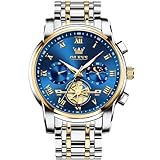
- Features a classic big dial and quartz movement with stable quality. High hardness coated glass mirror is wear-resistant, scratch-proof, Butterfly double buckle ensures comfortable wear
- Mirror diameter is 1.6 inches (41 mm), case thickness is 0.43 inches (11 mm), and band length is 7 inches (180 mm). The length of the watch can be adjusted, and it weighs 132 g(4.65 ounces). Maximum applicable to about an 8-9" wrist
- Luminous function can be activated by illuminating the watch under strong light for 30-40 seconds, providing a new visual experience at night. Manual includes detailed instructions for adjusting time and calendar
- Fashionable and elegant design for any man who appreciates quality and style. Versatile and stylish men's watches are suitable for any occasion, including parties, work, daily life and dating
- Water resistance for daily life, waterproof to 100 feet (30 m), generally resistant to splashing or brief submersion, but not suitable for swimming or bathing
Master Chronometer certification tests the finished watch
METAS Master Chronometer certification applies additional testing to the finished watch under conditions that include different temperatures, positions, magnetisation, and used power reserve. The program also validates power reserve and water resistance. METAS specifies a rate of 0 to +5 seconds per day for this designation. The watch must be Swiss made, and its movement must meet the ISO 3159 chronometer criteria. These requirements make Master Chronometer a broader testing scope than movement certification alone, not simply a different name for the same test.
Brand standards are not the same as independent certification
Brands may add their own quality controls after independent movement certification. For example, Rolex says its movements receive COSC certification before casing, after which finished watches undergo the brand’s Superlative Chronometer tests. Rolex reports a precision of approximately −2/+2 seconds per day for that standard. This is a manufacturer’s claim about its own process, not an independent comparison of all luxury watches. Rolex describes the process in its 2025 Land-Dweller announcement.
Rank #3

- Movement: Japanese Imported quartz analog movement, provide precise time and long term running.
- Waterproof: Water resistant to 30M. Daily use waterproof, washing hands, raining or splash. But not suitable for swimming, diving, shower.
- Material: Anti-scratch mineral glass and environmental protection vacuum plating case never fade. Genuine leather strap, delicate and soft.
- Multifunction Design: Simple and luxurious dial, covers the week,date, time display, chronograph, LED light functions.
- Perfect Gift: This elegant looking luxury wristwatch can be worn for a variety of occasions, whether formal, business or casual, or from indoor, outdoor events or everyday use.
Why are mechanical watches valued when quartz can be more accurate?
Precision is only one reason to value a watch. A mechanical watch may appeal for the visible and tactile complexity of its movement, the way its case and dial are designed, and the accumulated skills involved in making and maintaining it. These qualities are different from timekeeping accuracy: a compelling mechanical object need not be the most accurate available timekeeper.
Certification helps make performance claims specific, but it does not settle questions of taste, finishing, design, or emotional attachment. A buyer who primarily wants the most convenient time display may weigh those qualities differently from someone drawn to mechanical construction or horological heritage.
Independent reader supportYour contribution helps us test, update, and keep practical guides available for everyone.What do Swiss watch industry figures tell us?
Industry statistics show the scale of Swiss watchmaking, but they need careful interpretation: export values are not retail prices, and industry totals do not reveal the quality or precision of an individual watch.
Crashes, No Sound, or Screen Glitches?
Random freezes, missing sound and display glitches usually trace back to one bad driver. Find and replace yours safely.Free scan · under a minutePC Slower Than It Used to Be?
A free scan shows the junk files, broken settings and background clutter dragging Windows down - then fixes them in one click.Free scan · Windows 10 & 11| Figure | What it measures | Qualification |
|---|---|---|
| Over CHF 24 billion | Value of the Swiss watchmaking industry | Swiss Federal Department of Foreign Affairs figure for 2022, reported in its industry overview; not a current retail-sales total. |
| CHF 24.4 billion | Swiss watch exports | 2025 export value reported by the Federation of the Swiss Watch Industry; down 1.7% from 2024. These are export prices, not final consumer prices. |
| 14.6 million watches | Swiss watches exported | 2025 figure reported by the Federation of the Swiss Watch Industry; down 4.8% in quantity from 2024. |
The 2025 export figures indicate the value and volume of watches shipped from Switzerland, not what consumers paid in shops or how a particular product performs. The federation’s 2025 industry report states this distinction.
Best Value
How should you assess a precision claim?
When a watch’s accuracy matters, look beyond prestige language and identify what was tested. A useful check is to ask:
- What is certified? A movement certificate and a finished-watch certification cover different scopes.
- Who sets the standard? Independent certification and a manufacturer’s own standard should be identified separately.
- What does the test cover? Rate deviation is not the same as evaluation of magnetisation, power reserve, water resistance, or performance across temperatures and positions.
- Is the claim tied to a specific standard? A stated tolerance is meaningful when its testing basis and attribution are clear.
COSC, the Swiss Official Chronometer Testing Institute, was founded in 1973. The Federation of the Swiss Watch Industry reported in 2023 that more than two million timepieces a year received COSC certification. That dated figure describes certification volume, not the proportion of all watches that are certified or a guarantee that every certified watch performs identically. The federation later described a consumer-facing repositioning in its 2025 account. The federation’s 2023 history of COSC and its 2025 update provide that context.
Quick Recap
Product prices and availability are accurate as of the date/time indicated and are subject to change. Any price and availability information displayed on Amazon at the time of purchase will apply.




