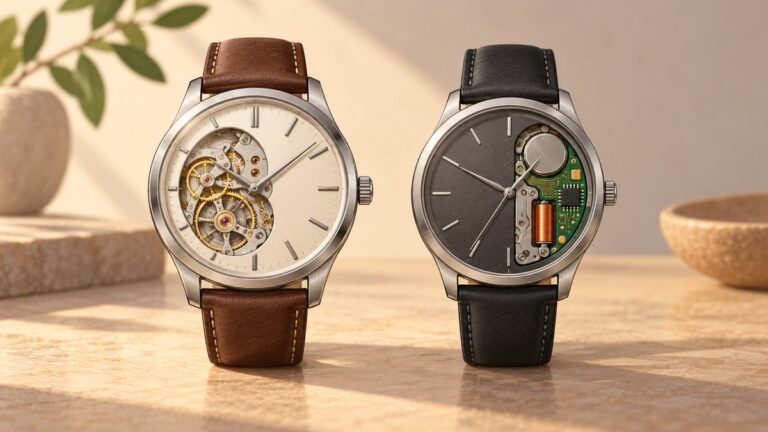
Short answer: A conventional mechanical watch movement is built around a mainspring, barrel, gear train, escapement, balance and hairspring, winding system, motion works, and a supporting framework of plates, bridges, jewels, screws, and bearings. An automatic watch adds a rotor and winding train; a date, chronograph, GMT, moon-phase, or other complication adds its own wheels, levers, springs, cams, and indicators.
There is no single parts list that applies to every watch. A simple hand-wound caliber may contain only the basic timekeeping mechanism, while an automatic chronograph or calendar movement can contain hundreds of additional components. The guide below maps the parts most commonly encountered and explains how they work together.
First, what counts as a watch movement?
The movement is the mechanism that powers, regulates, and displays the time. Caliber is often used interchangeably with movement in general conversation, although it more commonly identifies a particular movement design or reference. A mechanical movement may be manually wound or self-winding, also called automatic; both operate without a battery. Quartz watches use a battery and electronic regulation instead. Hamilton’s movement guide provides the same broad distinction between mechanical and quartz designs.
The crown, stem, dial, and hands sit at the boundary between the movement and the rest of the watch. The crown is outside the case, while the stem and the winding and setting mechanism are part of the movement assembly. The dial and hands are display components driven by the movement, but they are not usually counted among its internal mechanism.
#1 Best Overall
- I was upset when my watch’s band holder broke because I wasn't using my sport watch for long time.Sometimes i didn't want to buy whole new watch band,This kit watch band keeper is a great replacement
- We provide multiple sizes watch strap holder if you aren't sure what size you need. You will receive Six different sizes sturdy, black watch band loops with internal dimensions of 16mm/18mm/20mm/22mm/24mm/26mm
- Are you worried strap retaining rings comes out of the band on occasion ?--Our Bands Keeper Fastener Rings design is Anti-slip. Rubber stop was easy to install. They stretch over existing clasps .Prevent loosening and constraining extra length. Not easy to fall off
- Our replacement watch band comes in a sturdy, clear storage box that opens easily and closes securely.You no longer have to worry about losing the watch band strap loop
- The strap retainer rings is flexible and strong,making it easy to attach to the watch wristband and fits most watches. Whether it's diving or sports,Black is not only stylish,but also works well with various colors of straps
The basic mechanical movement at a glance
| System | Main parts | What it does | Usually found in |
|---|---|---|---|
| Framework | Main plate, bridges, cock, screws, pins, jewels | Holds every component in precise alignment | Mechanical movements |
| Power source | Mainspring, barrel, arbor, ratchet wheel, click | Stores and releases mechanical energy | Mechanical movements |
| Winding and setting | Crown, stem, winding pinion, crown wheel, sliding pinion, yoke | Winds the spring and selects hand-setting or calendar functions | Mechanical movements |
| Automatic winding | Rotor, rotor bearing, reduction wheel, reversing wheels | Uses wrist motion to wind the mainspring | Automatic mechanical movements |
| Going train | Center, third, fourth, and escape wheels | Transmits power and increases rotational speed | Mechanical movements |
| Escapement | Escape wheel, pallet fork, pallet stones, roller jewel | Meters the release of power and supplies impulses | Conventional mechanical movements |
| Regulating organ | Balance wheel, hairspring, balance staff, regulator | Sets the rate at which the watch runs | Conventional mechanical movements |
| Motion works | Cannon pinion, minute wheel, hour wheel | Turns the center-wheel rotation into hour and minute display | Watches with analog hands |
| Calendar or complication works | Date ring, jumpers, cams, clutches, extra wheels and levers | Provides functions beyond basic timekeeping | Only when fitted |
The power path is the easiest way to understand the whole mechanism: mainspring → barrel → gear train → escapement → balance and hairspring → hands. The supporting parts keep that chain working with extremely small clearances.
1. Structural parts: the movement’s framework
Main plate
The main plate is the foundation of the movement. It is the large metal plate on which the wheels, jewels, posts, screws, dial-side mechanisms, and bridges are mounted. It contains the bearing locations and holes that establish the positions of the major arbors.
The main plate is not simply a base. Its dimensions determine the distances between wheel centers, the height of the bridges, and the vertical alignment of the train. A small error in a bearing location can create excess friction, poor meshing, or an escapement that will not run correctly.
Bridges and cocks
A bridge is a removable supporting plate fixed to the main plate, usually with screws and locating pins. Common examples include the:
Recommended Free Tools
- Barrel bridge, which supports the barrel and its arbor.
- Train-wheel bridge, which supports some or all of the going-train wheels.
- Pallet bridge, which supports the pallet fork.
- Balance bridge, which supports the upper balance-staff pivot and often carries the regulator or stud support.
A cock performs a similar supporting function but is traditionally narrower or supported at one end. The distinction is partly historical and varies by construction. Some calibers use a balance cock, others a balance bridge, and some use a cantilevered or flying arrangement. Official ETA movement documentation lists the main plate, train-wheel bridge, barrel bridge, pallet bridge, and balance bridge as separate components.
Screws, pins, posts, and spacers
Screws secure bridges and other parts. Locating pins ensure that a bridge returns to exactly the same position after removal. Posts establish height or provide attachment points, while spacers and washers control vertical or lateral clearance.
These parts can look interchangeable but generally are not. Thread size, head shape, length, shoulder geometry, and position all matter. Substituting a visually similar screw can damage a thread, obstruct a wheel, or leave a bridge at the wrong height.
Jewels and jewel bearings
Most modern mechanical movements use synthetic ruby or another hard jewel at high-friction bearing points. A jewel provides a smooth, wear-resistant bearing for a wheel pivot and is often paired with a cap jewel that controls endshake or retains lubricant.
Windows Errors? Fix Them Before They Spread
Repair common Windows errors and clear accumulated junk for a smoother, more stable PC - no reinstall needed.Free scan · no reinstallOutdated Drivers Are Slowing You Down
One free scan finds every outdated or missing driver and matches the right update for your exact hardware.Free scan · exact hardware matchJewels are also functional parts of the escapement. The entry and exit pallet stones, and the roller jewel that delivers impulse to the pallet fork, are normally synthetic ruby. Consequently, a jewel count is not a count of decorative stones. It refers to functional bearing and escapement jewels, although counting conventions differ between movement designs. A higher number is not automatically a quality ranking.
Shock protection
The balance staff has especially delicate pivots, so the balance bearings commonly include a shock-absorber system. The system allows a pivot jewel or cap jewel to move slightly during an impact and then return to position, reducing the likelihood that the staff pivot will break. Seiko describes its Diashock system as a bearing structure used, for example, at the balance-wheel pivot to improve resistance to shock and vibration.
2. Power source: the mainspring and barrel
Mainspring
The mainspring is a long, flat coil of spring steel or a specialized alloy. It stores energy when wound and releases that energy as it attempts to return to its relaxed shape. In a hand-wound watch, the crown supplies the winding force. In an automatic watch, the rotor and automatic winding train do it.
The spring’s torque changes as it unwinds. It is generally strongest near full wind and weaker near the end of its power reserve, although the exact behavior depends on the spring, barrel, lubrication, and movement design. Seiko notes that the driving force differs between a fully wound and nearly unwound state, which is one reason a watch’s rate can vary as the mainspring state changes.
What’s actually slowing this PC down?
Pick the symptom - the matching free tool is one click away.
Barrel, arbor, and cover
The barrel is a drum that contains the mainspring. The spring’s inner end attaches to the barrel arbor; its outer end normally engages the inside wall of the barrel. The toothed rim around the barrel transmits the spring’s force to the first wheel of the going train.
The barrel cover retains the spring assembly. Some watches use one barrel, while others use multiple barrels in series or parallel to increase running time, alter torque delivery, or support a specialized constant-force system. The exact barrel arrangement is caliber-specific.
Ratchet wheel, click, and click spring
The ratchet wheel receives winding torque through the winding train and turns the barrel arbor or winding shaft. The click engages the ratchet teeth and prevents the wheel from rotating backward when the crown is released. A click spring keeps the click pressed against the ratchet.
Rank #2

- 【Quick Installation】The quick-release strap has a quick-release function, the quick-release spring bar allows you to change the watch strap in seconds without tools.
- 【High-quality material】: The watch strap is made of high-strength and environmentally friendly silicone rubber with a black matte stainless steel buckle. Simple fashion and durable.
- 【Soft and skin-friendly】: The watch accessory watch straps have no sharp edges, feel soft, are light, flexible to use, and very strong. The bracelet can be washed repeatedly without fading.
- 【Wide Application】: The watch strap for men and women is suitable for creating your unique daily style. Ideal for outdoor sports such as running, fitness, hiking, climbing, camping, fishing, golf and more.
- 【Compatibility】: The replacement silicone watch strap is suitable for any watch that uses a standard 22mm spring bar. Please confirm the width of the watch lugs before purchasing. Just choose the strap with the appropriate width; it will fit your watch.
In practical terms, these parts let the crown wind the mainspring without allowing the spring to unwind through the crown. ETA’s parts documentation identifies the barrel, crown wheel, click, click spring, and ratchet wheel as distinct components.
3. Winding and setting works
Crown and winding stem
The crown is the user-operated control on the case. The winding stem is the small shaft that connects it to the movement. Turning the crown in its normal position rotates the winding pinion and winding train. Pulling the crown outward moves the stem axially and selects other functions, such as hand-setting or date correction, depending on the caliber.
A screw-down crown belongs primarily to the case and water-resistance system. It does not change the basic internal winding architecture, although the stem and crown must be matched to the case and movement.
Winding pinion and crown wheel
The winding pinion receives the crown-stem rotation. The crown wheel changes the direction of that rotation and transfers it to the ratchet wheel. These parts belong to the manual-winding or keyless works, not to the automatic rotor system. The standard winding parts listed by ETA include the winding stem, winding pinion, crown wheel, ratchet wheel, and click.
Sliding pinion, yoke, setting lever, and springs
The sliding pinion is a movable toothed component that engages different wheels according to the crown position. The yoke moves it. The setting lever controls the stem’s axial positions, while the setting-lever spring or jumper holds the crown in those recognizable detents.
In the winding position, the stem engages the winding train. In the hand-setting position, the sliding pinion and setting wheels transmit crown rotation to the hands. A date position, when present, engages an additional corrector or calendar mechanism. The layout and number of springs vary considerably between calibers.
4. Automatic winding components
Rotor or oscillating weight
An automatic watch adds a weighted rotor, also called an oscillating weight. As the wearer’s wrist moves, the rotor swings around its bearing. That motion is reduced and directed into the winding train, which tensions the mainspring.
Automatic designs include full-size central rotors, micro-rotors integrated into the movement, and peripheral rotors around the edge of the caliber. The rotor’s presence does not by itself reveal whether the movement winds in one direction or both directions.
Rotor bearing
The rotor may turn on a ball bearing, jewel bearing, or another pivot arrangement. The bearing must carry the rotor’s weight, tolerate repeated motion, and keep friction low. A noisy or loose rotor can indicate a bearing or screw problem, but diagnosis requires inspection rather than guesswork because rotor noise varies by design.
Reduction wheel and reversing system
The rotor turns relatively slowly and irregularly, so an automatic movement uses a reduction wheel or equivalent gearing to convert that motion into useful winding torque. Because the rotor can turn in either direction, the caliber also needs a reversing mechanism, unless it is intentionally unidirectional.
Some systems use two reversing wheels; others use a pawl-based architecture. Seiko’s Magic Lever, for example, uses two differently shaped spring pawls to turn rotor motion in either direction into one-way motion of a transmission wheel. ETA documentation separately identifies the automatic-device framework, reversing wheels, reduction wheel, oscillating weight, and ball bearing.
Once the automatic train winds the mainspring, the remainder of the power path is broadly the same as in a hand-wound mechanical watch: barrel, going train, escapement, regulator, and display.
5. The going train: wheels that carry the power
The going train, also called the gear train, carries energy from the barrel to the escapement. It progressively reduces the available torque while increasing the rotational speed of the wheels. A conventional sequence is the barrel driving the center wheel, then the third wheel, fourth wheel, and escape wheel. The AWCI horological text describes this transmission through the center, third, fourth, and escape wheels toward the balance.
Center wheel and center pinion
The center wheel is usually driven directly or indirectly by the barrel. In a conventional twelve-hour display, it generally completes one revolution per hour. Its arbor often carries or connects to the cannon pinion, which ultimately drives the minute hand.
The center wheel may be located at the center of the movement, but not every movement uses the same center-seconds arrangement. In some designs, the seconds hand is placed centrally through a specially arranged fourth-wheel arbor; in others, seconds are displayed on a subsidiary dial.
Rank #3

- Premium Materials: Constructed from high-grade genuine leather paired with soft suede lining, offering remarkable flexibility and comfort throughout the day. The stainless steel buckle is polished for a sleek look and built to endure regular use.
- Multiple Sizing Choices: Available in 12mm,14mm,16mm,18mm,20mm and 22mm. Measure your watch lug width precisely to pick the right size of strap.
- Classic Design:Upgrade your watch's appearance with the genuine leather strap. Its timeless style elevates your overall look, making it appropriate for various occasions, whether you're going about your daily routine or attending a formal event.
- Easy Swap: Equipped with quick-release mechanism, you can effortlessly swap out your watch strap in seconds—no tools required. Refresh your watch's look with ease using our stylish replacement band.
- Versatile Compatibility: This strap is the perfect match for both casual and formal watches. Seamlessly switch between everyday looks and special event styles, creating a fresh appearance for every moment.
Third wheel
The third wheel is an intermediate wheel between the center wheel and fourth wheel. It transfers power and helps establish the correct speed and torque relationship between them. It is normally hidden beneath the bridges and is not visible to the wearer.
Fourth wheel and seconds pinion
The fourth wheel commonly rotates once per minute in a conventional movement and carries the seconds hand, either directly or through a seconds pinion. In a center-seconds watch, its arbor is routed through the center of the movement. In a small-seconds watch, it is positioned to drive a subsidiary seconds display.
Free tools Windows power users keep installed
One-click scans. No signup required.
Escape wheel
The escape wheel is the last wheel in the ordinary going train. Its specially shaped teeth interact with the pallet fork. Instead of allowing the train to run continuously, the escape wheel releases a controlled amount of energy and provides an impulse to the escapement.
Wheel-and-pinion assemblies may be made as one piece or assembled from separate parts. The small ends of their arbors are pivots, which run in jewel or metal bearings. Polished pivots, correct endshake, correct sideshake, and clean, properly lubricated bearings are essential to efficient power transmission.
6. The escapement
The escapement is the interface between the fast-moving going train and the oscillating balance. It performs two jobs: it meters the release of power so the train cannot run down freely, and it gives the balance a regular impulse to keep it oscillating. In a conventional Swiss lever movement, the principal parts are the escape wheel, pallet fork, pallet stones, roller table, impulse pin, safety roller, and guard pin.
Pallet fork or lever
The pallet fork, also called the lever, is the rocking component between the escape wheel and balance. It alternately locks and releases the escape-wheel teeth. It also receives energy from the escape wheel and passes an impulse to the balance through the roller jewel.
Do these 3 things before closing this tab:
1Scan for outdated or missing drivers - takes under a minute2Clear out junk files and repair common Windows errors3Fix the driver behind crashes, sound loss and screen glitchesEntry and exit pallet stones
Two jewel inserts are mounted in the fork: the entry pallet and exit pallet. Their locking and impulse faces engage the escape-wheel teeth. The angle, height, and position of these stones are critical. They are typically synthetic ruby and may be fixed in the fork with shellac or another appropriate adhesive in traditional constructions.
Escape-wheel teeth
Each escape-wheel tooth must lock against a pallet stone, release at the correct point, slide across the impulse surface, and deliver energy without excessive friction. Watchmakers evaluate conditions such as lock, drop, draw, endshake, and lubrication when checking the escapement. AWCI’s escapement material explains why these adjustments and careful handling matter to performance.
Roller table, impulse pin, safety roller, and guard pin
The balance staff carries a roller table, sometimes called an impulse roller, with an impulse pin or roller jewel. The pin enters the pallet fork’s notch and transfers the impulse between the balance and fork.
The safety roller and guard pin help prevent an accidental or unsafe unlocking of the escapement if the balance is displaced by shock or abnormal motion. AWCI’s labeled escapement reference identifies the safety roller, roller jewel, impulse roller, guard pin, pallet fork, pallet arbor, and pallet stones as related components.
Quick wins for a faster PC:
Clear out junk files and repair common Windows errorsFree Scan →Fix the driver behind crashes, sound loss and screen glitchesFind Drivers →Repair Windows errors before they cause bigger problemsFix Now →7. The regulating organ
Balance wheel
The balance wheel oscillates back and forth rather than rotating continuously. Together with the hairspring, it establishes the timekeeping period. Common constructions include a simple ring balance, a variable-inertia balance, and a free-sprung balance adjusted with screws or inertia blocks on the rim.
Hairspring or balance spring
The hairspring, also called the balance spring, is the extremely fine spring attached to the balance. It provides the restoring force that brings the balance back toward its neutral position after each swing.
Hairsprings may be made from specialized alloys or silicon, depending on the caliber. Seiko identifies its Spron alloy as being used for mainsprings and hairsprings, with resistance to tearing, corrosion, and wear. Material choice affects magnetic resistance, temperature behavior, durability, and manufacturing complexity, but it does not by itself tell you the complete quality of a movement.
Balance staff
The balance staff is the tiny arbor carrying the balance wheel, roller table, and associated components. Its pivots are among the most fragile parts in the watch. That is why the balance bearings commonly receive shock protection and why a watch should not be adjusted or disassembled without appropriate tools and training.
Stud, collet, regulator, and index
The inner end of the hairspring attaches to a collet mounted on the balance staff. Its outer end is secured by a stud or stud holder. A traditional regulator or index changes the effective active length of the hairspring by moving regulator pins. This changes the rate.
Rank #4

- XBDSW Natural high-quality resin strap, waterproof and sweatproof, durable and comfortable to wear
- Compatible with AE-1000W AE-1300 AE-1200 SGW-300H SGW-400H SGW-500H AQ-S810 AQ-S810W AQ-S800W W-S200H W-800H W-216H W-735H F-108WH W-215 AEQ-110 model watch band(the interface size is 18mm (0.7")
- Please make sure your watch model is listed in the description before purchasing, if not, use a metric ruler to measure the lug width or the width of the current strap connection (18mm (0.7")).To save your precious time and effort, and avoid the hassle of returns and exchanges, choose the correct size for your watch. It is very important to be accurate to the millimeter
- XBDSW High quality stainless steel buckle, durable
- If you have any technical problems or quality problems, please contact us XBHSW, we will be happy to resend replacement straps or accessories, please buy with confidence
A free-sprung balance generally has no conventional movable regulator. Instead, the watchmaker changes the balance’s effective inertia using screws or weights. This is one reason the visible regulator arrangement differs from caliber to caliber.
Balance bridge or balance cock
The balance bridge or cock supports the upper balance pivot and often carries the shock setting, stud support, and regulator. The exact form is a major visual difference between movement architectures, but the function remains the same: hold the balance staff in precise alignment while allowing the balance to oscillate freely.
8. Motion works: how the hands display time
The going train is concerned with transmitting power and controlling speed. The motion works are the dial-side gearing that turns those rotations into the familiar hour and minute display.
The Tool Desk
Outbyte PC Repair FREERepair Windows errors before they cause bigger problemsFix Now →Outbyte Driver Updater FREEScan for outdated or missing drivers - takes under a minuteDriver Scan →Cannon pinion
The cannon pinion is mounted on the center arbor and normally carries the minute hand. It is held with a controlled friction fit, allowing the hands to be moved during setting without forcing the winding train directly.
Minute wheel and hour wheel
The minute wheel transfers rotation from the cannon pinion to the hour wheel. The hour wheel rotates once every twelve hours in a standard twelve-hour display and carries the hour hand. ETA’s movement documentation lists the cannon pinion, minute wheel, and hour wheel as separate motion-work components.
Setting wheel and intermediate setting wheels
When the crown is pulled to the hand-setting position, the sliding pinion engages the setting wheel, often through one or more intermediate setting wheels. This train turns the cannon pinion and hour wheel so the hands can be set.
Hand-setting friction must be carefully balanced. If it is too loose, the hands can slip or fail to hold position. If it is too tight, setting the time can place unnecessary load on delicate components.
Free tools Windows power users keep installed
One-click scans. No signup required.
9. Calendar and display components
A basic time-only movement does not need a calendar. A date display commonly adds a date indicator or date ring, date-driving wheel, intermediate date wheel, date jumper, jumper spring, and date corrector. The driving parts advance the indicator, while the jumper holds it in position and helps produce the characteristic date change.
Depending on the design, the date may change gradually or jump quickly. The exact mechanism is caliber-specific. ETA’s parts documentation identifies the date indicator, date-indicator driving wheel, intermediate date wheel, date jumper, and date corrector.
Other calendar and display mechanisms
- Day display: a day wheel or day disc, day star, jumper, and driving components.
- GMT or dual time: an additional hour wheel, friction coupling, corrector, and 24-hour indicator.
- Power reserve: differential gears, a rack or cam, a spring, and a reserve indicator.
- Moon phase: a moon disc, star wheel, jumper, and reduction gearing.
- Small seconds: a separate fourth-wheel or subsidiary-seconds arrangement.
These parts should be treated as complication-specific. They are not present in every mechanical movement, and even two watches with the same advertised function may use different wheels, springs, cams, and correctors.
10. Chronograph components
A mechanical chronograph adds a stopwatch mechanism to the ordinary timekeeping train. It must start, stop, and reset one or more timing indications without disturbing the basic time display.
Common chronograph components include a chronograph center wheel, coupling mechanism, operating lever, column wheel or cam, heart pieces, reset hammers, brake, recorder wheels, and clutch components. The exact list depends on the architecture:
- A column-wheel chronograph uses a stepped column wheel whose columns coordinate the operating levers.
- A cam-operated chronograph uses shaped cams to perform the switching functions.
- A horizontal-coupling design engages wheels laterally.
- A vertical-clutch design engages components along the vertical axis and uses a different coupling arrangement.
A column wheel belongs to the chronograph control system, not to an ordinary time-only movement. Seiko’s technical explanation of a Spring Drive chronograph, for example, identifies a column wheel as part of that chronograph’s switching mechanism.
Independent reader supportYour contribution helps us test, update, and keep practical guides available for everyone.11. Lubrication, clearances, and adjustment
Lubricants
Oils and greases are not usually counted as movement parts, but they are essential to operation. Different lubricants are used for pivots, jewels, gear teeth, sliding surfaces, and escapement interfaces. The amount matters as much as the type: too much lubricant can migrate or increase drag, while too little can accelerate wear.
Lubrication is not a substitute for cleaning. Oil placed on contaminated or worn surfaces can carry debris through the bearing and make the problem worse.
What’s actually slowing this PC down?
Pick the symptom - the matching free tool is one click away.
Best Value

- PACKAGE CONTENTS - You will receive 6 black strap retaining rings with internal dimensions of 18mm/20mm/22mm. Black is not only stylish,but also works well with various colors of straps.
- PREMIUM MATERIAL - The strap rings is made of silicone,a soft rubber-like silicone. It is soft,lightweight,comfortable and withstands friction well. They are durable and can be used for a long time.
- HOW TO CHOOSE SIZE - To better match your watch,measure the width of your strap in millimeters with a ruler and add 1mm. Follow this method to order the perfect size. Suitable for most sports watches.
- EASY TO USE - The strap retainer rings is flexible and strong,making it easy to attach to the watch wristband. Simply stretch/slide it onto the clasp. It only takes a second to change.
- WIDE COMPATIBILITY - The strap retainer rings replacement accessory fits most wristbands or smartwatches. The high quality rubber strap ring holds the end of the strap in place and the classic black strap gives your watch a stylish look.
Endshake and sideshake
Endshake is the controlled vertical movement of an arbor between its bearing surfaces. Sideshake is controlled lateral movement. Both must exist in carefully measured amounts. Too little clearance can cause binding as parts expand or shift; too much can allow wheels to move out of alignment.
AWCI notes that escapement endshake must be small but present and depends on the movement’s thickness and manufacturing precision. The same principle applies throughout the train: the correct clearance is a functional specification, not an aesthetic preference.
What watchmakers adjust
Service and regulation may include beat setting, rate regulation, balance amplitude, escapement lock and drop, positional error, poising, hairspring correction, and inspection of pivots and jewels. Accuracy can change with the watch’s position, temperature, mainspring state, arm movement, and magnetism. Seiko specifically warns that these conditions affect the observed daily rate.
These adjustments are not interchangeable. A rate problem may come from regulation, but it can also result from low amplitude, dried lubricant, a damaged pivot, magnetism, a bent hairspring, incorrect endshake, or an escapement fault. Adjusting the regulator without diagnosing the cause can make the watch worse.
12. How all the parts work together
Hand-wound mechanical watch
- The wearer turns the crown.
- The crown rotates the stem and winding pinion.
- The crown wheel turns the ratchet wheel, while the click and click spring prevent reverse rotation.
- The ratchet winds the mainspring around the barrel arbor.
- As the mainspring unwinds, the barrel turns the center, third, fourth, and escape wheels.
- The escapement releases the train in controlled increments rather than allowing it to spin freely.
- The escape wheel gives impulses to the pallet fork, which interacts with the balance through the roller jewel.
- The balance and hairspring oscillate at a controlled rate.
- The motion works convert the center-wheel rotation into minute- and hour-hand movement.
- The fourth wheel commonly drives the seconds hand.
Automatic mechanical watch
In an automatic watch, wrist motion first turns the rotor. The automatic winding train, including the reduction and reversing components, transfers that motion to the mainspring. Once energy is stored in the barrel, the going train, escapement, balance, and motion works operate on essentially the same principles as in a hand-wound movement.
13. Quartz movements use a different parts map
A quartz movement still needs mechanical gears to move analog hands, but its power source and regulator are different. Its core components generally include a battery or other electrical source, quartz crystal oscillator, integrated circuit, coil, stepping motor, and hand-driving gear train.
The quartz crystal oscillates at a stable frequency. The integrated circuit divides and controls that signal, then sends electrical pulses to the coil and stepping motor. The motor advances the gear train in precise increments. There is therefore no conventional mainspring, escape wheel, pallet fork, balance wheel, or hairspring regulating the timekeeping.
Quartz watches can contain calendar and chronograph modules, but those modules may be electronically controlled, mechanically controlled, or a combination of both. The presence of gears at the hands does not make a quartz movement mechanical in the watchmaking sense.
Windows Errors? Fix Them Before They Spread
Repair common Windows errors and clear accumulated junk for a smoother, more stable PC - no reinstall needed.Free scan · no reinstallOutdated Drivers Are Slowing You Down
One free scan finds every outdated or missing driver and matches the right update for your exact hardware.Free scan · exact hardware match14. Spring Drive is a hybrid architecture
Spring Drive uses a mainspring as its sole motive power and sends that energy through a mechanical gear train, but it does not use a conventional escapement and balance-and-hairspring regulator.
Instead, the gear train drives a glide wheel, which acts as a generator. A quartz oscillator and integrated circuit monitor the system, while electromagnetic braking regulates the glide wheel’s speed. Seiko describes this as its Tri-synchro regulator, which coordinates mechanical, electrical, and electromagnetic energy.
A Spring Drive movement can therefore contain familiar mechanical parts such as a mainspring, barrel, gear train, rotor, and automatic winding system, while omitting the ordinary escape wheel, pallet fork, balance, and hairspring regulator. Its replacement parts include the glide wheel, generator, quartz oscillator, integrated circuit, and electromagnetic regulator.
15. Terminology that often causes confusion
- Movement and caliber
- Often interchangeable in general writing. Caliber usually identifies a specific movement design or reference.
- Balance and balance wheel
- The balance assembly can include the balance wheel, staff, roller, and related parts. Everyday descriptions often use balance to mean the whole regulating assembly.
- Pallet and pallet fork
- The pallet fork or lever is the complete rocking component. The pallet stones are the two jewels mounted on it.
- Barrel and main wheel
- Older or regional terminology may call the barrel or its toothed portion the main wheel. Modern descriptions generally distinguish the barrel from the center wheel.
- Second wheel, third wheel, and fourth wheel
- Translations and manufacturer catalogs do not always use these names consistently. Some ETA documentation uses second wheel for a component another source may call the fourth wheel or seconds wheel. When precision matters, identify the caliber and consult its technical diagram.
- Jewels
- Jewels are functional bearings and escapement parts, not merely decoration. The count is movement-specific and is not a direct quality score.
- Automatic
- Automatic means self-winding. It does not necessarily mean more accurate, better finished, or more durable.
- Complication
- In general, a complication is a function beyond hours, minutes, and seconds. Industry usage varies over whether a simple date should be counted as a complication.
16. If you want to inspect or learn these parts
A labeled movement photograph is useful for learning the layout, but the exact arrangement must be matched to the caliber. A simple three-hand movement, a hand-wound dress caliber, an automatic diver movement, and a chronograph can place their bridges, wheels, and winding systems in very different locations.
The Tool Desk
Outbyte PC Repair FREERepair Windows errors before they cause bigger problemsFix Now →Outbyte Driver Updater FREEScan for outdated or missing drivers - takes under a minuteDriver Scan →For study, a watch repair manual can help with terminology, exploded views, and the order in which components interact. Reading is safer than beginning with an expensive watch: the balance staff, hairspring, pallet stones, and tiny screws are easy to damage.
A watchmaker’s loupe and precision watch-repair tool kit can assist with inspection, but tools do not make unsupervised adjustment safe. Opening a case can compromise water resistance, and turning a regulator or removing a bridge without understanding endshake and spring tension can create new faults.
If practical work is the goal, a supervised watchmaking course is a better next step than learning by trial and error. Before buying any caliber-specific watch movement replacement parts, identify the exact caliber, variant, and revision. Mainsprings, stems, wheels, jewels, and balance assemblies are not universal, even when two parts look similar.
Parts checklist by movement type
| Movement type | Core parts you should expect | Parts you should not assume are present |
|---|---|---|
| Hand-wound mechanical | Main plate, bridges, jewels, mainspring, barrel, winding works, going train, escapement, balance and hairspring, motion works | Rotor, reversing wheels, date works, chronograph works |
| Automatic mechanical | All of the above basic mechanical systems plus rotor, rotor bearing, reduction and reversing train | Calendar or chronograph parts unless the watch has those functions |
| Mechanical calendar or GMT | Basic mechanical movement plus date, day, 24-hour, or related wheels, jumpers, correctors, and springs | Chronograph parts unless separately fitted |
| Mechanical chronograph | Basic movement plus column wheel or cam, clutch, operating levers, recorder wheels, hammers, and heart pieces | Automatic rotor unless the chronograph is self-winding |
| Quartz analog | Battery, quartz crystal, integrated circuit, coil, stepping motor, and hand-driving gear train | Mechanical mainspring, balance, hairspring, pallet fork, conventional escapement |
| Spring Drive | Mainspring, barrel, gear train, glide wheel, generator, quartz oscillator, integrated circuit, and electromagnetic regulator | Conventional escape wheel, pallet fork, balance, and hairspring regulator |
Frequently Asked Questions
Are all the parts listed here found in every watch movement?
No. The list is a map of parts commonly found across conventional mechanical watches and their complications. A basic hand-wound movement lacks automatic-winding and chronograph parts, while a quartz or Spring Drive movement uses a different regulating architecture.
Do these 3 things before closing this tab:
1Repair Windows errors before they cause bigger problems2Fix the driver behind crashes, sound loss and screen glitches3Clear out junk files and repair common Windows errorsDoes a watch with more jewels have a better movement?
Not necessarily. Jewels reduce friction at selected bearings and also serve in the escapement. Jewel counts vary with the design and display functions, so they should not be treated as a simple quality ranking.
Is the balance wheel the same thing as the escapement?
No. The balance wheel and hairspring form the regulating organ. The escapement includes the escape wheel, pallet fork, pallet stones, roller jewel, and associated safety components. They work together but are separate systems.
Can I use a generic replacement mainspring, stem, or wheel?
Usually not safely. Movement parts are caliber-specific, and even parts that look alike can differ in length, diameter, arbor shape, tooth count, or spring torque. Identify the exact caliber and consult its technical documentation or a qualified watchmaker before ordering.
The Bottom Line
The essential mechanical chain is simple to remember: the mainspring stores energy, the barrel releases it into the going train, the escapement meters it, the balance and hairspring regulate it, and the motion works turn it into the time shown by the hands. Plates, bridges, jewels, pivots, screws, springs, and carefully measured clearances make that chain possible. Automatic and complicated watches add mechanisms around it, while quartz and Spring Drive replace the conventional mechanical regulator with different technologies.
Quick Recap
Product prices and availability are accurate as of the date/time indicated and are subject to change. Any price and availability information displayed on Amazon at the time of purchase will apply.