If you want a watch with the clearest documented connection to human spaceflight, start with the OMEGA Speedmaster Moonwatch Professional. OMEGA says NASA declared the Speedmaster “Flight Qualified for all Manned Space Missions” on March 1, 1965. That historical qualification is not proof that every modern Speedmaster variant is qualified. The First Omega in Space is a heritage tribute to a watch worn on a 1962 mission, while the Speedmaster Pilot and Dark Side of the Moon models offer different design and functional priorities.
Best space watches at a glance
| Watch | Why consider it | Important distinction |
|---|---|---|
| OMEGA Speedmaster Moonwatch Professional | Strongest fit for buyers prioritizing the Speedmaster’s documented NASA qualification history. | OMEGA’s account concerns the Speedmaster qualification in 1965; do not assume every current variant has the same status. OMEGA’s account of the qualification |
| OMEGA First Omega in Space | Smaller-case modern tribute with a specific link to Walter Schirra’s personal CK 2998. | The current reissue is not the actual watch worn on Sigma 7. OMEGA’s 2024 announcement |
| OMEGA Speedmaster Pilot | Pilot-focused chronograph with 100 m water resistance and Calibre 9900. | The cited product announcement does not say it is NASA-qualified. OMEGA’s Speedmaster Pilot announcement |
| OMEGA Dark Side / Grey Side of the Moon | Contemporary ceramic construction and lunar-inspired styling across seven updated models announced in 2025. | The cited announcement does not establish flight qualification for these models. OMEGA’s 2025 collection announcement |
1. OMEGA Speedmaster Moonwatch Professional: best for NASA qualification history
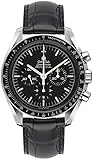
For a buyer who puts mission qualification ahead of novelty or materials, the Moonwatch is the clearest starting point. OMEGA’s retrospective dates NASA’s declaration that the Speedmaster was “Flight Qualified for all Manned Space Missions” to March 1, 1965. This is OMEGA’s account of NASA’s decision, rather than a newly verified NASA statement. Read OMEGA’s qualification history.
![[Omega] OMEGA Watch [2021 Omega 310.30.42.50.01.002 Speedmaster Moon Watch Professional Hand Winding See Through Back Chronograph Black 5 ATM Waterproof [Parallel Import], Black, Bracelet Type](https://m.media-amazon.com/images/I/41w4a0vIS+S._SL160_.jpg)
Keep the historical credential precise: it supports the Speedmaster’s place in the qualification story, not a blanket claim that every later Speedmaster reference was individually tested or qualified. If the specific reference’s current status matters, verify it with the manufacturer rather than relying on the family name alone.
2. OMEGA First Omega in Space: best for the early Speedmaster story in a modern watch
The First Omega in Space draws on the CK 2998, which OMEGA says Walter “Wally” Schirra bought personally and wore on the Mercury-Atlas 8 Sigma 7 mission on October 3, 1962. OMEGA describes the CK 2998 as released in 1959. See OMEGA’s model history and reissue details.
Quick wins for a faster PC:
Repair Windows errors before they cause bigger problemsFix Now →Fix the driver behind crashes, sound loss and screen glitchesFind Drivers →#1 Best Overall

- First Man On The Moon Watch Model 31130423001005
- Famous Manual-winding Chronograph Movement that was Worn on the Moon
- Omega Mechanical Caliber 1861
- Black Dial, 42mm Stainless Steel Case and Stainless Steel Bracelet
- Presentation Box Includes NATO Strap, Velcro Strap and Strap Changing Tools
The modern First Omega in Space announced in 2024 has a 39.70 mm case and Calibre 3861. It is a contemporary tribute, not Schirra’s actual flown watch. Its smaller stated diameter makes it the most compact of the options here for which OMEGA published a case measurement; try it on if fit is decisive, since diameter alone does not describe thickness, lug reach, or how a watch wears on your wrist.
3. OMEGA Speedmaster Pilot: best for pilot styling and added water resistance
OMEGA describes the Speedmaster Pilot as a 40.85 mm chronograph powered by Calibre 9900, with 100 m / 330 ft water resistance. The announcement also describes an included NATO strap option. Check OMEGA’s Pilot announcement.
Rank #2

- Model 310.32.42.50.01.001
Those specifications make it a distinct choice for someone drawn to aviation cues and a more water-resistant chronograph. The cited announcement does not call it NASA-qualified, so its pilot identity should not be treated as proof of spaceflight testing or mission use.
4. OMEGA Dark Side / Grey Side of the Moon: best for ceramic lunar-themed design
In 2025, OMEGA announced seven updated Dark Side and Grey Side models, emphasizing ceramic construction, slimmer profiles, advanced calibres, and rubber or nylon strap options. The collection has a 44.25 mm presence, making it the largest stated case size among the measured choices in this guide. See the 2025 collection announcement.
This line suits buyers who want contemporary materials and a strong lunar design rather than the most direct qualification credential. The announcement does not establish that these models are NASA-qualified. Because the release covers seven models with different calibres and constructions, check the individual reference for its exact movement, thickness, materials, and strap before choosing.
What “space watch” means—and what it does not
A space-themed dial, a pilot watch, a model inspired by lunar exploration, and a watch with a documented qualification or flight connection are not equivalent credentials. OMEGA’s history timeline says the Speedmaster went into space with Schirra in 1962, was worn by Edward White on the first American spacewalk, and was used by Apollo 13 astronauts to time an engine burn during their return. These are claims from the brand’s own history account; readers seeking independent primary documentation for individual mission details should consult NASA records. OMEGA’s Speedmaster timeline.
Rank #4
For selection, separate the kinds of connection:
- Qualification history: the Speedmaster qualification announced by NASA in 1965, as recounted by OMEGA.
- Personal flight history: Schirra’s CK 2998 on Sigma 7 in 1962, according to OMEGA; the present First Omega in Space is a reissue, not that watch.
- Design theme or adjacent use: pilot styling and lunar-inspired ceramic models can be appealing without establishing a NASA qualification.
How to choose between them
Start with the credential you actually want
If the defining requirement is the Speedmaster’s NASA qualification history, choose the Moonwatch family and confirm the exact reference. If you want the earlier Schirra connection in a modern reissue, consider the First Omega in Space. Pick the Pilot for aviation-oriented design, or the Dark Side / Grey Side for ceramic construction and a more contemporary lunar theme.
Compare fit using more than diameter
The published measurements here are 39.70 mm for the First Omega in Space, 40.85 mm for the Speedmaster Pilot, and 44.25 mm presence for the Dark Side / Grey Side update. These figures come from separate OMEGA announcements, and “presence” is not necessarily a directly comparable case-diameter specification. OMEGA’s published announcements do not provide comparable thickness or lug-to-lug measurements for all four choices, so wrist fit cannot be settled from these numbers alone.
What’s actually slowing this PC down?
Pick the symptom - the matching free tool is one click away.
Best Value

- Model 310.30.42.50.01.002
Check functions and ownership details by reference
Movement, water resistance, crystal, bezel material, strap or bracelet, servicing, and price can differ across models and regional offerings. The cited announcements establish Calibre 3861 for the First Omega in Space and Calibre 9900 plus 100 m / 330 ft water resistance for the Pilot; they do not establish a complete, directly comparable specification set for every option. Check the specific model and your market with OMEGA or an authorized seller before buying. Current prices and availability are not established by the cited material.
Quick Recap
Product prices and availability are accurate as of the date/time indicated and are subject to change. Any price and availability information displayed on Amazon at the time of purchase will apply.