Christiaan Huygens advanced the pendulum clock and tried to adapt mechanical clocks for navigation, but neither his pendulum clocks nor their tendency to synchronize solved the longitude problem at sea. Longitude could be calculated by comparing local time with time at a known reference meridian; the challenge was carrying a clock that kept that reference time through a ship’s motion and changing conditions.
Why longitude depended on keeping time
Longitude is a position east or west. A navigator could determine it by comparing local solar time with the time at a known reference location: the difference in time corresponds to the difference in longitude. That made a portable, dependable reference clock highly valuable. The clock had to preserve its rate while exposed to humidity and a vessel that pitched and tossed—conditions National Museums Scotland identifies as particularly difficult for pendulum mechanisms.
How Huygens developed clocks for land and sea
The pendulum clock
Huygens completed a pendulum-clock prototype by the end of 1656 and patented his design on June 16, 1657, according to the American Physical Society. The pendulum made clocks substantially more precise than earlier mechanisms, but precision under stable conditions did not guarantee reliable timekeeping aboard a moving ship.
Purpose-built sea clocks
Huygens worked with Alexander Bruce on clocks intended for maritime use. Bruce commissioned clocks from Dutch clockmaker Severyn Oosterwijck; National Museums Scotland describes a clock made in 1662 as part of the first attempt to establish longitude at sea with a purpose-made mechanical timepiece. The effort showed the promise of carrying a reference clock, but the shipboard environment remained the central obstacle.
The Tool Desk
Outbyte PC Repair FREEClear out junk files and repair common Windows errorsFree Scan →Outbyte Driver Updater FREEScan for outdated or missing drivers - takes under a minuteDriver Scan →#1 Best Overall

- Fun & Practical Wooden 3D Puzzles - Wonderful wooden 3D puzzles, which can be the entertainment of the families. And it will become a useful desk clock and beautiful craft when you finish it.
- Easily Assembled Desk Clock Kit - Pieces can be made together suitably, no tools nor glues needed, because of the clever design and exquisite laser cutting technology. Instructions with photos are included.
- Great Gift for Adults & Kids - Model DIY kits, isn’t it a good choice as a gift? Enhance the communication between families, develop intelligence and enjoy the artwork you made.
- High Quality Materials Using - Eco-friendly materials and exquisite cutting technology make sure that it would not hurt you when you’re making. Biomimetic wooden pattern on each pieces.
- Battery Operated - Powered by 1AA battery (not included)
The theory in Horologium Oscillatorium
Published in 1673, Huygens’s Horologium Oscillatorium developed the mathematical and mechanical theory of pendulums. The 1911 Encyclopaedia Britannica account discusses the relationship between pendulum length and oscillation time, the cycloid’s isochronous property, and cycloidal cheeks intended to correct the pendulum’s circular error. These refinements addressed the clock’s motion; they could not prevent a ship’s movement and environmental changes from disturbing its rate.
Why Huygens’s clocks synchronized
In 1665, while ill and confined to his rooms, Huygens observed two pendulum clocks mounted on a shared support settle into the same frequency while swinging in opposite phases. This was not a pair of clocks independently correcting their errors. Their tiny movements shook the support, which transmitted forces from one clock to the other. The clocks became coupled through that shared frame.
Rank #2

- Reproduction of a clock based on an escapement sketched by Leonardo da Vinci
- Assemble in either a wall mounted or standing configuration
- Uses the pendulum's weight as the power source
- Snap together assembly of textured parts
- No batteries, paint, or glue required
A Royal Society study by Bennett and coauthors explains that the effect disappeared when the clocks were separated or their pendulums swung in perpendicular planes. Those observations support the mechanical explanation: the common support enabled the interaction. Huygens’s observation is now understood as an early account of synchronization between coupled oscillators.
Why synchronization did not solve the sea-longitude problem
Huygens hoped that clocks might regulate one another, but synchronization was not a guarantee that either clock would preserve the correct reference time aboard a vessel. The Royal Society account notes that even slight motion could alter a pendulum clock’s rate, and the observation gave reason to doubt pendulum clocks as longitude instruments. National Museums Scotland likewise describes the early marine clocks as falling short of the hoped-for solution.
Rank #3
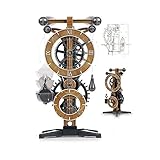
- Renewal Version.Reproduction of a clock based on an escapement sketched by Leonardo da Vinci Assemble in either a wall mounted or standing configuration No batteries, paint, or glue required
The distinction is important: a clock can synchronize with another clock and still be unsuitable for navigation if the coupled system’s rate changes with ship motion. Huygens’s work advanced both mechanical timekeeping and the study of synchronization, while leaving the practical sea-clock problem unsolved.
How clocks compared with astronomical methods
A carried clock and an astronomical observation approached the longitude problem differently. A clock attempted to retain reference time throughout a voyage so a navigator could compare it with local solar time. Astronomical approaches, including later lunar-distance methods, relied instead on observing celestial positions and relating them to time at a reference location.
Rank #4

- RGB Color‑Changing Backlight. Built‑in RGB backlight with multiple lighting modes, soft ambient glow enhances visual effect at night. USB powered for convenient daily use.
- Hinge Style Wooden Frame. Crafted using precision laser cut technology, the clock features a seamless "living hinge" pattern. This wooden structure allows gentle curves and bends, creating a dynamic 3D effect while maintaining durability.
- Silent Quartz Movement. High‑quality silent quartz mechanism, almost no ticking noise, creates quiet and comfortable living environment.
- 12 Inch Ideal Size. Practical diameter, proper dimension for most wall spaces, neither oversized nor too small for home display.
- Stylish Home Wall Decoration. Artistic hollow‑out craft design, fits multiple interior styles, refreshes wall aesthetic for various living spaces.
| Approach | What it depended on | Main practical challenge established by the historical sources |
|---|---|---|
| Carried clock | A dependable timekeeper preserving reference time, compared with local time | Ship movement and environmental conditions could disturb a pendulum clock’s rate. |
| Astronomical observation | Celestial observations and the equipment and skill to make and interpret them | It required observation rather than simply reading a carried clock; the reviewed historical accounts do not establish a numerical comparison of accuracy, cost, or ease. |
Later timekeepers associated with John Harrison became successful for this purpose; the 1771 Encyclopaedia Britannica entry records that an early Harrison timekeeper was tried in May 1736. That later development underscores why Huygens’s pendulum work should be treated as an important attempt, not the resolution of the navigational problem.
Independent reader supportYour contribution helps us test, update, and keep practical guides available for everyone.What Huygens’s legacy means for watch history
Huygens connected three subjects that remain relevant to horology: improving a clock’s regularity, adapting its mechanism to real operating conditions, and understanding how clocks can interact. His pendulum theory and the 1665 synchronization observation were significant advances, but marine navigation demanded more than a precise clock in a stable room. It demanded timekeeping that could withstand the conditions of a voyage.
Quick Recap
Best Value

- MECHANICAL CLOCK PUZZLE:The Pirate Ship Clock Puzzle makes a stunning centerpiece, blending nautical adventure with timeless craftsmanship. Display it on a bookshelf, desk, or mantel and let its intricate details and moving gears spark conversation and capture attention.
- BECOME A PROUD CLOCKSMITH: Build your own mechanical pendulum clock with this DIY kit for adults and teens. Assemble each precision-cut piece, wind it up, and enjoy the mesmerizing movement as time elegantly ticks by.
- EASY SELF-ASSEMBLY: Enjoy a fun, mess-free build with precision-cut wooden puzzle pieces—no tools or glue required. Clear, illustrated instructions and labeled parts guide adults and teens step-by-step for a smooth, enjoyable assembly experience.
- MODEL BUILDING KIT FOR ADULTS: Unleash your creativity with this DIY mechanical clock, featuring 269 precision-cut 3D wooden puzzle pieces. Perfect for hobbyists and makers, it offers a rewarding hands-on experience and the satisfaction of bringing an intricate working design to life.
- IMPRESSIVE GIFT: This 3D wooden mechanical clock puzzle combines craftsmanship and creativity, making a timeless gift for any occasion. Perfect for birthdays, anniversaries, holidays, or family bonding, this elegant gear clock kit delights adults and teens who love DIY model building.
Product prices and availability are accurate as of the date/time indicated and are subject to change. Any price and availability information displayed on Amazon at the time of purchase will apply.