A wearable brain-flow number is only as accurate as the quantity it measures and the validation behind it. A proprietary index that tracks changes alongside a reference instrument may be useful for following a response, but that does not prove it measures absolute cerebral blood flow or can diagnose a problem in an individual.
First, identify what the device actually measures
“Brain flow” can describe different physiological quantities—or a device-specific score. Before judging accuracy, look for the output’s name, units, and definition in the device documentation or validation paper.

As an Amazon Associate I earn from qualifying purchases.
- Blood flow describes blood moving through tissue or a region over time.
- Blood-flow velocity describes how quickly blood moves through a vessel. Transcranial Doppler (TCD), used in the cited studies, measures velocity in the middle cerebral artery; it is not a direct measurement of total cerebral blood flow.
- Blood volume and tissue oxygen saturation are separate measurements, not interchangeable readings of flow.
- A proprietary or dimensionless index may represent relative changes without having an interpretable absolute scale.
For example, Kumar et al.’s 2026 preprint describes Temple’s Brain Flow index as a proprietary, dimensionless proxy for relative cerebral hemodynamic changes. That is not the same output as TCD-measured middle cerebral artery velocity. Read the preprint.
Free tools Windows power users keep installed
One-click scans. No signup required.
Check what the wearable was compared against
A validation claim is meaningful only if the reference method measures a relevant quantity and the paper explains how the two signals were compared. TCD provides a reference for cerebral blood-flow velocity in a named artery, but it should not be described as a direct reading of total brain blood flow.
#1 Best Overall

- ⌚ MENS WATCHES ANALOG: Mens military watches made with shock-resistant stainless steel case and anti-scratch mineral window, exquisitely crafted and durable. Men's watch strap width: 22mm / 0.86 inches, stainless steel case: 42mm / 1.65 inches.
- ⌚ MILITARY WATCHES FOR MEN: This mens field watch is very suitable for active lifestyles, with a comfortable double nylon strap, will suitable for personal use and good for anniversary, graduation, business, birthday , the father's day , Christmas .
- ⌚3 ATM WATERPROOF MILITARY WATCHES: 30M waterproof, sweat-proof, rain-proof and hand-washing for daily life, no problem. But NOT suitable for swimming, bathing, diving or touch hot water. Perfect for most of indoor / outdoor sports.
- ⌚ EASY TO READ TIME: 12 / 24 hrs military time and luminous dial. The mens watches equipped with date calendar can tell you the time quickly and accurately. Come with luminous function, easy to read the time even in the dark.
- ⌚ PURCHASE WITHOUT WORRY: Japan imported quartz analog movement and battery, long-term operation. for 1 years,24-hour customer service is at your service.
Also distinguish correlation from agreement. Correlation indicates that two signals tend to change together; it does not establish that their numerical values match, that one device’s scale is calibrated to the other, or that a reading is accurate in absolute units.
What the Temple preprint found
Kumar et al. studied 23 healthy adults during cycling and a transition from standing to lying supine. The reported median within-subject correlations between the Brain Flow index and TCD-derived middle cerebral artery velocity were 0.795 during exercise and 0.799 during the postural transition (p<0.001). The researchers standardized signals within each session, so these results assess the shape of relative responses, not agreement in absolute units. The work is a preprint, not a peer-reviewed clinical validation, and its authors call for more studies with additional challenges and complementary measurement methods. See the study.
What the Openwater study found
Favilla et al. assessed a wearable optical headset in 25 healthy adults during breath holding. They reported a correlation of R=0.79 between relative optical flow and TCD velocity, and R=0.72 between relative blood volume and velocity. The distinction matters: the measured relative blood-volume signal was not proportional to velocity, so a correlated output should not simply be relabeled as the quantity it tracks. The authors called this a first in-vivo validation and said further validation in disease states is needed. Read the 2024 paper.
Rank #2
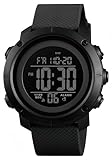
- FUNCTIONS: Countdown,Snooze,Hourly time,Date/Week,EL night-light,Stopwatch(1/100 seconds),Alarm,12/24 hour formart
- 164FT/50M WATERPROOF:Can't wear swimming and taking a hot bath. Because the general watch uses a sealing method to prevent the intrusion of sweat and harmful gases, it is not absolutely not water.only wash hands, shower, Satisfy daily use.NOTE: *Please don't press any buttons under water*
- HIGH QUALITY:Made with quality materials which enable the watch to be tough and durable.COMFORTABLE :Silicone watch band,Suitable for your wrist, Light weight and comfortable to wear.
- BACKLIGHT UPGRADE:Easy-to-read numbers can be clearly seen during the day and night.
- GIFT : It is a great gift for family and friends, especially suitable for you.
Ask whether the study matches the use you care about
Accuracy demonstrated in a controlled experiment does not automatically carry over to a different person, condition, activity, or setting. Read the study for the specific population and challenge tested, not just its headline correlation.
- Participants: Were they healthy volunteers or people with the condition for which you want to use the device? How many were studied?
- Challenge: Was the device tested during exercise, a posture change, breath holding, or another controlled maneuver? One challenge does not establish performance across all situations.
- Conditions: Was the reading collected under controlled conditions, or during ordinary movement? Consider device placement and whether the study tested motion.
- Replication: Has an independent group reproduced the finding, and is the evidence peer-reviewed or still a preprint?
- Intended use: Did the study validate a research signal, a trend, a clinical threshold, or a decision about an individual? These are different claims.
A method-specific example shows why the challenge matters. Lipnick et al. tested ultrasound-tagged near-infrared spectroscopy (UT-NIRS) and TCD in 10 healthy volunteers during carbon-dioxide challenges. TCD had an ROC AUC of 0.97 (95% CI 0.92–0.99), compared with 0.75 (95% CI 0.66–0.82) for that UT-NIRS flow-velocity index. UT-NIRS did not consistently detect the velocity decrease during induced hypocapnia, although it detected an increase during hypercapnia. The authors concluded that further refinement and validation were needed before widespread clinical use. These findings concern that method and protocol; they are not a verdict on every optical wearable. Read the 2018 comparison.
Independent reader supportYour contribution helps us test, update, and keep practical guides available for everyone.Do not use an oxygen reading as proof of flow accuracy
A cerebral oximeter’s tissue-oxygen saturation is not a substitute reference for a wearable flow index unless a study establishes that relationship for the specific device and intended use. Foss et al.’s 2017 validation-method paper evaluated cerebral tissue oxygen saturation against a weighted reference based on arterial and internal-jugular venous blood saturation in healthy adults under controlled hypoxia. That approach concerns validation of tissue oxygenation, not direct proof of brain-flow accuracy. See the method paper.
How to interpret a reading you see on your device
Unless published evidence establishes a meaningful scale and decision threshold for the specific device and use, treat an isolated consumer score as an estimate or possible trend—not as a diagnosis. The cited studies do not establish a universal normal Brain Flow score, an acceptable error range for consumer brain-flow wearables, or a validated at-home method for confirming an individual reading.
Do not use a wearable score to make a clinical decision or to rule out a health problem. If you have concerning symptoms or need guidance about a medical condition, contact a qualified health professional.

