A “pie-pan” Omega Constellation has a dial with a flatter center and a faceted outer section that slopes down toward the edge. The nickname describes the dial shape—not a specific Omega model or a guarantee that a watch is original. To identify an individual watch, check its caseback reference, movement, metal, dial, and condition together.
What is a pie-pan dial?
“Pie-pan” is collector terminology for a dial whose center is relatively flat and whose outer facets angle down toward the case. Seen from the front, the facets give the dial a shallow, many-sided profile. The term is not an Omega model name, and seeing a dial with this shape does not establish that its parts are original.
| # | Preview | Product | Price | |
|---|---|---|---|---|
| 1 |
|
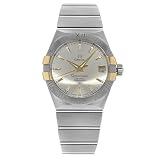
Omega Constellation Co-Axial 38mm 123.20.38.21.02.005 18K Yellow Gold and Stainless Steel Men's... | $5,380.00 | Buy on Amazon |
Omega’s Constellation collection began in 1952. Specialist histories link its origins to the Centenary chronometer series, introduced for Omega’s 1948 centenary. The collection spans many references and dial variations, so “pie-pan era” should not be taken to mean that every Constellation from that period has a strongly faceted dial.
Which Constellation references are associated with pie-pan dials?
Reference lists vary in scope, and a reference alone cannot prove the dial fitted to a particular watch is original. Watch Breaker says its reference data draws on Omega’s vintage database and factory catalogues; it also notes that Omega’s records do not describe dial shape. A specialist collector guide gives a broader set of commonly associated references, including 2852, 2943, 14381, 14393, and 167.005/167.008, while distinguishing dial and case variations.
#1 Best Overall
| Reference | Recorded movement | Other recorded detail |
|---|---|---|
| CK 2852 | Caliber 501 or 505 | Stainless steel; dated 1956 by Watch Breaker |
| OT 2852 | Caliber 501 or 505 | 18k solid yellow gold; dated 1956 by Watch Breaker |
| CK 2943 Calendar | Caliber 504 | Dated 1957 by Watch Breaker |
| CK 14381 | Caliber 551 | Dated 1959 by Watch Breaker |
| 14393 | Caliber 561 | A later calendar example listed by Watch Breaker; year not stated there |
These entries are reference checks, not an exhaustive catalogue or an authentication result. Watch Breaker’s reference guide is an independent resource, not Omega itself. Some examples associated with the broader period have flatter or domed dials; verify the shape on the specific watch rather than assuming it from a list.
How to assess a vintage pie-pan Constellation before buying
Evaluate the watch as a combination of parts and evidence. A convincing dial shape does not make an incompatible movement, worn case, or undocumented restoration disappear.
-
Match the caseback reference to the movement
Ask for clear photographs of the inside caseback and movement. The reference guide says the reference is stamped inside the caseback; compare it with the caliber shown in the movement photograph. For example, reference 2852 is listed with caliber 501 or 505, depending on version. A mismatch calls for an explanation and specialist assessment, not an assumption that the watch is correct.
-
Check the case metal and wear
Confirm the case designation rather than relying on the listing title. Cases may be solid gold, gold cap, stainless steel, or plated. Look closely at edges and lugs for wear that may expose a different underlying metal or reveal that the case has been heavily polished. The reference and its metal designation should make sense together.
PerformancePC Slower Than It Used to Be?DriversCrashes, No Sound, or Screen Glitches?PerformanceWindows Errors? Fix Them Before They SpreadSpecial offer. See more information about Outbyte and uninstall instructions. Please review EULA and Privacy policy. -
Inspect the dial and its printing
View the dial straight-on in good light, then examine it closely. Look for even, crisp lettering and note staining, scratches, lifting, or signs of refinishing. A dial can retain the pie-pan profile and still have damage or uncertain originality. Vintage Gold Watches, a specialist dealer, cautions that dial damage can be difficult to repair.
-
Ask about movement condition and service
Look for rust, damaged screw heads, and signs of heavy wear in movement photographs. Ask when the watch was last serviced and whether documentation is available. A seller’s statement that it runs does not establish its accuracy, and no vintage watch should be assumed waterproof without evidence for that individual watch.
-
Assess the seller and the terms
Consider the seller’s reputation, written disclosures, documentation, and return terms alongside the watch itself. If you cannot judge originality or condition from the available evidence, seek help from an experienced vintage Omega specialist or watchmaker before committing.
How to compare two pie-pan Constellations
There is no universally best pie-pan reference based on the available identification data. Compare the actual watches on the points that affect identity and condition:
Windows Errors? Fix Them Before They Spread
Repair common Windows errors and clear accumulated junk for a smoother, more stable PC - no reinstall needed.Free scan · no reinstallCrashes, No Sound, or Screen Glitches?
Random freezes, missing sound and display glitches usually trace back to one bad driver. Find and replace yours safely.Free scan · under a minute- Reference and caliber: Do the caseback reference and movement agree with the documented combination?
- Dial: Is the facet profile present, and what evidence supports the dial’s originality and condition?
- Case: Does the metal designation fit the reference, and how much wear or polishing is visible?
- Movement and service: What condition can be seen, and is there a credible service history?
- Disclosure and recourse: Does the seller explain uncertain or replaced parts, and are the return terms clear?
Asking prices and condition vary; the reference information does not establish a current market-price ranking.
Sources and limits
- Watch Breaker, “Vintage Omega Constellation: Every Reference and Calibre”—an independent guide that attributes its reference data to Omega’s vintage database and its movement and parts data to factory catalogues and technical guides.
- Vintage Gold Watches, “What’s An Omega Constellation Pie Pan Dial?”—a specialist dealer article dated September 2023, including buying guidance.
- Vintage Watch Life, “Omega Constellation Reference Guide – The Pie Pan Dial Era” and Goldammer Vintage Watches, “Omega Constellation Reference Guide – The Pie-Pan Era”—their visible reference summaries support the broader list and the warning that not all period examples have faceted dials.
No direct Omega primary source is cited here; the reference details are attributed to the independent guide’s account of Omega records and catalogues, not presented as factory authentication.
Quick Recap
Product prices and availability are accurate as of the date/time indicated and are subject to change. Any price and availability information displayed on Amazon at the time of purchase will apply.