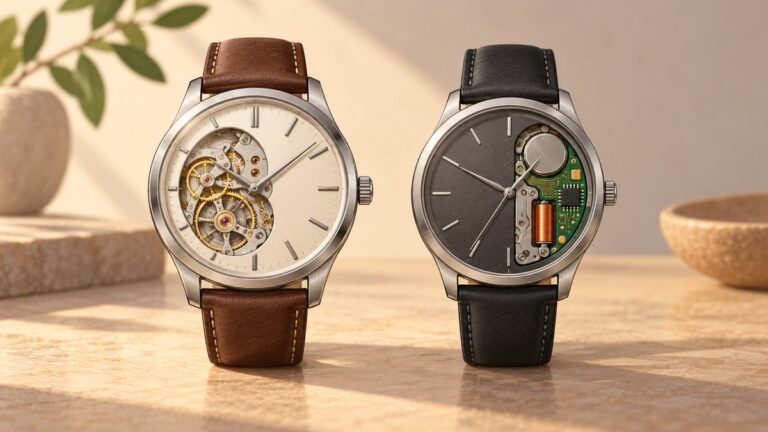
For most people wearing a two-tone chronograph every day, quartz is the practical choice: it keeps time far more closely and needs attention only when its battery is replaced. Choose an automatic when the appeal of a self-winding mechanical movement, battery-free operation and visible watchmaking outweighs tighter accuracy, longer unattended running and lower routine attention.
Start with the terms: chronograph, chronometer and two-tone
A chronograph is a watch that also measures elapsed time. Its pushers start, stop and reset a stopwatch mechanism while the regular hour, minute and running-seconds displays continue to show the time. Panerai defines a chronograph as a watch displaying hours, minutes and seconds together with a mechanism for measuring elapsed time (Panerai official FAQ).
As an Amazon Associate I earn from qualifying purchases.
A chronometer is different. It is a precision certification, not a stopwatch feature. A mechanical watch certified to the COSC tolerance cited by Breitling is allowed to run from -4 to +6 seconds per day. A watch can therefore be a chronograph without being a chronometer, or be a chronometer without having a chronograph.
PC Slower Than It Used to Be?
A free scan shows the junk files, broken settings and background clutter dragging Windows down - then fixes them in one click.Free scan · Windows 10 & 11Crashes, No Sound, or Screen Glitches?
Random freezes, missing sound and display glitches usually trace back to one bad driver. Find and replace yours safely.Free scan · under a minuteTwo-tone describes the case or bracelet using two contrasting metals or finishes, commonly a steel body with gold-colored or gold components. It is an aesthetic and wearing decision; it does not determine whether the movement should be quartz or automatic.
#1 Best Overall

- STAINLESS STEEL BRACELET for a durable and timeless accessory paired with a multi-row design that enhances the style of this analog watch
- BOX-SHAPED CRYSTAL adding a sophisticated touch and enhancing the smooth curves of the profile, creating a pleasing shape on the wrist
- MULTI-FUNCTION CHRONOGRAPH with precise timekeeping and a nod to automotive elegance
- WATER RESISTANT DESIGN ensures your wrist watch is ready for any adventure, rain or shine
- HIGH-CONTRAST SUBDIALS for superior visibility and a vintage appeal in this stylish analog watch
Quartz and automatic movements: how each one works
Quartz power and regulation
In a quartz watch, a battery powers an electronic oscillator regulated by a quartz crystal. Breitling describes the arrangement as a battery-powered movement driven and regulated by a quartz crystal and electronic oscillator (Breitling official FAQ). The electronic regulator produces a very stable time base, which is why a quartz chronograph normally stays much closer to reference time than a mechanical movement.
The trade-off is a finite battery. Patek Philippe states that a quartz movement battery lasts two to three years (Patek Philippe watch-care recommendations), while Cartier gives an average of at least three years for its quartz watches. Actual life depends on the movement, complications and battery specification. Replacing the battery is also an opportunity to test the case seals and water resistance.
Automatic power and regulation
An automatic watch is mechanical. A mainspring stores energy, and a rotor winds that spring as the wearer moves. Breitling explains that an automatic mechanical movement receives kinetic energy from the wearer’s movements (Breitling official FAQ); Victorinox similarly describes automatic winding as a watch winding itself on the wrist (Victorinox watches FAQ).
Automatic winding is not perpetual. When the stored energy runs out, the watch stops and must be worn long enough to wind, wound manually if the design permits, or reset after it has stopped. Patek Philippe lists typical self-winding reserves of 38 to 48 hours, and Victorinox gives the same 38-to-48-hour range depending on model. A watch left on a desk for a weekend can therefore be stopped by Monday.
Accuracy: the largest everyday difference
Quartz wins the accuracy comparison by a wide margin. Breitling says its current thermocompensated SuperQuartz models offer precision of +/-15 seconds per year. That is a yearly specification, not a guarantee that every quartz movement will achieve it; ordinary quartz models can have different published tolerances.
Mechanical performance is expressed per day because temperature, position, winding state and wear affect the regulating system. Breitling cites -4 to +6 seconds per day for certified mechanical chronometers. Swatch lists an automatic range of -10 to +40 seconds per day on its technical-information page (Swatch technical information). Those figures are brand- and movement-specific, but they illustrate why an automatic chronograph may require occasional correction while a quartz one usually does not.
Rank #2

- WATER RESISTANT MEN'S WATCHES: Up to 100m (330ft) this Fossil watch men is suitable for bathing, swimming or snorkeling, but is not resistant enough to withstand scuba diving; 10 ATM
- CASE & MOVEMENT: Fossil mens watch includes a 44mm case, 22mm band width, hardened mineral crystal lens that resists scratches, Quartz movement with chronograph analog watch display & date window, 3 subdials to track minutes, seconds & 24-hour time
- TIMELESS: Building off a classic design, a leather cuff adds rugged appeal to this steel chronograph watch; built to outlast trends, this Fossil watch for men offers ageless style & effortless wearability, and is an investment fit for any occasion
- WRIST WATCH BAND: Brown, genuine leather cuff band with a secure adjustable buckle closure for a customized fit of this men's wristwatch; interchangeable with all Fossil 22mm straps
- DIAL: One of many Fossil watches for men, this quartz watch is a style accessory that features a round silver stainless steel case with a tan brown dial, and wood accents
| Characteristic | Quartz two-tone chronograph | Automatic two-tone chronograph |
|---|---|---|
| Regulation | Battery, quartz crystal and electronic oscillator | Mainspring, escapement and self-winding rotor |
| Published example of accuracy | +/-15 seconds per year for current thermocompensated SuperQuartz models | -4 to +6 seconds per day for certified mechanical chronometers; -10 to +40 seconds per day for the automatic range listed by Swatch |
| When left unworn | Continues running until the battery is depleted | Typically stops after a 38-to-48-hour reserve is exhausted |
| Routine energy task | Battery replacement, commonly every two to three years or at least three years depending on guidance and model | Wear regularly or wind and reset when the reserve is exhausted |
| Long-term care guidance | General service guidance varies; Patek Philippe recommends eight to ten years for quartz and mechanical watches | Victorinox recommends a complete mechanical overhaul every four to six years; Patek Philippe gives eight to ten years as general service guidance |
Daily convenience and wearing pattern
If you rotate several watches
Quartz is easier for intermittent wear. Put it on after days or weeks in a drawer and the hands should still show the correct time unless the battery has run down. An automatic in the same situation may be stopped, requiring a time and date reset before use.
If one watch stays on your wrist
An automatic can remain running when worn frequently enough to replenish its reserve. It still may gain or lose seconds and need correcting. Quartz remains simpler if your priority is matching a phone, work clock or travel reference without adjustment.
If you dislike batteries
Automatic avoids a disposable cell during normal operation, but it is not maintenance-free. Mechanical parts, lubricants, seals and the chronograph mechanism eventually need inspection and service. Battery-free operation is therefore a preference for mechanical energy, not a promise of lower lifetime upkeep.
Maintenance, service and the cost of attention
Quartz maintenance
Plan on a battery change according to the movement’s specification. Patek Philippe’s stated two-to-three-year battery life and Cartier’s at-least-three-year average are useful planning figures, not universal guarantees. Do not leave a dead battery in the watch indefinitely; arrange replacement through an authorized service center or qualified watchmaker and have water resistance checked if the case is opened.
Automatic maintenance
Automatic chronographs contain more mechanical components and can be affected by lubrication age, impact and magnetism. Victorinox recommends a complete overhaul every four to six years for mechanical movements. Patek Philippe’s broader watch-care guidance recommends service every eight to ten years for both quartz and mechanical watches through an official Service Center or Authorized Retailer (Patek Philippe watch-care recommendations). These intervals are not contradictory: a brand may call for an earlier complete overhaul for a particular mechanical caliber while another gives a general interval.
Recommended Free Tools
What service should include
- Testing timekeeping and the chronograph start, stop and reset functions.
- Checking crown, pusher and crystal seals, especially after the case has been opened.
- Inspecting the bracelet, clasp and spring bars for wear.
- Confirming water resistance to the model’s stated rating.
- Replacing a quartz battery with the specified cell and checking for leakage or corrosion.
Service prices and turnaround vary by caliber, case construction and region. There is no single maintenance price that can be applied to every two-tone chronograph.
Rank #3

- Chronograph Movement with Tachymeter: Features a tachymeter index along its outer minute track to measure speed
- Stainless Steel Adjustable Bracelet: Stainless steel bracelet fits comfortably on your wrist and can be adjusted for a custom fit
- Sturdy Stainless Steel Watch Case: Sleek and scratch-resistant stainless steel
- Iconic 60's Design: This timepiece retains the classic Marlin features with a domed acrylic crystal lens and retro-style square markers at 3, 9, and 12 o'clock
- Water Resistant to 50 Meters
Shock, magnetism, temperature and water resistance
Mechanical sensitivity
Automatic movements are more sensitive to temperature fluctuations, knocks and the way they are worn, according to Swatch’s technical information. A hard impact can alter regulation or damage the chronograph’s operating parts. Magnetic fields can also disturb a mechanical hairspring. If an automatic suddenly runs very fast after contact with a strong magnetic source or a knock, stop treating the rate as normal and have it inspected.
Quartz resilience and its limits
Quartz regulation is generally less affected by ordinary positional changes and wearing patterns, but the movement is not indestructible. Impacts can damage the electronic module, hands or chronograph gear train, and water can destroy either movement if seals fail. Quartz should be selected for its accuracy and convenience, not as permission to ignore shock or moisture precautions.
Water resistance and chronograph pushers
Use the exact water-resistance rating published for the model and keep the crown fully secured. Do not operate chronograph pushers underwater; pressure on a pusher can provide a path for water into the case. Have resistance tested after battery replacement, case opening or a significant impact. A rating on the dial or case does not remove the need for periodic seal checks.
Do these 3 things before closing this tab:
1Clear out junk files and repair common Windows errors2Scan for outdated or missing drivers - takes under a minute3Repair Windows errors before they cause bigger problemsTwo-tone design details that matter more than the movement
Bracelet and clasp
Two-tone surfaces show scratches and fingerprints differently, so inspect the transition between metals, the quality of the clasp and the security of the adjustment system. A well-finished bracelet should articulate without sharp edges, and the clasp should close positively without excessive play. If the watch will be worn every day, these contact points affect comfort more than the movement label.
Case comfort and proportions
Chronograph cases are often thicker than simple three-hand watches because they contain additional gears, pushers and subdials. Check lug length, case thickness and the position of the crown and pushers against your wrist. Gold-colored or precious-metal components can add visual weight; try the watch with the bracelet sized rather than judging from photographs.
Legibility
A two-tone chronograph can have several reflective surfaces competing with subdials and a date window. Look for strong contrast between the hands, hour markers and dial, and make sure the elapsed-time scale can be read quickly. If timing is occasional but reading the current time is constant, prioritize the main hands over decorative subdial finishing.
Rank #4

- WATER RESISTANT MEN'S WATCHES: Up to 100m (330ft) this Fossil watch men is suitable for bathing, swimming or snorkeling, but is not resistant enough to withstand scuba diving; 10 ATM
- CASE & MOVEMENT: Fossil mens watch includes a 44 mm case, 22mm band width, hardened mineral crystal lens that resists scratches, Quartz movement with chronograph analog watch display & date window, 3 subdials to track minutes, seconds & 24-hour time
- TIMELESS: Building off a classic design, a leather cuff adds rugged appeal to this steel chronograph watch; built to outlast trends, this Fossil watch for men offers ageless style & effortless wearability, and is an investment fit for any occasion
- WRIST WATCH BAND: Brown, genuine leather cuff band with a secure adjustable buckle closure for a customized fit of this men's wristwatch; interchangeable with all Fossil 22mm straps
- DIAL: One of many Fossil watches for men, this quartz watch is a style accessory that features a round silver stainless steel case with a black dial, and orange accents
Which movement fits common daily-wear scenarios?
Office, commuting and travel
Quartz suits a schedule built around punctual meetings, travel connections and long periods when the watch is off the wrist. Its tighter rate reduces the need to correct the time, and it will not normally stop during a short trip in a suitcase.
What’s actually slowing this PC down?
Pick the symptom - the matching free tool is one click away.
Frequent sport or active work
Consider the model’s shock protection, pusher design and water resistance before choosing either movement. An automatic may need inspection after a hard impact; quartz avoids some mechanical regulation concerns but can still suffer physical damage. Neither type should be used with wet pushers or an unsecured crown.
Weekend and occasional wear
Quartz is the lower-attention option. An automatic can be satisfying if resetting it is part of the ritual, but its 38-to-48-hour typical reserve means it may not be ready after a couple of days off the wrist.
Mechanical-watch enthusiasm
Choose automatic when you value the visible sweep and changing behavior of a mechanical movement, the connection between wrist motion and stored energy, and the craft of a serviceable mechanism. Accept that accuracy is measured in seconds per day and that winding, regulation and service are part of ownership.
A practical buying checklist
- Decide your tolerance for correction. If even a few seconds of daily drift is annoying, start with quartz; if periodic resetting is acceptable, automatic remains viable.
- Check the exact movement specification. Look for the stated accuracy, battery type or power reserve rather than relying on the word “quartz” or “automatic.”
- Confirm the chronograph controls. Test that start, stop and reset are distinct and that the elapsed-time scale is legible.
- Read the water-resistance instructions. Verify the rating, crown-locking method and prohibition on operating pushers underwater.
- Assess the wearing pattern. Intermittent wear favors a watch that keeps running unattended; frequent wear can keep an automatic wound.
- Inspect bracelet and clasp security. Check adjustment range, articulation, sharp edges and whether the two-tone finish suits your tolerance for visible marks.
- Plan authorized support. Confirm that battery replacement, water-resistance testing and mechanical servicing are available in your region.
- Read the warranty and manual. Follow the model-specific limits for magnetism, shocks, winding and pusher use.
Bottom line for a daily two-tone chronograph
Movement choice should follow your routine, not the two-tone styling. Quartz is the dependable default when accuracy, immediate readiness and minimal attention matter most. Automatic earns its place when mechanical character, self-winding energy and battery-free operation are central to why you want the watch, and you are prepared for a shorter unattended reserve, greater sensitivity and eventual mechanical service.
The Tool Desk
Outbyte Driver Updater FREEFix the driver behind crashes, sound loss and screen glitchesFind Drivers →Outbyte PC Repair FREEClear out junk files and repair common Windows errorsFree Scan →Quick Recap
Product prices and availability are accurate as of the date/time indicated and are subject to change. Any price and availability information displayed on Amazon at the time of purchase will apply.