The history of clocks is the history of learning how to count something that repeats. A clock needs three basic parts: an oscillator that produces regular cycles, a counting mechanism that keeps track of them, and a display that makes the result understandable. The oscillator has changed from the Sun’s apparent movement to flowing water, pendulums, balance wheels, quartz crystals, and atomic transitions.
That is why the story is not simply a march from analog faces to digital screens. An analog dial can be powered by an electronic quartz movement, while a digital display can be driven by mechanical parts. The most important advances came when clockmakers and scientists found more stable ways to generate and count repeated events.
Every clock answers the same practical question: how much time has passed since a reference point? The answer may appear as a shadow, a bell, a moving hand, glowing numerals, or a radio-controlled signal, but underneath is always a process that can be compared with itself.
| Period | Timekeeping reference | What changed |
|---|---|---|
| Ancient world | Sun, Moon, stars, water, sand, and flame | Time could be observed or measured in intervals, but accuracy depended heavily on nature and materials. |
| 14th–17th centuries | Weight-driven gears, verge-and-foliot escapements, springs, and balance wheels | Time became mechanical, public, and eventually portable. |
| 1656 onward | Pendulum and improved escapements | Regular oscillation made clocks far more precise. |
| 18th–early 20th centuries | Marine chronometers and observatory regulators | Accurate time supported navigation, astronomy, and scientific measurement. |
| 1920s onward | Quartz crystal | Electronic timekeeping became smaller, cheaper, more reliable, and suitable for mass-produced watches. |
| 1949 onward | Atomic transitions | The second became based on a reproducible property of nature rather than Earth’s irregular rotation. |
Before clocks: reading time in nature
Long before people built clocks, they recognized recurring patterns in the world around them. The rising and setting of the Sun divided the day, the phases of the Moon provided a longer cycle, and the apparent movement of stars offered another way to track the passage of night. Archaeological evidence suggests that ancient peoples recorded lunar phases tens of thousands of years ago.
Outdated Drivers Are Slowing You Down
One free scan finds every outdated or missing driver and matches the right update for your exact hardware.Free scan · exact hardware matchWindows Errors? Fix Them Before They Spread
Repair common Windows errors and clear accumulated junk for a smoother, more stable PC - no reinstall needed.Free scan · no reinstall#1 Best Overall

- Easy to See: Designed with big numerals by AKCISOT.
- Keep Time Accurate: AKCISOT clock movements undergo thorough testing before being offered for sale.
- Silent: Features AKCISOT's quiet sweep movement.
- Simple Design: Presents a clean clock face by AKCISOT.
- What You Get: An AKCISOT wall clock and two hooks.
These observations were not clocks in the mechanical sense, but they supplied the first time references. Nature provided the oscillator; human beings supplied memory, markings, and interpretation.
Sundials and the first analog display
The ancient Egyptians were using sundials roughly 5,000 years ago. A sundial translates the Sun’s changing position into the movement of a shadow across a marked scale. Egyptian systems also helped establish the familiar division of daytime and nighttime into twelve-hour portions, although the length of an hour could vary seasonally in systems based on unequal hours.
A sundial contains the essential visual idea that later analog clocks would preserve:
- a fixed scale or dial;
- a moving indicator, in this case a shadow; and
- a relationship between angular movement and elapsed time.
It is important, however, not to imagine a sundial as an independent, universal timekeeper. Its reading depends on the position of the observer, the season, and the relationship between local solar time and later standardized time. It also fails at night, and clouds can make it difficult or impossible to read.
What’s actually slowing this PC down?
Pick the symptom - the matching free tool is one click away.
Water, sand, and fire: measuring time without sunlight
People needed timekeeping indoors and after sunset, so they developed devices that used the predictable movement of matter. Water clocks, or clepsydrae, were among the most important early solutions. In a simple Egyptian water clock, liquid escaped through an opening in a vessel and the changing water level was compared with marked hour divisions.
Water clocks were used and refined by the Greeks and Romans. Chinese engineers developed particularly sophisticated hydraulic and astronomical mechanisms. These devices could measure time when a sundial could not, but their accuracy was limited by the shape of the vessel, the size of the opening, water pressure, temperature, and the changing rate of flow as the water level fell.
Sandglasses applied the same general idea to grains of sand moving through a narrow opening. Candle clocks used the controlled consumption of wax or another fuel. Both could be useful for measuring a defined interval, but they normally needed to be turned over, relit, or reset. They did not yet provide the self-maintaining, continuously counted time that people would later expect from a clock.
Do these 3 things before closing this tab:
1Repair Windows errors before they cause bigger problems2Fix the driver behind crashes, sound loss and screen glitches3Clear out junk files and repair common Windows errorsSu Song’s astronomical clock tower
An important step toward automated mechanical timekeeping appeared in China during the eleventh century. Su Song’s astronomical clock tower, associated with 1089, combined a water-powered mechanism with an astronomical display. The original tower no longer survives, but a detailed description of its mechanism does.
Su Song’s design is significant because it shows that clocks were not merely devices for announcing daily hours. They could also model the heavens, connect engineering with astronomy, and present a structured view of the cosmos. Timekeeping and scientific representation were already closely related.
The medieval mechanical clock makes time public
Large mechanical clocks began appearing in European city towers during the first half of the fourteenth century. No single person invented the mechanical clock; its development was cumulative and involved advances in gears, metalworking, weights, escapements, and practical clockmaking across different regions.
Many early European tower clocks were powered by falling weights and regulated by a verge-and-foliot escapement. The escapement allowed the gear train to move in controlled increments rather than letting the weights fall freely. It was a crucial mechanical solution, but not a highly stable one. Friction, changes in driving force, and imperfections in construction could alter the rate significantly.
Free tools Windows power users keep installed
One-click scans. No signup required.
Early tower clocks were therefore more valuable as public signals than as precision instruments. Their bells made time audible and communal. They called people to religious services, marked markets and civic events, organized labor, and eventually helped coordinate transportation. A clock tower changed time from something people primarily inferred from the sky into something a city could announce to everyone at once.
Rank #2

- 1-[Easy to Read] - Round in shape, with protected clear glass and clear numbers, it ensures easy reading and good looks even from a distance.
- 2-[Silent Working] - Using high quality silent non-ticking mechanisms with smooth movement ensures a quiet environment and keeps accurate time.
- 3-[Hanging Clock] - Hanging clocks have a slot in the back and the packing contains hooks for installation. It is powered by one AA battery (not included).
- 4-[Decor Clock] - Vintage - style wall decoration for the office, school, classroom, and home, and perfect for festivals, birthdays, and elderly gifts.
- 5-[Service Guarantee] - if there is any problem with the product, please feel free to contact us immediately and we will help you.
This social change may have mattered as much as the mechanism itself. A public clock encouraged a shared schedule. It made punctuality visible, gave civic authorities a common reference, and helped separate daily organization from the changing position of the Sun.
Springs and watches: time becomes portable
During the early sixteenth century, clockmakers began using coiled springs as a source of power instead of relying exclusively on heavy hanging weights. A spring could store energy in a compact space, making smaller clocks and early watches possible.
Portability transformed the meaning of timekeeping. A tower clock belonged to a community or building; a watch belonged to an individual. Time moved from architecture into clothing, travel, trade, and personal routine.
Quick wins for a faster PC:
Clear out junk files and repair common Windows errorsFree Scan →Fix the driver behind crashes, sound loss and screen glitchesFind Drivers →Early spring-driven watches had a serious problem: their rate changed as the mainspring unwound. The driving force was not constant, so the mechanism could run faster or slower at different points in its power reserve. The small balance wheel used in a watch also needed a more reliable regulating system.
The balance spring
The balance spring, developed through the work of Christiaan Huygens and other seventeenth-century innovators, gave the balance wheel a much more regular oscillation. Its function was comparable to that of a pendulum in a clock: it provided a repeatable natural period around which the escapement could regulate the gear train.
The improvement was transformative for pocket watches. The Metropolitan Museum of Art describes the balance spring as a major advance in watch timekeeping, comparable in importance to applying the pendulum to clocks. It also established a principle that remains central to mechanical watches today: a good watch is fundamentally an oscillator, an escapement, a gear train, and a display working together.
The pendulum revolution begins in 1656
In 1656, Christiaan Huygens applied the pendulum to a clock. The result was a dramatic improvement over the older foliot regulator because a pendulum’s period is much more predictable when it is allowed to swing through a small angle.
Recommended Free Tools
The pendulum did not make a clock perfect. Air resistance, friction, temperature, the amplitude of the swing, and the design of the escapement still affected the rate. Nevertheless, it offered a far more stable oscillator than earlier mechanical regulators and made practical precision timekeeping possible.
Why the pendulum created the longcase clock
A better oscillator changed the entire clock around it. A pendulum needs enough length to achieve its desired period, must swing freely, and needs protection from accidental disturbance. These requirements encouraged the tall case associated with the longcase clock, often called a grandfather clock.
The anchor escapement became especially important in English clockmaking during the later seventeenth century. Museum evidence identifies Joseph Knibb’s work in Oxford around 1670 as an early example of combining an anchor escapement with a long pendulum. William Clement was later credited with developing the anchor form. Such attributions should be understood as part of a chain of refinement rather than proof that one person single-handedly created the modern clock.
Clockmakers continued to solve the pendulum’s remaining weaknesses. Temperature changes could make a pendulum expand or contract, altering its effective length and therefore its rate. Temperature-compensated designs, including mercury pendulums associated with George Graham, reduced that problem.
Free tools Windows power users keep installed
One-click scans. No signup required.
John Harrison and the longitude problem
The next great challenge was not simply making a clock accurate on land. It was making one accurate enough to survive a ship, a voyage, and changing weather.
Rank #3
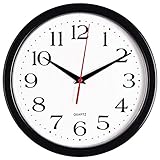
- 10 Inch clock. Large black bold numbers against white face background creates easy viewing. Precise Quartz movements guarantee accurate time
- Silent non-ticking mechanism with sweeping movement. enjoy a quiet environment!
- Sturdy plastic frame and glass lens make it easy to clean and keeps dust away from dial
- The perfect wall clock for an office, classroom, bedroom, bathroom, shop, gym or any room in your home of business
- Lightweight and easy to hang. Powered by 1 "AA" battery - not included. 12 Months Manufacture Warranty
Latitude can be estimated from the height of the Sun or stars. Longitude is more difficult because it requires knowing how far east or west a vessel has traveled. One practical method is to compare local solar time with the time at a known reference meridian. Earth rotates 360 degrees in roughly 24 hours, so a time difference corresponds to an angular difference in longitude.
That method is straightforward in principle but demanding in practice. A ship needed a portable clock that maintained reference time despite rolling and pitching, temperature changes, humidity, and long periods without maintenance. A small daily error could become a serious navigational error after weeks at sea.
The British Longitude Act of 1714 offered a substantial reward for a practical solution. John Harrison, a self-taught clockmaker, pursued a series of marine timekeepers:
- H1 used paired balances to reduce the effects of a ship’s motion.
- H2 and H3 explored additional mechanical solutions, including ways to compensate for movement and temperature.
- H4, completed in 1759, used a high-frequency balance influenced by watch technology and was much more compact than Harrison’s earlier sea clocks.
H4 performed successfully during sea trials, including the 1761–1762 voyage to Jamaica, and met the accuracy requirements associated with the longitude prize. The Commissioners of Longitude continued to debate whether Harrison’s design was sufficiently practical and reproducible, so the story was not a simple instant victory. Later clockmakers simplified marine chronometers and reduced their cost, helping spread the technology during the nineteenth century.
Harrison’s achievement should also be placed alongside lunar-distance methods, which became a practical alternative for navigators. The chronometer was not the only answer to longitude, but it made accurate reference time portable and dependable enough to reshape navigation.
The consequences reached far beyond the clockmaker’s workshop. Marine chronometers improved maps, ocean travel, naval operations, maritime trade, and global communication. The history of clocks is therefore also a history of navigation and state power.
Observatory clocks and the search for a better regulator
By the nineteenth and early twentieth centuries, the most precise clocks were increasingly found in observatories and laboratories rather than ordinary homes. Scientists needed timekeepers for astronomical observations, and astronomers needed accurate time to determine the position of celestial objects.
One problem was that the regulating pendulum was often also responsible for driving the hands and overcoming mechanical friction. Every additional mechanical task could disturb the oscillator. Free-pendulum designs separated the timekeeping function from much of the work of the clock. The Shortt clock, demonstrated in 1921, became a leading precision timekeeper before quartz technology surpassed it.
This period makes an important distinction clear: the appearance of a clock does not tell you how its time is generated. A clock can have traditional analog hands and an advanced regulator. Conversely, a digital-looking display says only that the result is presented as numerals; it does not identify the oscillator beneath it.
Quartz turns timekeeping electronic
Quartz timekeeping emerged from research during the 1920s. In 1927, Warren A. Marrison of Bell Telephone Laboratories developed a quartz timekeeping device based on the piezoelectric behavior of quartz.
Do these 3 things before closing this tab:
1Scan for outdated or missing drivers - takes under a minute2Repair Windows errors before they cause bigger problems3Fix the driver behind crashes, sound loss and screen glitchesQuartz has a useful two-way relationship with electricity and mechanical vibration. An applied electric field makes a properly shaped crystal deform and vibrate. Mechanical vibration produces an electrical signal. In an electronic feedback circuit, the crystal can therefore act as a highly stable frequency reference.
A quartz clock does not need the large gear trains, pendulum, or mechanical escapement required by earlier precision clocks. The electronic circuit keeps the crystal oscillating, divides the frequency into usable pulses, and sends those pulses to a display or a motor that moves hands.
Rank #4

- ✅ **Choose the Right Size** –We recommend the 12 inch “Standard Size” for home and office environments to ensure optimal viewing.The 8 inch model is a specially designed Compact Size, suitable only for very small spaces such as bathrooms or laundry rooms.
- ✅ **Easy-to-Read Large Numbers** –Bold 3D white numerals on a soft gray dial provide clear visibility from across the room—even for seniors or in low light.
- ✅ **Modern Minimalist Design** –Sleek white ABS frame and neutral gray face blend seamlessly with farmhouse, Scandinavian, industrial, or contemporary decor.
- ✅ **Easy to Hang ** –1 hook included.Powered by one 1 AA battery (not included).Installation Sequence:Insert into (+) first, then insert into (-).
- ✅ **Silent Operation**–Quartz movement produces non-ticking noise, making it ideal for light sleepers, nurseries, libraries, or home offices.
Quartz is not flawless. Its frequency depends on the crystal’s shape and cut, temperature, aging, and the surrounding environment. But the improvement in reliability, size, maintenance, and cost was enormous. NIST has reported accuracies of roughly three seconds per year for quartz standards in controlled applications, although ordinary consumer quartz watches can perform differently depending on their movement, temperature, battery condition, and adjustment.
The quartz revolution reaches the wrist
The invention of the quartz oscillator and the commercialization of quartz wristwatches were separate stages. Seiko’s Astron, which went on sale in Tokyo on December 25, 1969, was the first commercial quartz wristwatch with an analog dial. It used an electronic time base while preserving the familiar visual language of hands and a circular dial.
Quick wins for a faster PC:
Fix the driver behind crashes, sound loss and screen glitchesFind Drivers →Clear out junk files and repair common Windows errorsFree Scan →Scan for outdated or missing drivers - takes under a minuteDriver Scan →Quartz made accurate watches accessible to a mass market and challenged the traditional mechanical-watch industry. Mechanical watches did not disappear, but their role changed. For many buyers, they became objects of craftsmanship, design, heritage, and mechanical interest rather than the cheapest or most accurate way to keep time.
Digital displays change how time is read
The Hamilton Pulsar became a landmark in digital wristwatch history. Prototypes appeared in 1970, and the watch was marketed in the early 1970s as a futuristic time computer. Its LED display showed numerals rather than hands and a dial, and the wearer pressed a button to illuminate the time.
The change was more than cosmetic. An analog clock asks the reader to interpret geometry: the position of the minute hand in relation to the hour hand, and the hand’s location around the dial. A digital clock presents a numerical result directly. Digital watches altered the visual grammar of time and became symbols of electronics, modernity, and the future.
Analog versus digital is not the whole story
The words analog and digital usually describe the display, not the entire clock.
What’s actually slowing this PC down?
Pick the symptom - the matching free tool is one click away.
| Display | Possible timekeeping mechanism | Example |
|---|---|---|
| Analog hands | Mechanical balance wheel, quartz crystal, or another electronic regulator | A traditional mechanical watch or Seiko Astron |
| Digital numerals | Usually quartz-based electronics, but the display itself may use LEDs, liquid crystals, or mechanical numeral wheels | Hamilton Pulsar or a modern digital watch |
| Scientific time signal | Atomic reference combined with electronics, counters, and communications systems | National time standards or satellite-navigation signals |
A quartz watch with hands is analog in display but electronic in regulation. A digital watch may use a quartz oscillator internally and only convert the counted frequency into numerals at the final display stage. In a modern watch, mechanical, electronic, and software layers can coexist.
Independent reader supportYour contribution helps us test, update, and keep practical guides available for everyone.Atomic clocks redefine the second
Quartz improved practical clocks, but scientists eventually needed a reference more stable and reproducible than any manufactured crystal or pendulum. Atomic clocks use the resonant frequency associated with transitions between energy states in atoms.
The first public atomic clock, based on ammonia, was demonstrated by the U.S. National Bureau of Standards in 1949. It was not initially more accurate than the best existing clocks, but it established a new direction. Cesium soon became the preferred basis because its transition could be controlled and reproduced with exceptional stability.
In 1967, the international second was redefined using cesium-133. One second corresponds to 9,192,631,770 cycles of radiation associated with the atom’s transition. The definition moved the standard away from one tied indirectly to Earth’s astronomical motion and toward a reproducible property of nature.
An atomic clock is still a system, not a bare atom sitting beside a dial. Electronics interrogate the atoms, maintain the relevant frequency, count cycles, and distribute the resulting time. The atom supplies the reference; the rest of the clock makes that reference usable.
Why atomic time matters to ordinary life
Atomic clocks became essential to national time standards, telecommunications, scientific measurement, satellite navigation, and GPS. GPS satellites carry atomic clocks and broadcast timing signals. A receiver compares signals arriving from multiple satellites to calculate position. Because radio signals travel at the speed of light, even very small timing errors can produce substantial positional errors.
The same principle affects spacecraft navigation. NASA has noted that spacecraft navigation depends on clocks capable of resolving extremely small differences in signal travel time. In this environment, time is not merely a label placed on an event; it is a measurement tool for distance.
Best Value

- Large Digital Wall Clock with Big Numbers - Easy to Read: WallarGe digital wall clock has a high-definition LCD screen measures 14x6 inch and the time display is 8.1x4.3 inch, the large display helps you read the time from many angles at a room distance. You can also read the indoor temperature and date on screen for full information
- Digital Wall Clock Battery Operated - Easy to Setup: The clock is supported by 4xAA battery (not included). There is a low battery indicator display on screen when battery is not power enough, no more worries about forgetting to replace new batteries. The function buttons are at the back which are easily to set
- Day and Temp Display Switchable: There are three modes optional for the day/temp display: Day only, Temp only, Day and Temp display in turns every 10s. Just click the button at back to choose the display mode you favored. No matter which mode of day/temp you choose, the time and date will not change
- Wall Mount Large Digital Clock with Fold-out Stand - Digital Clock for Wall or Desk: The clock comes with a mounting template ruler showing 8.7 inches distance between two mounting holes, so you don't need to measure holes on wall. If you intend it to be placed on desk with no holes on wall, you can just unfold the fold-out stand
- Wall Clock Large Display with AUTO DST: The clock will automatically adjust time in Daylight Saving Time with AUTO DST on. It has two time display modes (Military time and Standard time), just click 12/24 button to switch. And the alarm is optional, it can be turned off manually if for no need
UTC connects atomic regularity with Earth’s rotation
Modern civil time has to satisfy two different needs. Scientists and communications systems need a stable, uniform reference. People also expect noon to remain broadly connected with the Sun being overhead and the day-night cycle.
Coordinated Universal Time, or UTC, is maintained using atomic clocks and is adjusted when necessary to remain broadly aligned with Earth’s irregular rotation. Atomic time supplies stability, while civil time retains a relationship with the rotating planet. This compromise is why the world’s time system is both highly precise and still connected to astronomy.
Optical clocks: the story is still continuing
Cesium clocks define the second, but they are not necessarily the final form of precision timekeeping. Optical atomic clocks use much higher-frequency optical transitions and technologies such as laser cooling and optical lattices. Because the reference frequency is higher, researchers can potentially resolve smaller changes and achieve greater stability.
Optical clocks remain a developing scientific frontier rather than a simple consumer replacement for quartz or a completed replacement for all cesium standards. Their importance is already apparent in research involving fundamental physics, geodesy, and next-generation measurement systems, but their role in the international definition and distribution of time continues to develop.
What the history of clocks really shows
The familiar clock face hides a long sequence of engineering compromises. Each generation improved the oscillator, but each improvement created new design requirements.
PC Slower Than It Used to Be?
A free scan shows the junk files, broken settings and background clutter dragging Windows down - then fixes them in one click.Free scan · Windows 10 & 11Outdated Drivers Are Slowing You Down
One free scan finds every outdated or missing driver and matches the right update for your exact hardware.Free scan · exact hardware match- Sundials were simple and durable but depended on sunlight, location, and the season.
- Water, sand, and candle clocks worked beyond daylight but were affected by flow, material, temperature, and humidity.
- Mechanical clocks automated counting and made time public, but friction and changing drive force limited their precision.
- Spring-driven watches made time personal and portable, but their rate varied as the spring unwound.
- Pendulum clocks and balance-spring watches provided much more regular oscillation, but remained sensitive to position, temperature, air resistance, and mechanical wear.
- Marine chronometers made reliable portable reference time possible at sea.
- Quartz clocks delivered low-cost electronic stability and drove both analog and digital consumer watches.
- Atomic clocks provided the reproducible reference required by global science and infrastructure.
The progression also changed the social meaning of time. Time began as an observation of nature, became a public service in the tower clock, turned into a personal possession in the watch, and finally became invisible infrastructure inside networks, satellites, laboratories, and computers.
A practical way to understand any clock
When examining a clock or watch, ask three questions:
- What is oscillating? It might be a pendulum, balance wheel, quartz crystal, or atomic transition.
- How are the cycles counted? Look for gears and an escapement in a mechanical watch, or an electronic divider and counter in a quartz watch.
- How is the result displayed or distributed? It may appear as hands, numerals, bells, a rotating shadow, or a signal sent to another system.
That framework explains why an old-looking analog watch may contain modern electronics and why a digital clock is not automatically more scientifically advanced. The display is the part people see. The oscillator and counting system determine what the clock can actually do.
The Tool Desk
Outbyte Driver Updater FREEFix the driver behind crashes, sound loss and screen glitchesFind Drivers →Outbyte PC Repair FREEClear out junk files and repair common Windows errorsFree Scan →Frequently Asked Questions
Who invented the first clock?
No single person invented the clock. Timekeeping developed through many technologies and cultures, from astronomical observation and Egyptian sundials to water clocks, Chinese hydraulic mechanisms, medieval European tower clocks, pendulums, watches, quartz, and atomic references.
Is an analog watch always mechanical?
No. Analog describes the display, usually hands moving around a dial. An analog watch can use a mechanical balance wheel or an electronic quartz oscillator. Seiko’s Astron, introduced commercially on December 25, 1969, was an early quartz watch with an analog display.
Why was the pendulum such an important clock invention?
A pendulum provided a more predictable oscillation than the earlier verge-and-foliot regulator. That improved the clock’s rate and encouraged related changes to the escapement, gear train, and case. Pendulum clocks still required compensation for friction, air resistance, and temperature.
How did John Harrison’s clock help solve longitude?
A navigator could compare local solar time with the time at a known reference meridian. The difference indicated longitude. Harrison’s marine timekeepers were designed to preserve reference time despite a ship’s motion and changing conditions. His H4, completed in 1759, succeeded in sea trials, although lunar-distance navigation also became a practical method.
Are atomic clocks used in ordinary wristwatches?
Usually not. Most ordinary wristwatches use mechanical balance wheels or quartz crystals. Atomic clocks are mainly used as reference standards and in systems such as telecommunications and satellite navigation. Some consumer devices can synchronize with atomic-based broadcasts or network time without containing a laboratory-style atomic clock.
The Bottom Line
From a shadow crossing a stone to an atomic transition counted billions of times, every clock is an attempt to find a stable repeating event and turn it into useful information. Analog hands and digital numerals are only different ways of showing the result. The deeper history of clocks is the search for better oscillators—and the gradual transformation of time from a natural observation into the invisible infrastructure of modern life.
Quick Recap
Product prices and availability are accurate as of the date/time indicated and are subject to change. Any price and availability information displayed on Amazon at the time of purchase will apply.