Free tools Windows power users keep installed
One-click scans. No signup required.
An accelerometer in a smartwatch is a tiny motion sensor that measures acceleration along three perpendicular axes, usually called X, Y, and Z. The watch uses those measurements to recognize movement patterns and estimate steps, workouts, wrist gestures, inactivity, sleep movement, and other activity data.
The accelerometer does not directly count steps, measure calories, or identify an exercise. It supplies raw motion data; the watch’s software, often combined with other sensors, interprets that data.
As an Amazon Associate I earn from qualifying purchases.
What does an accelerometer measure?
Acceleration is a change in velocity over time. That means an accelerometer measures how quickly movement changes—not speed itself. A stationary watch can still report acceleration because Earth’s gravity is acting on it.
Do these 3 things before closing this tab:
1Fix the driver behind crashes, sound loss and screen glitches2Repair Windows errors before they cause bigger problems3Scan for outdated or missing drivers - takes under a minuteRaw accelerometer readings normally contain both gravitational acceleration and movement caused by the wearer. Software can estimate the gravity component and subtract it to produce a linear-acceleration signal, although that processing is not perfect. Apple describes 1 g as approximately 9.8 m/s², while Android’s standard accelerometer reports readings in m/s².
#1 Best Overall
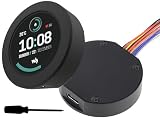
- ESP32-S3-Touch-LCD-1.28-B with CNC Metal Case is a low-cost, high-performance MCU board designed by Waveshare, with onboard 1.28inch round capacitive touch display,etc. Embedded GC9A01 Display Driver And CST816S Capacitive Touch Control Chip
- Equipped with Xtensa 32-bit LX7 dual-core processor, up to 240MHz main frequency. Supports 2.4GHz W-i-F-i (802.11 b/g/n) and Blue-too-th 5 (LE), with onboard antenna. Built in 512KB of SRAM and 384KB ROM, with onboard 2MB PSRAM and an external 16MB Flash memory
- Onboard 1.28inch capacitive touch display, 240×240 resolution, 65K color
- Onboard QMI8658 6-axis IMU (3-axis accelerometer and 3-axis gyroscope) for detecting motion gesture. Onboard 3.7V batt recharge/discharge header and 6 × GPIO pins via SH1.0 connector
- Integrated with USB serial port full-speed controller, GPIO pins allows flexibly configuring pin functions
Sources: Apple’s raw accelerometer documentation and Android’s motion-sensor documentation.
Why does a smartwatch use three axes?
A three-axis accelerometer measures movement independently along three perpendicular directions. Depending on the manufacturer’s coordinate convention:
- One axis may run across the watch face.
- One may run from the top of the watch toward the bottom.
- One may run perpendicular to the display.
The exact axis orientation varies by device and software. The axes move with the watch, so the software must account for whether the watch is tilted, rotated, worn on the left or right wrist, or held in an unusual position.
Three-axis does not mean the watch contains three large, separate sensors. A single compact sensor package can contain sensing elements for all three directions.
How does a smartwatch accelerometer work?
Most smartwatch accelerometers are based on MEMS—microelectromechanical systems. A simplified explanation is:
- A microscopic proof mass is suspended inside the sensor.
- When the watch accelerates, inertia causes that mass to shift relative to its frame.
- Tiny electrical structures detect the displacement.
- The sensor converts the displacement into digital X-, Y-, and Z-axis values.
- A processor or low-power sensor hub filters those values and looks for recognizable patterns.
Different manufacturers use different capacitive structures, calibration methods, filters, and processing architectures, so this description should not be treated as an identical design for every smartwatch.
One representative wearable component is Bosch’s BMA400. Its published specifications include three axes, selectable measurement ranges of ±2 g, ±4 g, ±8 g, and ±16 g, and output data rates from 12.5 Hz to 800 Hz. Those are component capabilities, not universal smartwatch specifications, and a finished watch may select different settings for different functions.
Recommended Free Tools
Source: Bosch BMA400 specifications.
What does an accelerometer do in a smartwatch?
Step counting
The watch samples wrist movement, filters noise, compensates for gravity, and searches for recurring peaks and timing patterns associated with walking. It may also consider cadence, duration, wrist position, and readings from the gyroscope or GPS.
Walking is inferred from the wrist, not observed directly at the feet. As a result, the watch may miss steps when the watch arm is stationary—for example, while pushing a stroller, carrying groceries, holding a handrail, using crutches, or carrying a bag containing the watch. Repetitive hand movements can also create false steps.
Rank #2

- Bluetooth Calls & Notifications: Bluetooth 5.3 for making calls and real-time alerts from Facebook, WhatsApp, iMessage. Stay connected without reaching for your phone.
- 24/7 Health & Sleep Tracking: Monitors heart rate, SpO2, stress levels, steps and calories, alongside deep, light and REM sleep stages. Sync all your data via the Veryfit App.(*Health metrics are for reference only, not a substitute for medical diagnosis.)
- 120+ Sports Modes & IP68 Waterproof: 120+ workout modes for yoga, hiking, gym, running, and more. IP68 waterproof stands up to rain, splashes, and pool time.
- 1.85” HD Screen & Custom Faces: Crisp 1.85” HD display with smooth touch. Pick from 100+ designed watch faces or upload your photos for a customized style.
- 7-Day Battery & Smart Tools: A 2.5-hour fast charge delivers 7 days of heavy use and 30 days standby. Features cycle tracking, alarm, weather, music control,camera control and more.
Some platforms provide dedicated low-power step functions. Android distinguishes between a step detector, which reports individual detected steps, and a step counter, which reports a cumulative total under the platform’s specified reset conditions. These are derived motion functions, not simply raw accelerometer readings.
Sources: Android sensor types and Android motion sensors.
What’s actually slowing this PC down?
Pick the symptom - the matching free tool is one click away.
Activity recognition and workout detection
Acceleration patterns can help identify broad states such as stillness, walking, running, cycling-related movement, shaking, or repetitive exercise. Automatic workout detection uses those patterns to prompt the wearer or start an activity session.
These are algorithmic features. The accelerometer alone cannot reliably identify every activity, so watches may combine it with a gyroscope, GPS, heart-rate sensor, barometer, and workout-specific software.
Wrist gestures and screen wake
Raise-to-wake, wrist flicks, shaking, and other motion controls can use characteristic combinations of acceleration and orientation. Reliability depends on the watch’s fit, wearing position, sensitivity thresholds, and software.
Orientation and tilt
Because gravity provides a reference direction, the accelerometer can help estimate tilt when the watch is relatively still. This supports screen orientation, interactive apps, and motion controls. Full orientation and heading may require a gyroscope, magnetometer, sensor fusion, and additional processing.
Sleep and inactivity estimates
Small changes in movement can help estimate periods of immobility, restlessness, and sleep-related movement. These are estimates, not automatically clinical sleep measurements or diagnoses.
Fall and impact detection
A sudden acceleration change and impact-like pattern can contribute to fall-detection algorithms. Reliable detection generally requires orientation, timing, context, and software analysis. A detected event is not proof that a fall occurred, and no wearable should be treated as an infallible emergency system.
Cadence, intensity, and calorie estimates
Repeated acceleration patterns can contribute to cadence and exercise-intensity estimates. Calorie or energy-expenditure figures are modeled estimates that may combine motion, heart rate, body information, workout type, and proprietary algorithms. The accelerometer does not measure calories directly.
Rank #3

- TARGET AUDIENCE: This is a development board module that requires customers to develop their own applications to fully utilize its functions. Suitable for tech enthusiasts, developers or amateurs who are familiar with programming
- WEARABLE DEVELOPMENT BOARD: Support for ESP32-S3 Touch Active Matrices Organic Light Emitting Diode 2.06 is an excellent development board that features a powerful support for ESP32-S3R8 microcontroller and a 2.06in Active MX Organic Light Emitting Diode capacitive touch display, which is highly suitable for prototyping and functional verification of wearable applications
- ADVANCED CONNECTION AND PROCESSING CAPABILITIES: This touch watch development board is powered by the support for Xtensa 32 bit LX7 dual core processor with a maximum frequency of 240MHz, supporting 2.4GHz WiFi(802.11b /g/n) and Bluetooth 5(LE). Ensure seamless communication and efficient performance
- COMPREHENSIVE FEATURES: The touch watch development board is equipped with a 6 axes IMU (accelerometer and gyroscope) for motion tracking, a support for PCF85063 RTC chip for real time clock functionality, and an integrated sound codec, and is specifically designed for dynamic and responsive wearable applications
- POWER MANAGEMENT: This development board integrates the power management IC, providing efficient battery charging, voltage output management, and extended battery life. Also equipped with a dedicated li ion battery for uninterrupted operating
A 2025 living review found that consumer wearable energy-expenditure estimates can have large errors, while step-count performance varies by device and situation. Source: npj Digital Medicine review.
Quick wins for a faster PC:
Repair Windows errors before they cause bigger problemsFix Now →Fix the driver behind crashes, sound loss and screen glitchesFind Drivers →Clear out junk files and repair common Windows errorsFree Scan →Accelerometer vs. gyroscope, GPS, and other sensors
| Sensor | Primarily measures | Typical smartwatch uses |
|---|---|---|
| Accelerometer | Linear acceleration, including gravity | Steps, movement, tilt, gestures, activity detection |
| Gyroscope | Angular velocity and rotation | Wrist rotation, orientation changes, motion analysis |
| GPS | Position and movement relative to satellites | Outdoor route, distance, pace, and speed |
| Barometer | Air-pressure changes | Estimated elevation and floors climbed |
| Optical heart-rate sensor | Changes in blood volume at the skin | Heart-rate estimates and related workout metrics |
The accelerometer and gyroscope complement each other: the accelerometer is useful for translation and gravity-based tilt, while the gyroscope is better at detecting rotation. Combining them can help distinguish a wrist twist from straight-line movement.
Apple lists accelerometer, gyroscope, attitude, pedometer, and environmental data as separate but combinable motion services. Source: Apple Core Motion documentation.
Why smartwatch readings can be wrong
The watch observes the wrist, not the feet
Arm movement is not identical to walking. A stationary watch arm can cause undercounting, while unusually vigorous arm movement can cause overcounting.
Repetitive nonwalking motion
Cooking, brushing teeth, folding laundry, drumming, waving, washing dishes, and vehicle vibration can resemble movement patterns associated with steps. Algorithms try to reject these patterns, but unusual motion can still produce errors.
Fit and placement
A loose watch can produce noisier signals. Wearing it upside down, over clothing, on an unusual body location, or in a bag changes the movement pattern the algorithm expects. Consistent placement and the manufacturer’s recommended fit generally improve comparability.
Slow or irregular movement
Regular walking is easier to classify than slow, shuffling, assisted, or irregular walking. The watch’s thresholds and training data may not represent every gait or activity equally well.
Calibration and hardware limits
Sensor bias, temperature, mechanical stress, manufacturing variation, vibration, and software calibration can affect measurements. A technically functional sensor can still produce unsatisfactory results because of filtering, thresholds, placement, or algorithm limitations.
In a 2024 study of 104 healthy adults, Apple Watch Series 6 and Galaxy Watch 4 produced different group-level step-count errors: reported mean absolute percentage error was 6.4% and 10.5%, respectively. Those results apply to the tested models and study conditions—not to every current smartwatch or individual user.
Rank #4

- Bluetooth Calls & Notifications: Bluetooth 5.3 for making calls and real-time alerts from Facebook, WhatsApp, iMessage. Stay connected without reaching for your phone.
- 24/7 Health & Sleep Tracking: Monitors heart rate, SpO2, stress levels, steps and calories, alongside deep, light and REM sleep stages. Sync all your data via the Veryfit App.(*Health metrics are for reference only, not a substitute for medical diagnosis.)
- 120+ Sports Modes & IP68 Waterproof: 120+ workout modes for yoga, hiking, gym, running, and more. IP68 waterproof stands up to rain, splashes, and pool time.
- 1.85” HD Screen & Custom Faces: Crisp 1.85” HD display with smooth touch. Pick from 100+ designed watch faces or upload your photos for a customized style.
- 7-Day Battery & Smart Tools: A 2.5-hour fast charge delivers 7 days of heavy use and 30 days standby. Features cycle tracking, alarm, weather, music control,camera control and more.
Source: the 2024 validation study.
Does a better accelerometer make a better smartwatch?
Not necessarily. A component datasheet describes what a chip can do; it does not prove how a finished watch samples, filters, calibrates, or interprets the signal.
Real-world movement tracking also depends on:
- Algorithm quality and training data.
- Sensor fusion with the gyroscope, GPS, heart-rate sensor, and barometer.
- Calibration and compensation for bias and temperature.
- Fit, wearing position, and wrist preference.
- Low-power operating modes.
- Independent validation under realistic conditions.
A higher sampling rate is not automatically better. It can capture more detail but increases power use and data processing. Watches may use different rates for gestures, workouts, continuous monitoring, and low-power step detection. Likewise, a high-g measurement range means the sensor can measure larger acceleration; it does not automatically mean lower noise or more accurate step counts.
Which accelerometer specifications matter?
Technical readers may encounter these specifications:
- Axes: Three axes provide directional coverage.
- Measurement range: The largest acceleration the sensor can measure, such as ±2 g or ±8 g.
- Resolution: The smallest change the sensor can distinguish.
- Noise density: A measure of unwanted variation in the signal.
- Output data rate: How frequently the sensor can provide readings.
- Low-power modes: Settings that reduce energy use during continuous monitoring.
- Interrupts and wake-up functions: Hardware features that can alert the processor when movement occurs.
- Integrated step functions: Dedicated processing intended to reduce power use.
Consumers usually cannot predict finished-product accuracy from these figures alone. Independent testing, software quality, fit, battery behavior, and compatibility are more useful buying signals.
How to choose a smartwatch for movement tracking
- Check ecosystem compatibility. Apple Watch is primarily an iPhone product. Wear OS watches require compatible Android phones, and features can vary by phone brand, operating-system version, region, and account.
- Look for independent validation. Prefer evidence for the specific model and metric you care about rather than a general claim about sensor quality.
- Consider the complete sensor set. GPS, a gyroscope, optical heart-rate hardware, and a barometer may matter more for your activities than the accelerometer’s headline specifications.
- Evaluate battery life and sampling behavior. More continuous sensing can increase power use; low-power sensor hubs and adaptive sampling can help.
- Prioritize fit. A comfortable, secure fit and consistent wearing position improve the quality and comparability of motion data.
- Check the app and health features. Data processing, historical trends, workout detection, and export options depend heavily on the software ecosystem.
- Treat health metrics as estimates. Unless a specific feature has appropriate regulatory authorization and evidence, do not assume it is medical-grade.
Most modern smartwatches and fitness wearables include an accelerometer, so its mere presence is rarely a meaningful differentiator. The more important question is how well the complete product turns motion data into the metric you need.
Simple examples
A watch lying still on a table
The watch still detects gravity. Turning it face-up, face-down, or onto an edge changes how that gravity vector appears across its X, Y, and Z axes.
Raising your wrist
The watch detects a characteristic combination of acceleration and orientation change. Software may interpret it as a wrist raise and wake the display.
Walking while carrying a bag
Your feet may be taking regular steps, but the watch arm may move less than usual. The expected wrist pattern becomes weaker, increasing the chance of undercounting.
The Tool Desk
Outbyte Driver Updater FREEFix the driver behind crashes, sound loss and screen glitchesFind Drivers →Outbyte PC Repair FREEClear out junk files and repair common Windows errorsFree Scan →Driving over a rough road
Vehicle vibration creates acceleration patterns. Algorithms generally try to prevent those vibrations from becoming steps, but unusual conditions can still cause false readings.
Best Value

- TARGET AUDIENCE: This is a development board module that requires customers to develop their own applications to fully utilize its functions. Suitable for tech enthusiasts, developers or amateurs who are familiar with programming
- WEARABLE DEVELOPMENT BOARD: Support for ESP32-S3 Touch Active Matrices Organic Light Emitting Diode 2.06 is an excellent development board that features a powerful support for ESP32-S3R8 microcontroller and a 2.06in Active MX Organic Light Emitting Diode capacitive touch display, which is highly suitable for prototyping and functional verification of wearable applications
- ADVANCED CONNECTION AND PROCESSING CAPABILITIES: This touch watch development board is powered by the support for Xtensa 32 bit LX7 dual core processor with a maximum frequency of 240MHz, supporting 2.4GHz WiFi(802.11b /g/n) and Bluetooth 5(LE). Ensure seamless communication and efficient performance
- COMPREHENSIVE FEATURES: The touch watch development board is equipped with a 6 axes IMU (accelerometer and gyroscope) for motion tracking, a support for PCF85063 RTC chip for real time clock functionality, and an integrated sound codec, and is specifically designed for dynamic and responsive wearable applications
- POWER MANAGEMENT: This development board integrates the AXP2101 power management IC, providing efficient battery charging, voltage output management, and extended battery life. Also equipped with a dedicated li ion battery for uninterrupted operating
Frequently asked questions
Can a smartwatch work without an accelerometer?
Some basic watch functions may work, but modern activity tracking, step counting, gesture controls, screen wake, and many motion features depend on an accelerometer or a comparable motion sensor.
Does an accelerometer measure steps directly?
No. It measures acceleration. A step-counting algorithm interprets repeated movement patterns as steps.
Can it detect running?
It can contribute to running detection by recognizing repeated motion patterns. The watch may also use GPS, heart rate, cadence, and other context.
Does it work without GPS?
Yes. Steps, gestures, tilt, and many indoor activity features can use the accelerometer without GPS. GPS is more useful for outdoor position, route, distance, and pace.
Why does my watch count steps while I am driving?
Road vibration or repeated hand movement can resemble walking. A loose fit, unusual driving conditions, or imperfect filtering can increase the error.
Is an accelerometer the same as a pedometer?
No. An accelerometer is a sensor. A pedometer is a step-counting function that can use accelerometer data and software algorithms.
Can an accelerometer measure calories?
No. Calories are estimated from motion and often other inputs such as heart rate, body information, and workout type.
Is smartwatch motion data medical-grade?
Not automatically. Motion features are generally consumer estimates unless the specific product feature has appropriate regulatory authorization and supporting evidence.
Quick Recap
Product prices and availability are accurate as of the date/time indicated and are subject to change. Any price and availability information displayed on Amazon at the time of purchase will apply.




