Quick wins for a faster PC:
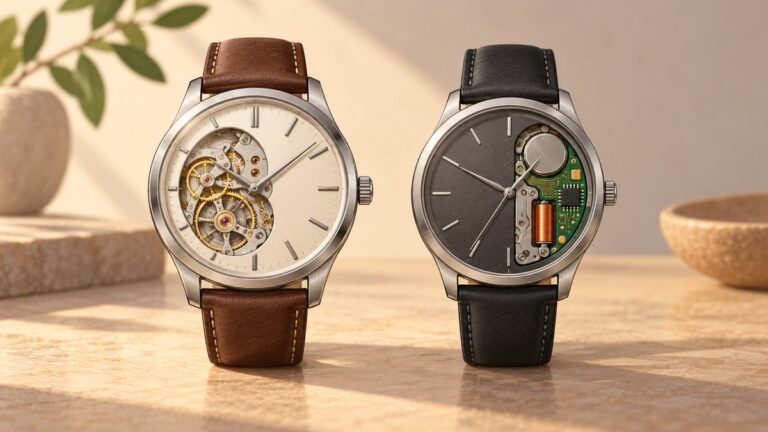
Repair Windows errors before they cause bigger problemsFix Now →Fix the driver behind crashes, sound loss and screen glitchesFind Drivers →Clear out junk files and repair common Windows errorsFree Scan →An automatic watch is a mechanical watch that winds its mainspring using motion from the person wearing it. A weighted rotor moves as the wrist moves; gears and a winding mechanism pass that motion to the mainspring, which stores energy to run the watch. It still needs care and may need winding or resetting after it stops.
How does an automatic watch work?
The American Watchmakers-Clockmakers Institute describes an automatic watch as a mechanical watch that uses gravity and a mechanical system to supply energy to an accumulator, usually a mainspring inside a barrel. In everyday wear, the rotor or oscillating weight responds to movement. A reduction gear train carries that motion through the winding mechanism to the mainspring.
The mainspring stores energy and releases it through the watch’s mechanical timekeeping train. Automatic describes the way the spring is wound; it does not mean the watch is electronic or maintenance-free. The winding system also needs a slipping mainspring arrangement to prevent winding beyond the spring’s working limit, and a means of preventing automatic winding from simply turning the crown.
What moves, and how is that motion used?
The weight’s travel and the route by which its motion reaches the mainspring vary by design. In a bumper mechanism, the weight moves through a limited arc and is stopped and redirected at the ends of its travel. A full rotor can turn continuously around the movement. Some winding systems accept rotor movement in both directions and transmit winding in one direction.
What’s actually slowing this PC down?
Pick the symptom - the matching free tool is one click away.
#1 Best Overall

- Stainless steel case 40mm diameter x 14.1mm thick; Exhibition case back; Black dial; Luminous hands.Band Length: 205mm
- NH35A Japanese Automatic movement, 24 jewel; Assembled in Malaysia; Watch weight 155 grams
- Includes gift box, instructions and 3 year limited manufacturer warranty; Invicta Customer Service can be reached at 1-800-327-7682 for questions (re: Additional links, band replacement, band adjustment, warranty questions, etc.)
Before wristwatches: automatic pocket watches
Self-winding experiments began long before automatic wristwatches. The British Museum’s historical note traces a pedometer winding system associated with Abraham-Louis Perrelet to as early as 1770. It describes Breguet’s perpétuelles of the 1780s, which used an oscillating platinum weight, and notes that Louis Recordon received a London patent in 1780. These were significant experiments and working examples, not the start of universal self-winding: key-wound and later stem-wound watches remained alternatives.
Breguet’s own history says the first Perpétuelle was sold to the Duc d’Orléans in 1780. The company also identifies a surviving repeating Perpétuelle, no. 1/8/82, completed in 1782. That account is a primary source for Breguet’s watches; the broader early history is better understood as a developing lineage than as a settled contest over a single inventor.
Rank #2

- Stainless Steel case with Black Resin Band
- Black Dial with date window at 3 O'clock
- Luminous markers and hour hands; sweep second hand
- Anti-reverse bezel
- Water-resistant to 200 M (660 feet)
How did John Harwood make an automatic wristwatch?
Putting an automatic mechanism in a wristwatch posed a packaging challenge: the winding weight and its bearing had to fit in a much smaller case and still wind effectively. According to the British Museum, John Harwood began work on a Swiss-made 13-ligne wristwatch movement in 1922 and received British patent 218,487 in 1923. The museum documents a Swiss-made Harwood self-winding watch in production in 1929.
A limited-arc rotor and a bezel for setting
Harwood’s winding weight moved back and forth through a limited arc, meeting spring buffers at the ends of its travel. The design did away with the usual winding stem and crown. Instead, turning the front bezel operated the hand-setting mechanism; an aperture showed when the setting mechanism was engaged. The museum notes that production was short-lived and affected by the 1930s slump.
Rank #3

- [Luxurious Mechanical Watch] High quality hollow mechanical watch appearance retro gorgeous, exquisite carving and design of the golden appearance of the European nobility more highlight your noble identity extraordinary taste, to bring you a pleasant luxury experience
- [Mechanical Movement] This watch has manual self-winding. Please consider that mechanical watches that require manual winding can only keep time for a short time after winding. To prevent running or inaccurate time, it is advised that you verify the time periodically and wind up the chain 15–20 times.
- [Waterproof] Water resistant to 50m (165ft) -suitable for short periods of recreational swimming and showering, but not diving or snorkeling
- [Ideal as a Gift] This beautiful retro-style watch can be worn on any occasion or given as a gift to your father, brother, partner, or boyfriend. At weddings and any holiday gatherings, it can be a really appreciated and elegant gift.
- [Professional After-Sale Service] Please contact us if you need any additional details about our watches. We will be happy to answer and help you anytime.
Harwood later recalled of an early experimental model: “The first experimental model, I must say, was by no means efficient.” The recollection, reproduced by the British Museum, captures a central challenge of early automatic wristwatches: making a compact winding system work reliably in practice.
What was the Rolex Perpetual rotor?
Rolex dates its Oyster waterproof and dustproof wristwatch to 1926 and its Perpetual rotor system to 1931. The company says wrist movement winds the watch through the rotor and describes its 1931 mechanism as “the world’s first self-winding mechanism with a Perpetual rotor.” That priority wording is Rolex’s claim. It is distinct from Harwood’s earlier patented and produced wristwatch, which used a limited-arc bumper design.
Rank #4

- Invicta Pro Diver Automatic Champagne Dial Men's Watch 49317
The two dates describe different engineering milestones. In Rolex’s account, the Oyster case addressed protection from dust and water, while the Perpetual rotor addressed automatic winding. The company connects the two as the basis of the Oyster Perpetual concept; the rotor date should not be confused with the earlier Oyster case date.
Independent reader supportYour contribution helps us test, update, and keep practical guides available for everyone.How did automatic winding develop after the early wristwatches?
Seiko’s Magic Lever, 1959
Seiko’s museum dates the Magic Lever to 1959. The mechanism takes rotor movement in either direction and converts it into one-direction transmission at the winding wheel. The museum identifies the Gyro Marvel as the first Seiko watch to use it. It is one documented solution to the problem of using movement efficiently, rather than a claim that all automatic watches wind in the same way.
Best Value

- VERSATILE STYLE: From desk to dinner, daily commute to jet-set journey, think of this Fossil watch for men as his best-dressed essential; with an exposed automatic movement, it's a sleek, pulled-together style that never takes itself too seriously
- CASE & MOVEMENT: An automatic watch with a 44mm case, 22mm band width, hardened mineral crystal lens resists scratches, accurate Automatic movement with accurate analog watch display, imported
- DIAL: One of many among Fossil watches for men, this quartz watch features a round silver stainless steel case, with a blue satin and skeleton dial and gold accents
- WRIST WATCH BAND: Brown, genuine leather band with a secure adjustable buckle closure for a customized fit of this wristwatch; interchangeable with all 22mm Fossil watch straps
- WATER RESISTANT MEN'S WATCHES: Up to 50m (165ft); wearable for short periods of recreational swimming and showering, but not diving or snorkeling; 5 ATM
The Sportsmatic 5, 1963
Seiko’s company history dates the Sportsmatic 5 to 1963 and describes it as combining automatic winding with a visible day-date display, a waterproof structure, shockproof structure and the Magic Lever. It illustrates how automatic winding appeared in watches with a broader set of practical features, beyond the early engineering novelty.
How do automatic winding designs differ?
| Design | Weight travel | How motion is transmitted | Setting or winding detail |
|---|---|---|---|
| Harwood bumper wristwatch | Limited arc; the weight meets spring buffers and reverses. | The oscillating weight drives the winding system; the British Museum account describes the design but does not specify a bidirectional transmission detail. | No normal winding stem or crown; turning the front bezel operated the hand-setting mechanism. |
| Rolex Perpetual rotor | Rolex describes a Perpetual rotor; the cited company history does not specify its travel in further technical detail. | Rolex says wrist movement winds the watch. The cited history does not state whether winding is transmitted from one or both directions of rotor movement. | The cited Rolex history does not detail the setting arrangement. |
| Seiko Magic Lever | The cited Seiko museum account describes rotor motion but does not specify a limited or full rotation arc. | Rotor motion in either direction is converted into one-direction transmission. | The cited museum account does not detail the setting arrangement. |
The designs answer different mechanical questions: how far the weight can travel, how the movement is passed on, and how the wearer sets or winds the watch. A particular winding mechanism should not be assumed to reveal a watch’s intended price or market; the cited histories do not establish broad market comparisons.
Quick Recap
Product prices and availability are accurate as of the date/time indicated and are subject to change. Any price and availability information displayed on Amazon at the time of purchase will apply.