An astronomical watch adds one or more displays tied to celestial cycles or phenomena—such as the Moon’s phase, the stars’ positions, or the difference between clock time and solar time—to the timekeeping found on a standard watch. The term describes a broad family of functions, not one required layout or a promise of greater accuracy.
How is an astronomical watch different from a standard watch?
A standard watch is principally for indicating civil time. An astronomical watch adds information about the sky or a celestial cycle; its underlying timekeeping movement can otherwise be conventional. The distinction is in what the dial also tells you, not necessarily in how the watch keeps ordinary hours and minutes.
As an Amazon Associate I earn from qualifying purchases.
There is no single complication that every astronomical watch must have. A watch might show only the Moon’s phase, or combine several indications, such as sidereal time, a star chart, or sunrise and sunset. Jaeger-LeCoultre describes celestial complications as capturing astronomical cycles such as moon phases and the sidereal day (Jaeger-LeCoultre’s explanation of celestial complications).
What does a moon-phase watch show?
A moon-phase display indicates the Moon’s changing appearance over its cycle, usually with a small image of the Moon moving across a dial aperture. It does not, by itself, show the Moon’s position in the sky or tell you when it rises. The mechanism may be a simple approximation or a more precise astronomical moon-phase display.
#1 Best Overall

- 40mmmm stainless steel case
- 8 inch brown two- piece quick release
- blue dial
- mineral glass lens
- water resistant up to 50 meters
| Mechanism described by watch.swiss | Cycle represented | Approximate correction interval stated |
|---|---|---|
| Simple moon-phase mechanism | About 29.5 days | Once every 2 years and 7 months |
| Astronomical moon-phase mechanism | 29 days, 12 hours and 45 minutes | Once every 122 years |
These are figures watch.swiss gives for the mechanisms it describes, not specifications that apply to every watch in either category. The actual lunar cycle is cited as 29 days, 12 hours, 44 minutes and 2.8 seconds; a mechanism’s displayed cycle can differ slightly, which is why correction intervals vary (watch.swiss on astronomical complications). A moon-phase display is therefore not automatically maintenance-free or perfectly synchronized with the Moon.
What is sidereal time on a watch?
Sidereal time measures Earth’s rotation relative to distant stars, rather than relative to the Sun. A sidereal day is about 23 hours, 56 minutes and 4 seconds in mean solar time—roughly 3 minutes and 56 seconds shorter than a mean solar day. Because stars return to similar apparent positions at the same sidereal time, the measure is useful in astronomy.
Rank #2

- 14K GOLD PLATED VINTAGE DRESS WATCH – Features an elegant gold tone case with a clean dial and bold Arabic numerals, designed for men who appreciate classic vintage style. Suitable as an everyday wear watch or for formal occasions, this analog watch effortlessly elevates any outfit.
- SUN MOON PHASE DISPLAY – The decorative sun-moon phase dial adds a sophisticated vintage complication that sets this timepiece apart from ordinary mens dress watches. A stunning conversation piece and a standout feature among gold tone analog watches for men.
- ACCURATE JAPANESE QUARTZ MOVEMENT – Powered by a precise Japanese quartz movement for reliable everyday timekeeping with minimal maintenance. Built to last and backed by the Peugeot reputation for quality affordable luxury watches for men.
- GENUINE LEATHER STRAP – Soft, durable, and fully adjustable genuine leather band fits a range of wrist sizes comfortably. Perfect as a mens leather watch for the office, date nights, weddings, or any special occasion.
- PEUGEOT LIFETIME WARRANTY & GIFT READY – Every Peugeot watch is backed by a Lifetime Warranty including free battery replacement for the life of the watch. Arrives beautifully gift boxed — ideal as a birthday gift, anniversary gift, graduation gift, or holiday gift for men.
On a watch, a sidereal-time indication is a separate time scale, not another name for ordinary local time. George Margetts’s 1778 watch at the British Museum illustrates how such displays can work: its dial turns once per sidereal day, while the solar and lunar hands follow their respective cycles. The Museum notes that the watch’s movement was standard for its period, despite the elaborate astronomical dial (British Museum collection record for George Margetts’s astronomical watch).
Quick wins for a faster PC:
Clear out junk files and repair common Windows errorsFree Scan →Fix the driver behind crashes, sound loss and screen glitchesFind Drivers →What does equation of time mean on a watch?
The equation of time is the difference between mean time—the averaged time used by clocks—and apparent solar time, which follows the Sun’s actual position as a sundial would. The difference changes through the year, so an equation-of-time display indicates how far the two time readings diverge at a given date. Audemars Piguet explains the complication as showing the difference between mean time and true solar time (Audemars Piguet’s explanation of astronomical complications).
Rank #3

- For a touch of modern elegance and functionality, the women’s Calendrier not only tracks the phases of the moon, but also displays the time, month, day, and date.
- The mother-of-pearl dial in a beautiful blue hue is inset with diamond accents and has reflective qualities.
- Due to the iridescent properties of mother-of-pearl, no two dials are alike in color and tone, creating a unique look.
- Along with a versatile 37mm silver-tone stainless steel case and bracelet, it runs on Eco-Drive technology, meaning it’s sustainably powered by any light and never needs a battery
- Blending elevated style and advanced features into one elegant timepiece.
What other astronomical displays might a watch have?
- Sky chart: A chart of stars visible in a particular part of the sky; some charts may also depict the Moon. Its usefulness depends on what portion of the sky and what location or settings the watch represents.
- Sunrise and sunset: Indications of the times those events occur. The display’s accuracy and setup depend on the mechanism and its settings.
- Tide times: A tide indication can represent predicted high or low tides, sometimes for named ports. It is not interchangeable with a general display of the Moon’s phase.
- Perpetual calendar: A calendar function that accounts for calendar variations. It is often grouped with celestial complications, but it tracks the calendar rather than directly depicting the sky.
These are distinct functions, and a watch may combine several. Patek Philippe’s glossary, for example, treats sky charts and sidereal time as separate complications (Patek Philippe glossary).
Independent reader supportYour contribution helps us test, update, and keep practical guides available for everyone.How can one watch combine ordinary timekeeping and astronomy?
George Daniels’s Space Traveller II, described by the Science Museum, displays mean solar time and sidereal time, along with moon phase, an annular calendar and equation of time. Its stopwatch can operate using either solar or sidereal time. It demonstrates that astronomical indications can sit alongside familiar timing functions rather than replace them (Science Museum article on the Space Traveller II).
Rank #4

- Timeless styling that effortlessly takes you from work to play.
- Analog Month/Day/Date, Moonphase Indicator
- Black Stainless Steel
- Spherical Mineral Crystal
- 100 Meters Water Resistant and 5 Year Limited Warranty
An earlier example shows the range possible in a different design. Margetts’s 1778 watch combines a rotating dial with indications for the Sun, Moon, zodiac, visible stars, lunar age and high-tide times for named ports. These examples are historically specific; they do not establish a standard feature set for astronomical watches today.
Do these 3 things before closing this tab:
1Scan for outdated or missing drivers - takes under a minute2Clear out junk files and repair common Windows errors3Fix the driver behind crashes, sound loss and screen glitchesQuick Recap
Best Value
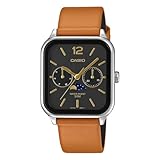
- To the moon and back - track the lunar phases with striking analog timepieces featuring multiple inset dials
- These timepieces bring together stylish fashion and classic lunar design
- Case size (L? W? H): 44.5 ? 34 ? 9.4 mmCase and bezel material: Stainless steel Band: Genuine Leather BandWater resistance: 50-meter water resistancePower supply and battery life: Approx
What should you compare when assessing an astronomical watch?
- What does the display track? Identify whether it shows a lunar phase, a time scale, solar-time difference, a sky chart, or an event such as a tide.
- How closely does it follow the phenomenon? For cycle-based displays, check whether the mechanism approximates the cycle and how often it needs correction.
- What settings does it require? Some indications may depend on the date, time, latitude or longitude. Confirm which settings the specific watch needs rather than assuming every display is automatic.
- Can you read it easily? A technically rich dial is only useful if its indications are legible to you.
- Does it serve a practical purpose for you? Some displays can help with observation or planning; others chiefly demonstrate mechanical craft. A higher complication count does not necessarily make a watch more useful in daily wear.
Product prices and availability are accurate as of the date/time indicated and are subject to change. Any price and availability information displayed on Amazon at the time of purchase will apply.




