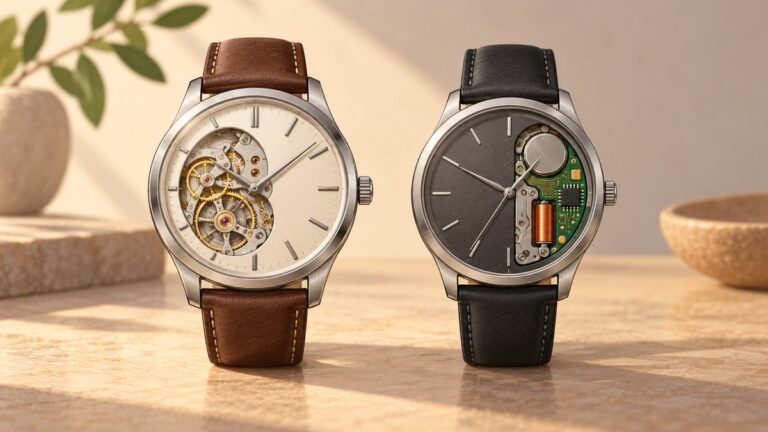
Watches tick because their movements release power in timed increments to move the hands. In a mechanical watch, a mainspring drives gears and an escapement meters the release. In a common analog quartz watch, an electronic circuit turns a vibrating crystal’s signal into timed pulses that drive a step motor. The visible seconds-hand motion and the sound you hear are related, but they are not the same thing.
What “ticking” can mean
People use “tick” for two different observations: the sound coming from a movement and the seconds hand’s visible steps. A watch can have a conspicuous one-second hand jump without a loud sound, or a mechanical movement can make an audible beat while its hand appears to sweep. Case construction, movement design and listening conditions affect what you hear, so not every watch is necessarily audible in every setting.

Why a mechanical watch ticks
A mechanical watch stores energy in a wound mainspring. As the spring unwinds, a gear train carries that energy toward the hands. The escapement regulates its release: the balance wheel oscillates and unlocks the escapement in alternating beats, allowing the escape wheel to advance. The characteristic mechanical tick is associated with an escape-wheel tooth contacting an entry or exit pallet stone. A hand-wound watch gets its energy when you wind the crown; an automatic watch uses wrist motion to wind its mainspring. Fratello Watches and manufacturers Hamilton and Victorinox describe these components and their roles.
Why some mechanical seconds hands look smooth
Mechanical hands also move in discrete increments. If a movement beats rapidly enough, the small advances can merge into an apparent sweep at ordinary viewing distance. For example, Fratello gives 28,800 vibrations per hour as a movement-rate example: divided by 3,600 seconds, that is eight vibrations per second. It is an example, not a specification shared by all mechanical watches; movement designs and beat rates vary.
#1 Best Overall
- Winding Mode: Manual Winding
- Model Number: ST3600
- Case Diameter: Approx. 37.2mm
- Thickness: Approx. 4.50mm
- Frequency: 21600
Why a quartz watch often ticks once a second
In a typical analog quartz watch, a quartz crystal vibrates at a stable frequency and an electronic circuit divides that signal into timed pulses. NIST says most wristwatch quartz crystals vibrate at 32,768 Hz; dividing by 32,768 produces one-second ticks. The circuit’s output controls a step motor, which advances the seconds hand, commonly in a visible one-second jump. The crystal itself is vibrating many thousands of times a second—the hand’s jump is not a direct view of those vibrations. See NIST’s timekeeping FAQ and Seiko’s quartz explanation.
One step per second is common, not universal. Some quartz designs move the hand more frequently; Fratello notes that higher-frequency examples can use more battery power. A watch’s hand motion therefore does not, by itself, tell you everything about how its movement is regulated.
How the movement types compare
| Movement | Power source | Regulating element | Typical seconds-hand motion | Sound |
|---|---|---|---|---|
| Mechanical | Wound mainspring; wound by crown or, in an automatic watch, wrist motion | Balance and escapement | Discrete beats; faster beats can look like a sweep | Ticking is associated with escape-wheel and pallet-stone contact |
| Common analog quartz | Battery | Quartz oscillator and electronic circuit | Usually one step per second, though some designs step more often | The visible step is a motor action; audibility varies |
| Spring Drive | Mainspring | Quartz oscillator and electronic control regulate a glide wheel | Smooth glide | Silent glide rather than a traditional escapement beat |
Hamilton characterizes quartz watches as stronger in accuracy and reliability while noting the appeal of mechanical craftsmanship. That is a broad manufacturer perspective, not a quantified ranking that applies to every watch or wearer. For practical purposes, the key distinction here is how each movement stores and regulates energy, not whether a particular hand looks more or less continuous.
Spring Drive: mainspring power with quartz regulation
Grand Seiko’s Spring Drive shows why “mechanical versus quartz” is not always a simple either-or. A mainspring supplies the power and drives a glide wheel. The system generates electricity for a 32,768 Hz quartz oscillator and an integrated circuit; the circuit compares the reference signal with the wheel’s rotation and applies electromagnetic braking as needed. The result is a smooth, silent seconds-hand glide, rather than the beats of a traditional escapement or the common one-second step of analog quartz. Grand Seiko explains the Spring Drive movement; the Seiko Museum’s Spring Drive overview provides additional background.
Rank #3

- 【 ALLOY MATERIAL】The quartz watch movement is alloy material, and not easy to deform, the alloy watch movement can effectively resist oxidation and rust.The watch movement repair part is and not easy to deform,easy to use.
- 【PRACTICAL】A good replacement for old or damaged mechanical movements.Easy to install and to use.Watch movement accessories have stable characteristics and high reliability keep its long service life.
- 【EXQUISITE APPEARANCE】Watch repair kit,exquisite and small size, simple and compact design,easy to carry.Bring you a comfortable and convenient daily life experience.
- 【IMPORTANT WATCH REPLACEMENT ACCESSORIES】The watch repair tool kit is important watch replacement accessories which is easy to install and to use.The watch repair tool kit is the necessary accessory for watchrepair.
- 【SUITABLE FOR】The watch repair tool is suitable for watchmakers and watch repairmen,and also for you to replace your own watch movement at home.The watch repair tool is easy to carry the watch repair kit set and get the job done by anywhere.
Why quartz became associated with one-second jumps
Seiko’s Quartz Astron 35SQ, identified by the Seiko Museum Ginza as the first quartz wristwatch, launched on December 25, 1969. The museum reports that the original Astron used an 8,192 Hz oscillator and gives its accuracy as ±0.2 seconds per day and ±5 seconds per month. Later quartz timepieces adopted 32,768 Hz as a standard frequency. Those figures describe the Astron and the museum’s historical account; they are not accuracy claims for quartz watches generally.
Common misconceptions about ticking watches
- “Quartz ticks; mechanical watches sweep.” Both can move in increments. Rapid mechanical beats may appear smooth, while many analog quartz watches make a one-second jump.
- “A smooth-looking hand moves continuously.” It may be advancing in rapid discrete steps. Spring Drive is a distinct design that produces a smooth glide.
- “The hand’s movement explains the sound.” The mechanical tick is associated with escapement contact; a quartz hand’s jump is an electrically timed motor action. Visible motion and sound should not be treated as the same phenomenon.
- “Every watch must make an audible tick.” Whether you hear one depends on the movement, case and listening conditions.
Further reading on timekeeping
For a broader introduction to time and frequency—not a watch-repair guide—NIST recommends From Sundials to Atomic Clocks in its timekeeping FAQ.
Quick Recap
Best Value

- [Practice Watch Repair Skills] These non-functional watch movements are designed for beginners, students, and hobbyists to practice disassembly, assembly, and movement structure research.
- [Learning & Training Material] Ideal for understanding mechanical watch components, internal structures, and basic repair techniques without using a working movement.
- [Random Vintage Styles] Includes assorted old movement styles shipped randomly, providing different structures and designs for exploration and hands-on learning.
- [ DIY Practice Option] A practical choice for beginners who want to learn watch repair skills, test tools, and improve handling techniques before working on valuable watches.
- [10 Piece Value Pack] Includes 10 non-working watch movements, suitable for watchmaking practice, classroom demonstrations, hobby projects, and movement study.
Rank #4

- 100% Brand new and high quality.
- Product material is strong, durable, long service life.
- Can be used as a spare parts to facilitate the replacement of your movement.
- Single calendar movement, high accuracy.
- Type:2813
Product prices and availability are accurate as of the date/time indicated and are subject to change. Any price and availability information displayed on Amazon at the time of purchase will apply.