Recommended Free Tools
Oris is the independent Swiss mechanical watch brand that survived the quartz crisis by changing its business model. Founded in Hölstein in 1904 as an industrial maker of relatively affordable pin-lever watches, it grew into a multi-factory manufacturer, reached a reported peak of roughly 1.2 million watches and clocks per year, nearly collapsed during the quartz era, and then rebuilt itself around mechanical watches and practical complications.
That transformation explains the brand’s modern character: the red rotor, Big Crown and Pointer Date, Aquis and Divers Sixty-Five tool watches, ProPilot aviation designs, and selective in-house movement families are products of a strategic reinvention—not a simple continuation of an unchanged artisanal tradition.
Oris began as an industrial watchmaker, not a small artisanal atelier
Oris was founded to make practical, relatively affordable watches at industrial scale. That original identity matters because the company’s modern reputation as an independent mechanical specialist was not simply inherited from 1904. It was rebuilt after the quartz crisis, when Oris abandoned quartz and chose mechanical watches as its entire strategic focus.
The result is a history shaped by three major reversals: a small Hölstein factory became a multi-site manufacturer; a successful pin-lever business was constrained by Swiss regulation; and a company that once produced more than a million watches and clocks annually was reduced to a few dozen employees before independence and mechanical specialization gave it a new direction.
#1 Best Overall

- Material: This band is made of durable double-layer nylon weave and the nylon fabric is crafted from cotton woven material which is exceptionally soft and light, making comfortable to wear.
- Band Width (Size): Standard 16mm, 18mm, 19mm, 20mm, 21mm, 22mm, 24mm. This watch band is compatible with all watches (including smart watches) with above band width. To determine the right size, use a ruler measure the interior distance between the two lugs on the watch case.
- Adjustable: Fit wrist 14.5cm-22cm (5.7-8.6 inches). Adopt an durable Hook and Loop closure which can be cycled (opened and closed) thousands of times, allowing the watch to be fastened or adjusted in seconds.
- Quick Release Design: Quick release spring bars allow you to easily install and remove the watch band without tools. You just need to slide quick release knob with finger.
- Washable: This one-piece strap can be washed when it gets dirty because its color is a permanent ink that will not fade. Ideal for sports and everyday use.
1904: Oris is founded in Hölstein
Paul Cattin and Georges Christian founded Oris in Hölstein, Switzerland. On June 1, 1904, they purchased the recently closed Lohner & Co. factory and signed an agreement with Hölstein’s mayor. The company took its name from a nearby brook.
From the beginning, Oris was oriented toward useful, affordable production rather than haute horlogerie. Its early watches used Roskopf-style pin-lever escapements. A pin-lever movement was simpler and less expensive to produce than a traditional Swiss lever movement, making it appropriate for a company whose proposition was dependable mechanical timekeeping at a lower price.
That choice later became a competitive and regulatory problem, but it also explains why Oris’s history cannot be reduced to a story of luxury watchmaking. The brand’s industrial DNA—cost-conscious construction, volume production, and functional design—was present before its modern tool-watch collections existed.
1906–1925: from one factory to a production network
Oris expanded quickly beyond its original Hölstein site:
Quick wins for a faster PC:
Clear out junk files and repair common Windows errorsFree Scan →Fix the driver behind crashes, sound loss and screen glitchesFind Drivers →| Year | Development |
|---|---|
| 1906 | A facility opened in Holderbank. |
| 1908 | Oris added a factory in Como. |
| 1911 | The company had become Hölstein’s largest employer, with more than 300 workers. |
| 1916 | A facility opened in Courgenay. |
| 1925 | Oris added facilities in Herbetswil and Ziefen. |
The network was more than a collection of assembly locations. Ziefen, for example, was associated with electroplating. Oris was building specialized industrial capacity across multiple sites, including the ability to make tools and machinery for its own production.
A contemporary enthusiast-history account reports that Oris had made more than one million watches by 1914 and later promoted a production rate of approximately one watch every three seconds once its factory network was operating. Those figures are useful indicators of the company’s intended scale, but they should be treated as historical-account claims rather than independently audited production statistics.
The gradual move from pocket watches to wristwatches
Oris’s move into wristwatches was not a single, unambiguous event. Some historical accounts identify an early pilot-oriented wristwatch in 1917. Oris’s own later chronology treats 1925 as the more meaningful date—the point at which the company began manufacturing wristwatches in earnest.
Both statements can be true if they describe different stages: an early or specialized wristwatch in 1917, followed by a broader and more deliberate production transition in 1925. The distinction is important because it avoids presenting a reported early pilot watch as proof that Oris had already converted its entire business from pocket watches.
1927–1971: the long Herzog era
Georges Christian died in 1927. Jacques-David LeCoultre subsequently became president of Oris’s board, while Christian’s brother-in-law, Oscar Herzog, became general manager in 1928. Herzog remained in that position until 1971, making him the central executive figure in Oris’s most consequential period.
Under Herzog, Oris expanded into a substantial manufacturer, but it also had to operate within an increasingly difficult regulatory environment. The company’s pin-lever technology helped it serve a value-conscious market, yet competitors using Swiss lever escapements were widely perceived as having a technical advantage.
The Swiss Watch Statute and Oris’s fight for technical freedom
On March 12, 1934, Switzerland introduced the Watch Statute. The system was intended to protect and regulate the national watch industry, but it also restricted companies from introducing certain technologies without authorization.
For Oris, the consequences were particularly important. Its use of pin-lever, or Roskopf-style, escapements was central to its business model, while the company was constrained in adopting the Swiss lever technology used by many competitors. The statute did not make Oris’s watches worthless, nor did it single-handedly cause all of the company’s later problems. It did, however, limit the speed at which Oris could respond to a changing technical market.
Do these 3 things before closing this tab:
1Fix the driver behind crashes, sound loss and screen glitches2Clear out junk files and repair common Windows errors3Scan for outdated or missing drivers - takes under a minuteRank #2

- SELECT PROPER SIZE: Before buying, please measure your watch lug width correctly (in mm) and choose proper width watch bands for your watch is very important. We provide 20mm 22mm nylon watch bands, can meet your different size needs. The interchangeable straps are compatible with regular and smartwatches that use standard spring bars. You can refer the picture or 'Product Description' section on this page to measure, or contact us directly
- PREMIUM MATERIAL: Tobfit replacement sport nylon watch band for women and men is made of Durable and Premium tighter woven nylon materials, which can prevent skin from irritation rash, it is soft, durable, breathable, washable, drying fast and comfortable to wear. A great alternative to silicone bands for daily workouts. Soft and comfortable feeling brings good time all day
- PERSONALIZED DESIGN: The unique nylon weave dense hook-and-loop design let you can adjust the band size as you like. The nylon watch bands with reinforced to prevent smartwatch from falling. The lightweight material will not let your wrist have any burden even if you are exercising. Various popular colors are available for women and men, Looks more elegant. Makes Your Smart Watch Looks More Fashionable, Youthful. Best Choice of Any Occasions Like Travel, Work, Party
- SECURE CONNECTOR: Quick Release design saves your time that makes it fast and simple to install and replace your nylon watch band. You may slide lever with finger to attach the strap to your watch, which lock onto the Smart watch interface precisely and securely. The stretchy elastic soft nylon wristband with a adjust clasp for quick and easy adjustment. And it will fit for 6"-8.3" (150mm-210mm) wrists which covers most of the population
- QUALITY CONTROL: 100% Flawless, Our Nylon Sport Watch Replacement Band Are Sold Without Any Scar And Dirt, Every Piece Of nylon weave Watch Band is Selected Carefully. If There Are Any Problems With our watch Band You Received, Just Feel Free to Contact Us And Then We Will Offer A Fast Replacement Or Of Your Money Solution Immediately.
Oris eventually challenged the restrictions through legal and institutional means. In 1956, Oscar Herzog hired lawyer Rolf Portmann, who spent years campaigning against the limitations. The Watch Statute was gradually liberalized and was ultimately abolished in 1971.
Once the restrictions were removed, Oris introduced lever-escapement movements, including Calibre 645 and subsequently Calibre 652. Oris’s official history identifies Calibre 652 as receiving full chronometer certification from the Observatoire Astronomique et Chronométrique. The change was more than a technical footnote: it represented Oris finally gaining the freedom to compete on the same movement terms as much of the Swiss industry.
Oris at its industrial peak
By the end of the 1960s, Oris’s official historical account places the company among the world’s ten largest watch companies. It employed roughly 800 people, produced approximately 1.2 million watches and clocks annually, made its own tools and machinery, and maintained an apprenticeship program for engineers and watchmakers.
Some accounts put the late-period workforce closer to 900 employees. That difference does not necessarily indicate a contradiction: the figures may refer to different points in the company’s employment cycle. The consistent point is that Oris was a large, vertically capable manufacturer—not a niche brand operating from a single workshop.
What’s actually slowing this PC down?
Pick the symptom - the matching free tool is one click away.
This peak makes the subsequent collapse particularly significant. Oris had the scale, infrastructure, and technical culture of a major industrial business. The quartz crisis did not merely reduce sales; it undermined the economic logic of the mechanical production system on which the company had been built.
1970–1982: ASUAG, quartz, and near-collapse
In 1970, Oris joined ASUAG, the large Swiss watch group that later became associated with the Swatch Group. The timing placed Oris inside a rapidly changing industry just as quartz technology began to transform what consumers expected from a watch.
Quartz watches offered inexpensive, highly accurate timekeeping and required a very different manufacturing and commercial model. The crisis had technological and market causes of its own; it should not be explained as a simple continuation of the Watch Statute problem. The statute had constrained Oris’s earlier movement choices, while quartz attacked the market for mechanical watches much more broadly.
Oris’s workforce fell from a peak variously reported at approximately 800 to 900 employees to only a few dozen, according to the company’s official history. The decline illustrates how close the business came to disappearing as an independent manufacturer.
PC Slower Than It Used to Be?
A free scan shows the junk files, broken settings and background clutter dragging Windows down - then fixes them in one click.Free scan · Windows 10 & 11Outdated Drivers Are Slowing You Down
One free scan finds every outdated or missing driver and matches the right update for your exact hardware.Free scan · exact hardware matchIn 1982, Rolf Portmann and Ulrich W. Herzog led a management buyout that created the new Oris SA and restored the company’s independence. The buyout did not instantly erase every quartz product. Oris’s mechanical-only strategy followed the transaction and was implemented progressively: another Oris account describes the renewed mechanical focus as beginning in 1985, with quartz watches phased out by the early 1990s.
The decisive choice: mechanical watches only
Oris’s post-buyout decision was unusual because it rejected the technology that had come to dominate the mass market. The company did not attempt to compete with quartz on price, accuracy, or electronics. Instead, it concentrated on mechanical watches and built a new identity around useful complications, recognizable tool-watch designs, and comparatively accessible Swiss mechanical products.
This was a reinvention, not a return to an unchanged past. Oris had made quartz watches, had operated at enormous industrial scale, and had used third-party as well as internally developed technologies. The mechanical-only strategy was a deliberate answer to the quartz crisis rather than proof that the brand had never changed.
1991: Calibre 581 makes the strategy credible
The 1991 Calibre 581 helped demonstrate that the mechanical strategy could produce more than simple time-only watches. It included a moon-phase module developed by an internal team and was described by Oris as its most complicated calibre at the time.
Quick wins for a faster PC:
Clear out junk files and repair common Windows errorsFree Scan →Fix the driver behind crashes, sound loss and screen glitchesFind Drivers →Rank #3

- SIZE SELECTION: Available in 14mm 15mm 16mm 17mm 18mm 19mm 20mm 21mm 22mm 23mm and 24mm, please accurately measure your watch lug width and choose the right size
- WATCH BAND MATERIAL: Vintage Crazy Horse Leather lined with soft genuine leather, comfortable on your wrist, polished solid stainless steel buckle
- RETRO LOOKING: Natural crack appears when the leather is bent (NOTE: the black strap no crack), elegant and stylish. It's a loud little piece that express your style and personality
- BAND LENGTH: This strap is a regular length, suitable for wrists of 6" to 8", please refer to figure 6 for details
- BISONSTRAP SERVICE:If there are any question about the strap, please email us. REFUND or FREE REPLACEMENT, we will try our best to satisfy every customer
Calibre 581 was important symbolically as well as technically. After the company had survived by narrowing its focus, a complication such as a moon phase showed that mechanical specialization could support distinction and development rather than merely nostalgia.
1997: the Worldtimer turns complication into a practical tool
Oris’s 1997 Worldtimer expressed one of the brand’s recurring design principles: a complication should solve a real problem for the wearer.
Pushers on either side of the case allowed local time to be moved forward or backward in one-hour increments. If the adjustment crossed midnight, the date changed with it. That arrangement was more convenient than asking the wearer to stop the watch and manipulate the crown through multiple settings, particularly when traveling across time zones.
The Worldtimer therefore fits Oris’s broader identity better than a complication included solely for display. It made a mechanically sophisticated feature directly useful in everyday travel.
The Tool Desk
Outbyte Driver Updater FREEScan for outdated or missing drivers - takes under a minuteDriver Scan →Outbyte PC Repair FREERepair Windows errors before they cause bigger problemsFix Now →2002–2004: the red rotor, tool-watch functions, and the centenary
In 2002, the red automatic rotor became a registered Oris trademark. The rotor gave automatic Oris watches an immediately recognizable visual signature, but its significance went beyond color. It helped communicate the brand’s modern position: Swiss-made mechanical watches, practical functions, and a price-conscious alternative to the most expensive names in Swiss horology.
The early 2000s also saw Oris develop functions for specialist environments:
- Williams Formula 1 partnership: Oris entered a strategic partnership with the Williams Formula 1 team in 2003 and released WilliamsF1 watches.
- Quick-Lock Crown: a crown-security system intended to help protect the case against accidental opening.
- BC4 Flight Timer: an aviation-oriented design using vertical crown control.
- Rotation Safety System: a system for diving bezels designed to reduce the risk of an unintended bezel movement.
These were not unrelated product experiments. Motorsport, aviation, and diving gave Oris contexts in which a watch’s controls and protections could be judged by function. They also helped establish the specialist, tool-oriented design language that became central to the modern brand.
Oris celebrated its 100th anniversary in 2004 with the Centennial Set, limited to 1,904 pieces. The set paired an Atelier Worldtimer using Calibre 690 with a mechanical eight-day alarm clock. Including the clock connected the anniversary to Oris’s broader history as a maker of clocks as well as wristwatches.
Free tools Windows power users keep installed
One-click scans. No signup required.
The collections that carry Oris’s identity
Big Crown and Big Crown Pointer Date
The Big Crown is Oris’s historically important pilot-oriented family. Its Pointer Date heritage is associated with Oris’s 1938 design history, making the collection a direct link between the company’s early wristwatch period and its modern mechanical portfolio.
The oversized crown is functional as well as stylistic: it was designed to be easier to operate, including when the wearer was dealing with gloves or difficult conditions. The Pointer Date display adds a distinctive calendar function without turning the watch into an unnecessarily complex instrument.
Aquis
Aquis is Oris’s modern dive-watch family. Its identity is built around water resistance, a rotating diving bezel, and a robust everyday format. It represents the brand’s contemporary interpretation of the practical tool watch rather than a direct reproduction of a historical model.
Divers Sixty-Five
Divers Sixty-Five takes a more explicitly vintage-inspired approach to diving watches. It draws on Oris’s historical diving designs while presenting them in a form intended for modern wear. The collection shows how Oris can use its archive without abandoning current case construction and daily usability.
Recommended Free Tools
Rank #4

- 【Please measure the lugs before order】 Please make sure to choose the correct width strap for the watch. Follow the instructions in the second picture to measure the lugs of the watch
- 【Design】Fully polished stainless steel mesh watch band with brushed folding clasp, shining appearance, stylish and breathable. Quick Release Design(with 1.78mm dia quick release spring bars*4, two for directly using, two for spare), easy to fit and remove
- 【Double Lock Folding Clasp】Our stainless steel mesh watch bands, adopt 0.6mm dia stainless steel wire woven it with double lock folding clasp, you can adjust length of the band directly without using any tools
- 【Find Your Fit】20mm stainless steel metal mesh watch bands feel great on your wrist and fits any wrist 6.77''-8.58'' in circumference
- 【Comfort for Daily Wear】The breathable stainless steel mesh design improves airflow and reduces wrist pressure, making it comfortable for long hours of wear in both casual and business settings
ProPilot and Big Crown ProPilot
ProPilot is Oris’s aviation-focused line. The most technically unusual example is the Big Crown ProPilot Altimeter, announced in 2014 and described by Oris as the world’s first automatic mechanical watch with a mechanical altimeter. That “world’s first” wording should be attributed to Oris rather than treated as an independently verified universal historical conclusion.
Regardless of the superlative, the watch illustrates the company’s willingness to pair a mechanical movement with a literal instrument function. It is a particularly clear expression of Oris’s post-quartz strategy: mechanical watchmaking justified through use, engineering, and personality.
Artelier
Artelier is the more dress-oriented side of the collection structure. The name is connected with the 2002 Atelier collection and the 2004 Centennial Set, whose Worldtimer and alarm clock linked formal design to mechanical functionality.
2014: Calibre 110 and a selective return to in-house development
For its 110th anniversary in 2014, Oris introduced Calibre 110, its first fully developed movement in 35 years. Oris states that it had produced 279 in-house calibres before 1981, after which the quartz crisis and restructuring across the Swiss industry pushed the company toward third-party movements.
What’s actually slowing this PC down?
Pick the symptom - the matching free tool is one click away.
Calibre 110 was a carefully chosen statement of independence. It is a hand-wound movement operating at 3 Hz, with a 10-day power reserve and a non-linear power-reserve indicator. The long reserve was supplied by a single large barrel, while the non-linear display was intended to show the remaining energy in a more useful way than a simple linear scale.
The movement did not mean that Oris had become fully vertically integrated or that every Oris watch would use a company-developed calibre. Oris’s own help-center guidance distinguishes between selected models using the in-house-developed Calibre 110+ and Calibre 400+ families and other watches using Sellita or ETA movements.
That distinction is essential. In modern watch language, independent describes Oris’s ownership and strategic position. It does not mean every component, movement, or manufacturing process is performed internally. Oris’s history is better understood as selective in-house development combined with outside movement supply where that makes commercial and technical sense.
2016–2018: a modern identity takes shape
In 2016, Oris said its future had been placed in the hands of the next generation of leaders: joint executive officers Rolf Studer and Claudine Gertiser-Herzog. The same year, the company announced Maison Oris, its first Swiss boutique, operated in cooperation with jeweller Seiler.
In 2018, Oris introduced a new brand identity whose logo referenced the company’s 1904 founding and its Hölstein origin. This was a useful visual summary of the brand’s direction. Oris was presenting itself as both historically rooted and deliberately contemporary—an independent company whose mechanical identity had been chosen, tested, and refined over decades.
Independent reader supportYour contribution helps us test, update, and keep practical guides available for everyone.2021: climate neutrality and the limits of the claim
Oris’s 2021 sustainability reporting stated that the company became climate neutral in 2021 by calculating and offsetting its carbon emissions through ClimatePartner. The report also described a broader program intended to reduce emissions and support environmental initiatives.
The wording matters. Climate neutrality based on calculation and offsetting is not the same as eliminating all emissions from manufacturing, logistics, or operations. The most accurate historical account is therefore that Oris reported climate-neutral status through measurement and offsetting while beginning further emissions-reduction work.
Because 2021 is the endpoint of this article, later changes to Oris’s leadership, collections, prices, service policies, retailer availability, warranties, and sustainability reporting should be checked separately before publication or purchase. Current Oris materials continue to describe the company as independent and fully mechanical, but those are current-status claims rather than facts that should be projected backward across the entire company’s history.
Best Value

- 【Compatible】These straps are compatible with any watch (traditional or smartwatch) that uses standard 18mm spring bars. Measure the inner distance between two lugs on your watch casing. The strap will fit your watch only if the lug width of the watch is the same width as the strap. This stylish silicone watch strap can be matched with any style outfit, suitable for many occasions.
- 【Band Length】Fit wrists from about 5.7" to about 8" around, Length: 212mm | Width: 18mm | Thickness 2.6mm, 12 holes on the strap which will comfortably fit most men and women.
- 【Premium Quality Silicone Watch Bands】Made of high-quality Environmental super soft silicone, No peculiar smell and harmless, No allergies concerns, No sharp edges, lightweight, flexible yet fairly sturdy, watch strap can be washed repeatedly without fading.
- 【Great Wearing Experience】Soft Silicone Rubber Surface with Textured Non-slip Back, Waterproof & Washable.Perfect for outdoor fitness, sports, any type of workout, or everyday use. Integrated quick-release spring bars allow you to swap straps in seconds without any tools.
- 【Service】Please contact us if you have any trouble, we will respond to you within 24 hours. We take care of all quality-related issues with a replacement or 100% refund.
What Oris’s history actually means
Oris’s appeal is not based on an uninterrupted tradition of artisanal exclusivity. Its earliest success came from industrial production, affordable movements, multiple factories, and substantial output. The company was once a major volume manufacturer, complete with its own machinery and apprenticeship system.
Its modern identity emerged when that original model became vulnerable. Regulation had limited movement choices; quartz changed the economics of timekeeping; and the company nearly disappeared. The 1982 buyout then gave Oris the freedom to make a narrower choice: abandon quartz progressively, remain mechanical, and compete through useful functions and distinctive design rather than sheer scale.
That is why the red rotor, the Worldtimer’s hourly pushers, the Aquis bezel, the ProPilot Altimeter, and the Calibre 110 power reserve belong in the same story. They are different expressions of a consistent post-crisis argument: a mechanical watch should earn its place through engineering, legibility, durability, and practical character.
Oris history at a glance
| Year | Why it matters |
|---|---|
| 1904 | Paul Cattin and Georges Christian found Oris in Hölstein. |
| 1906–1925 | Oris builds a multi-factory industrial network. |
| 1917 / 1925 | An early pilot-oriented wristwatch is reported in 1917; Oris identifies 1925 as the start of serious wristwatch production. |
| 1934–1971 | The Swiss Watch Statute restricts technological adoption; Oris campaigns for greater freedom. |
| Late 1960s | Oris reaches its industrial peak, producing approximately 1.2 million watches and clocks annually according to its historical account. |
| 1970 | Oris joins ASUAG as the quartz crisis begins reshaping Swiss watchmaking. |
| 1982 | Rolf Portmann and Ulrich W. Herzog lead a management buyout and restore independence. |
| 1985–early 1990s | Oris progressively implements its mechanical-only strategy and phases out quartz. |
| 1991 | Calibre 581 introduces an internally developed moon-phase module. |
| 1997 | The Worldtimer introduces practical one-hour local-time adjustment. |
| 2002 | The red automatic rotor becomes a registered trademark. |
| 2004 | The Centennial Set marks the 100th anniversary with an Atelier Worldtimer and mechanical alarm clock. |
| 2014 | Oris introduces Calibre 110 and the Big Crown ProPilot Altimeter. |
| 2021 | Oris reports climate neutrality through calculated emissions and offsetting. |
Scope and sourcing: This history is centered on Oris through 2021. Historical production figures, superlative claims, and sustainability language are attributed to the brand or historical accounts where appropriate; they should not be read as independent audits of every figure or claim.
Frequently Asked Questions
Was Oris always a mechanical-only watch brand?
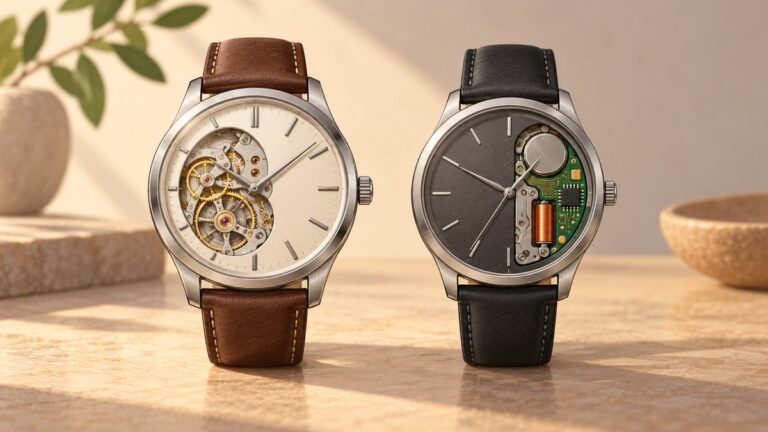
No. Oris began with relatively affordable mechanical watches using Roskopf-style pin-lever movements, but it later made quartz watches during the industry’s transition. After the 1982 management buyout, the company progressively focused on mechanical watches, with quartz phased out by the early 1990s.
Does Oris make all of its own watch movements?
Oris uses both in-house-developed and third-party movements. Selected watches use families such as Calibre 110+ and Calibre 400+, while other models use movements supplied by Sellita or ETA. Independent ownership does not mean that every component or calibre is made internally.
Why do Oris watches have a red rotor?
The red automatic rotor became a registered Oris trademark in 2002. It is a visual signature associated with the brand’s modern focus on Swiss mechanical watches and practical functionality.
Did Oris make its first wristwatch in 1917 or 1925?
The company’s early wristwatch history has two commonly cited milestones. Some accounts report an early pilot-oriented wristwatch in 1917, while Oris’s own chronology identifies 1925 as the point when it began manufacturing wristwatches in earnest.
Where should I buy an Oris watch?
For a new watch, use an Oris boutique, authorized dealer, eShop, or the brand’s official store-finder network. Oris warns that purchases outside its authorized network may carry authenticity and warranty-service risks.
Do these 3 things before closing this tab:
1Clear out junk files and repair common Windows errors2Scan for outdated or missing drivers - takes under a minute3Repair Windows errors before they cause bigger problemsThe Bottom Line
Oris became the modern independent mechanical brand it is by making a deliberate post-quartz choice. Its story runs from affordable pin-lever production and a sprawling industrial network to regulatory battles, near-collapse, a 1982 management buyout, and a renewed emphasis on practical mechanical watches. The red rotor and in-house Calibre 110 family are visible symbols of that reinvention—not evidence that Oris has always made every movement entirely in-house.