Regulating a mechanical watch means changing its rate—how quickly or slowly it runs. First identify the movement, then measure its timekeeping repeatedly in more than one position. The available manufacturer documentation does not establish a complete, movement-specific adjustment procedure for all three calibers, so do not assume a regulator’s direction or make a physical adjustment based on a generic guide. For the 8215, MIYOTA publishes a rate range; the available Seiko NH36 page is an instruction index, and no accessible primary PT5000 technical guide establishes its tolerance or adjustment method.
Identify the movement before doing anything
Check the case back and the watch’s paperwork for the caliber code. Seiko’s official instruction index says to find the code inscribed on the case back and read the instructions for that caliber. A modified watch or one with a replacement movement may not contain the caliber its original model name suggests, so verify the movement rather than relying on the watch’s branding.
As an Amazon Associate I earn from qualifying purchases.
Use documentation for the exact caliber and variant wherever possible. The sources discussed below do not provide enough detail to safely prescribe a physical adjustment for every movement in this article.
What regulation changes—and what it does not
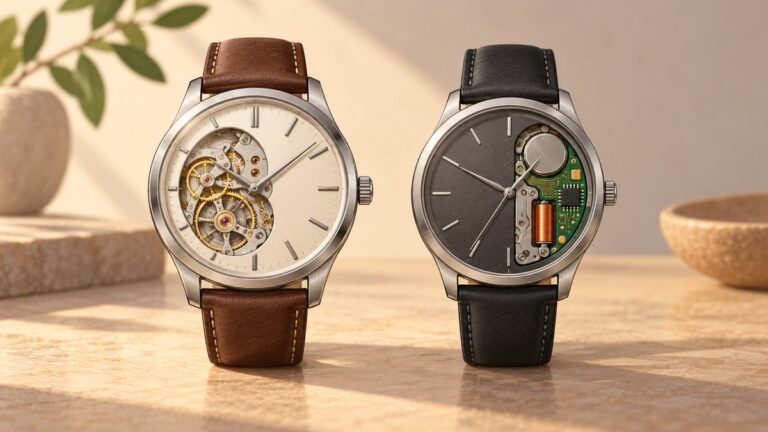
Rate is the gain or loss of time over an interval. Beat error is a separate measurement concerning the balance’s timing symmetry. A watch can have an undesirable rate, beat error, or variation in rate between positions; those observations are not interchangeable and do not necessarily have the same remedy.
#1 Best Overall

- Ultra-Precision: The No.1000 timegrapher delivers industry-leading ±0.1s/d accuracy (50-sample avg.) for advanced movements and ±999s/d range for antique/faulty watches. Instantly diagnose timing issues with this professional watch timegrapher. NOTE: Our mechanical watch timegrapher No. 1000 is only suitable for mechanical movement watches and does not support quartz movement watches!
- Smart Frequency Analysis & Multi-Parameter Display: Auto-detects standard beats (manual mode for special frequencies) with 2-60s sampling cycles. Test 6 positions (pocket watches to tourbillons). Color LCD shows real-time rate, amplitude, beat error, lift angle, and timing curves – essential timegrapher intelligence.
- Comprehensive Performance Metrics: The timegrapher features either a microphone or sensor that detects the ticking sounds or vibrations produced by the escapement. Measures critical parameters: amplitude (100°-360°), beat error (0.0-9.9ms), and adjustable lift angle (30°-70°). Live graphs enable swift diagnostics for watch timegrapher professionals.
- Professional Calibration Essential: The definitive tool for watchmakers, manufacturers, and technicians. Perfectly complements watch demagnetizer professional setups for complete movement servicing. Indispensable bench equipment for precision calibration.
- 12-Month Satisfaction Guarantee: All SWANSOFT 1000 timegrapher units include 12-month support. Contact us 24/7 – your satisfaction drives our professional commitment.
Seiko’s technical guide for the related 4R35B/4R36A describes the regulator as changing rate through the operative length of the balance spring, while describing the stud support separately as a beat-error correction. That is useful context, not an NH36 adjustment manual: it does not establish the exact NH36 procedure or adjustment direction.
What the published information establishes for each movement
| Movement | What the available primary source establishes | What it does not establish |
|---|---|---|
| Miyota 8215 | MIYOTA’s product specifications list an accuracy range of −20 to +40 seconds per day and posture difference under 50 seconds. They also list approximately 42 hours of running time and a frequency of 21,600 vibrations per hour. | These are movement specifications, not a guarantee of the daily performance of a particular cased watch. The cited specifications do not, by themselves, give a complete adjustment procedure or promise a particular result after regulation. |
| Seiko NH36 | Seiko’s official consumer instruction index lists an NH36 instruction and directs owners to use the instruction matching the caliber code on the case back. | The index is not a technical regulation guide and does not establish the NH36’s factory tolerance or a regulator adjustment procedure. |
| PT5000 | No accessible primary maker technical guide was available to establish a movement-specific rate tolerance or procedure. | A numerical tolerance, adjustment direction, and detailed procedure are not established here. Do not substitute an unverified figure or instruction from a reseller or forum. |
Because the available sources differ in what they document, they do not support ranking these three movements by accuracy or comparing their tolerances on equal terms.
Rank #2
- Timegrapher NO.1000
- coaxial test
- for almost all mechanical watch
- Multi-purpose timegrapher, popular with the professional watchmakers as well as the watch collection
Establish a baseline before considering an adjustment
A single timing result is not a diagnosis. Mechanical-watch rate can vary with position and state of wind, and a reading only describes the conditions under which it was taken. A timegrapher can show rate and position differences; it is a measurement tool, not a guarantee that an adjustment will improve the watch’s real-world performance.
PC Slower Than It Used to Be?
A free scan shows the junk files, broken settings and background clutter dragging Windows down - then fixes them in one click.Free scan · Windows 10 & 11Crashes, No Sound, or Screen Glitches?
Random freezes, missing sound and display glitches usually trace back to one bad driver. Find and replace yours safely.Free scan · under a minute- Confirm the caliber. Record the exact movement code and check the matching manufacturer documentation, particularly if the watch may have been modified.
- Record the watch’s condition. Note when it was wound, how it has been worn or rested, and any known service history. Keep the circumstances consistent when repeating measurements.
- Measure more than once. Use a timegrapher if you have access to one and know how to interpret its readings. Otherwise, compare the watch with a reliable reference over a consistent interval and record the elapsed-time difference. Do not treat one result as representative of every position or day.
- Compare positions and repeat. Record which position the watch was in and whether the reading was stable. Seiko’s 6R15 guide describes measurements in three positions soon after full winding and a later dial-up reading after 24 hours; those are instructions for the 6R15, not a universal test schedule for the 8215, NH36, or PT5000.
- Decide whether the observed pattern is consistent. A repeated, similar rate under comparable conditions is more informative than a one-off reading. Marked changes between positions, unstable results, or uncertainty about the measurement are reasons to seek a watchmaker’s assessment rather than to adjust by guesswork.
When to stop and use a watchmaker
Do not open the case or move a regulator unless you have documentation for the exact caliber, suitable tools, and the skill to work without damaging the movement. The sources available here do not verify lever directions or a safe step-by-step physical adjustment for these three calibers. A small movement of a regulator should not be assumed to produce a predictable change in seconds per day.
Rank #3

- Model of this Watch timing machine:NO.1000;110V-220V US plug;
- Easy to use for mechanical watch collection. This watch tester automatically calculates rate, amplitude, and beat error using readings from the microphone stand.
- LCD screen displayed.According to different watches, the instrument will automatically adjust optimal signal level during testing. - The LCD screen shows the readings in real time with 2 dotted lines moving across the screen to provide a visual representation of the “tic tock” from your watch
- 6 kinds of testing position can be adjusted. Amplitude level is between 275 and 315; Rate Deviation Range: ±999 s/d with precision ± 1 s/d'
- The sampling period can selected by 2 , 4 , 6 , 8 , 10, 20, 30 , 60 seconds, and the average of corresponding period will be regard as the precise value of the watch.
- Stop if you cannot positively identify the movement or find instructions that apply to that exact caliber.
- Stop if the watch has inconsistent readings, large positional differences, visible damage, or unknown service needs. Regulation may not address an underlying mechanical problem.
- Ask a qualified watchmaker to measure and assess the watch if you lack a timegrapher, appropriate tools, or confidence working on the movement.
The sensible goal is not to chase a number from one reading. It is to understand the watch’s repeatable behavior, compare it with specifications only where those specifications are actually published, and avoid applying an unverified adjustment method.
Quick Recap
Product prices and availability are accurate as of the date/time indicated and are subject to change. Any price and availability information displayed on Amazon at the time of purchase will apply.