Quick wins for a faster PC:
Repair Windows errors before they cause bigger problemsFix Now →Fix the driver behind crashes, sound loss and screen glitchesFind Drivers →A watch that consistently gains or loses time may need its rate corrected; one that changes unpredictably, stops, or shows other functional problems needs diagnosis rather than an assumed adjustment. There is no universal seconds-per-day cutoff that separates regulation from service. Start with the accuracy specification for the exact movement, then consider how the watch behaves and its maintenance history.
What regulation changes—and what service addresses
Regulation adjusts a movement’s rate so it runs faster or slower. It may be appropriate when a watch keeps a steady rate but is consistently ahead of or behind the time, provided its performance is outside the specification for that movement.
As an Amazon Associate I earn from qualifying purchases.
Service is a broader diagnosis and maintenance process. Depending on the watch and the work required, it can involve disassembly, cleaning, lubrication, repair, adjustment, and quality-control checks. Patek Philippe describes diagnosing a movement to assess accuracy and service needs, then checking rate accuracy after reassembly. Its final quality-control inspection lasts 14 days and includes checks such as air-tightness, winding speed, power reserve, rate accuracy, and kinetic simulation. That is Patek Philippe’s process, not a universal procedure or duration. Patek Philippe’s service process
Use the pattern of timekeeping as your first clue
Consistent gain or loss
If the watch is reliably fast or slow by roughly the same amount over repeated observations, rate adjustment may be enough—but consistency alone does not prove that regulation is the only work needed. Patek Philippe’s instructions for reference 5204/1R say that a watch can be considered precise when its deviation remains constant and that such a deviation can be corrected. Treat that as guidance about stable rate error, not a guarantee about every watch. Patek Philippe user instructions
#1 Best Overall

- Ultra-Precision: The No.1000 timegrapher delivers industry-leading ±0.1s/d accuracy (50-sample avg.) for advanced movements and ±999s/d range for antique/faulty watches. Instantly diagnose timing issues with this professional watch timegrapher. NOTE: Our mechanical watch timegrapher No. 1000 is only suitable for mechanical movement watches and does not support quartz movement watches!
- Smart Frequency Analysis & Multi-Parameter Display: Auto-detects standard beats (manual mode for special frequencies) with 2-60s sampling cycles. Test 6 positions (pocket watches to tourbillons). Color LCD shows real-time rate, amplitude, beat error, lift angle, and timing curves – essential timegrapher intelligence.
- Comprehensive Performance Metrics: The timegrapher features either a microphone or sensor that detects the ticking sounds or vibrations produced by the escapement. Measures critical parameters: amplitude (100°-360°), beat error (0.0-9.9ms), and adjustable lift angle (30°-70°). Live graphs enable swift diagnostics for watch timegrapher professionals.
- Professional Calibration Essential: The definitive tool for watchmakers, manufacturers, and technicians. Perfectly complements watch demagnetizer professional setups for complete movement servicing. Indispensable bench equipment for precision calibration.
- 12-Month Satisfaction Guarantee: All SWANSOFT 1000 timegrapher units include 12-month support. Contact us 24/7 – your satisfaction drives our professional commitment.
Changing rate, stopping, or other symptoms
If the rate varies substantially, the watch stops, or there is another functional concern, do not assume a rate adjustment will resolve it. Those signs call for diagnosis. Rate alone cannot establish the cause: the cited guidance does not support inferring magnetism, wear, dried lubricant, or a damaged component from a daily gain or loss.
Magnetism is one possible factor to consider if performance has changed. Hamilton notes that strong magnetic fields can affect a watch’s function and accuracy or stop it, but rate behavior by itself does not diagnose magnetism. Hamilton watch-care guidance
Rank #2
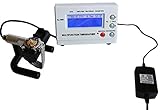
- Timegrapher NO.1000
- coaxial test
- for almost all mechanical watch
- Multi-purpose timegrapher, popular with the professional watchmakers as well as the watch collection
Check the right accuracy standard for your watch
Identify the watch’s brand, model, and movement, then look up the accuracy specification that applies to that exact movement. Seiko says accuracy depends on movement type and advises owners with concerns to seek inspection by an authorized service center or appointed dealer. Seiko accuracy FAQ
Free tools Windows power users keep installed
One-click scans. No signup required.
Do not treat a certification limit as the service threshold for every watch. For example, METAS states a rate criterion of 0 to +5 seconds per day for Master Chronometer certification. That figure describes that certification context; it is not a universal definition of acceptable accuracy or an automatic reason to service a watch. METAS watch certification criteria
Rank #3

- Model of this Watch timing machine:NO.1000;110V-220V US plug;
- Easy to use for mechanical watch collection. This watch tester automatically calculates rate, amplitude, and beat error using readings from the microphone stand.
- LCD screen displayed.According to different watches, the instrument will automatically adjust optimal signal level during testing. - The LCD screen shows the readings in real time with 2 dotted lines moving across the screen to provide a visual representation of the “tic tock” from your watch
- 6 kinds of testing position can be adjusted. Amplitude level is between 275 and 315; Rate Deviation Range: ±999 s/d with precision ± 1 s/d'
- The sampling period can selected by 2 , 4 , 6 , 8 , 10, 20, 30 , 60 seconds, and the average of corresponding period will be regard as the precise value of the watch.
Track performance before deciding what to do
- Identify the movement and its stated tolerance. Use the watch’s documentation or the manufacturer’s model-specific information rather than applying a generic seconds-per-day rule.
- Record how the watch behaves in ordinary use. Note whether it is consistently gaining or losing, whether the amount changes, and whether it stops. A timing log can show a pattern, but it cannot replace inspection.
- Review service history and the maker’s maintenance guidance. An overdue recommended examination is relevant even when the rate seems steady.
- Ask a qualified watchmaker or authorized service provider to diagnose it when concerns persist. Share the observed pattern and any known damage or functional symptoms.
What a professional timing check can—and cannot—tell you
A watchmaker does not judge a mechanical movement by daily rate alone. The cited workshop guidance checks amplitude, delta, rate, and beat error on a measuring device, then considers adjustments when readings fall outside that workshop’s tolerances. Those are diagnostic inputs, not universal consumer thresholds. Cousins UK workshop guidance
A timegrapher can be useful to someone trained to interpret its readings, but the readings do not by themselves determine whether a watch needs full service. Professional diagnosis may include checks beyond timing, as the Patek Philippe service process illustrates.
Service intervals depend on the maker and watch
There is no single service interval in the cited manufacturer guidance. Patek Philippe recommends service every eight to ten years through an official Service Center or Authorized Retailer. Seiko’s Philippine mechanical-watch FAQ recommends taking a mechanical watch to a service center once every three years for examination, cleaning, and oiling where needed. These are brand-specific recommendations from different contexts, not competing universal rules. Follow the instructions for the exact watch and confirm the appropriate local service route. Patek Philippe care recommendations; Seiko Philippine mechanical-watch FAQ
Quick Recap
Product prices and availability are accurate as of the date/time indicated and are subject to change. Any price and availability information displayed on Amazon at the time of purchase will apply.