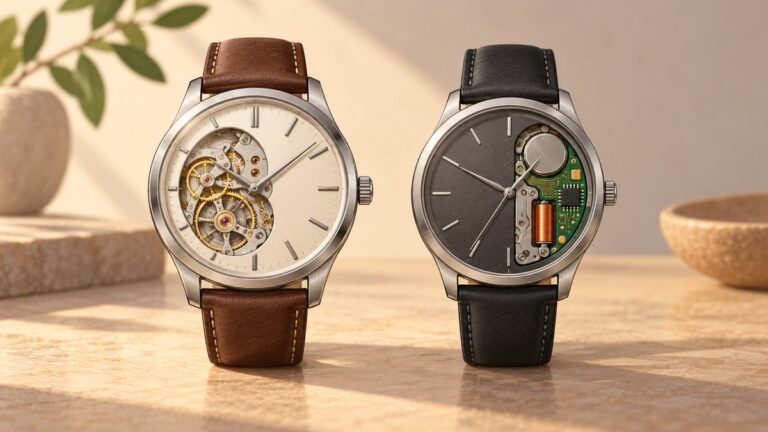
A perpetual calendar is usually more useful if you want a watch to keep track of dates; a moonphase is more useful if you want to follow the lunar cycle. They serve different purposes, and some watches combine both. The practical choice is the complication whose information you will actually use.
What does each complication tell you?
Perpetual calendar: calendar information
A perpetual calendar is a mechanical calendar that accounts for different month lengths and leap years. Depending on the watch, it can show the date, day, month and leap-year indication. While running, it can keep the calendar aligned for decades without routine month-end corrections. Patek Philippe’s overview of calendar watches and IWC’s explanation of its perpetual calendar describe these functions.
As an Amazon Associate I earn from qualifying purchases.
One way to understand the mechanism is as a mechanical memory of the calendar cycle, rather than an astronomical display. A. Lange & Söhne describes a design using a 48-step cam that turns once every four years; recesses of different depths encode months of different lengths, including February 29. Other movements may use different mechanisms. A. Lange & Söhne’s explanation of perpetual-calendar watches gives this example.
Do these 3 things before closing this tab:
1Scan for outdated or missing drivers - takes under a minute2Clear out junk files and repair common Windows errors3Fix the driver behind crashes, sound loss and screen glitchesMoonphase: the lunar cycle
A moonphase shows the Moon’s phase as it progresses through its cycle. Patek Philippe defines the cycle as “the interval between two successive new moons.” It does not provide the date, month or leap-year information of a calendar complication. Patek Philippe’s moonphase setting guide explains the display and gives a model-dependent setting method.
#1 Best Overall

- Powered by the Orient In-House F6B24 Automatic / Hand-Winding / Hacking Movement
- Case Diameter: 41.5 Case Thickness: 14.2mm Lug Width: 21mm Lug to Lug Length: 47mm
- Domed Mineral Crystal
- 24-Hour Sun and Moon and Moon Subdial
- Water resistant to 30m (100ft): in general, withstands splashes or brief immersion in water, but not suitable for swimming or bathing
Which complication is more useful day to day?
| What you want from the watch | Better fit | Why |
|---|---|---|
| A quick reference for date and other calendar details | Perpetual calendar | It can display date, day and month, and mechanically account for month lengths and leap years. The indications vary by model. |
| A visual indication of the Moon’s phase | Moonphase | It tracks the lunar cycle rather than the civil calendar. |
| Both kinds of information | A watch with both | The complications can coexist; check the specific dial to see which indications it includes and how clearly they can be read. |
For most people choosing on practical information alone, the perpetual calendar has the stronger everyday case because dates are used more routinely than lunar-phase indications. That does not make a moonphase pointless: it is the relevant choice if lunar awareness is what you want, and its display can also be an appealing part of a watch’s design. Look at the actual layout before deciding; complications that are useful in theory may be hard to read on a particular dial.
Do you need a perpetual calendar or a moonphase?
Choose by the question you want your watch to answer:
Rank #2

- 40mmmm stainless steel case
- 8 inch brown two- piece quick release
- blue dial
- mineral glass lens
- water resistant up to 50 meters
- Choose a perpetual calendar if you want a mechanical watch to display calendar information and handle ordinary month-length changes and leap years while it continues running.
- Choose a moonphase if you want to see the Moon’s phase and are more interested in the lunar cycle than in additional calendar indications.
- Consider both if you want both functions and are comfortable with the specific watch’s display and setting instructions.
There is no established basis here for saying that one category is categorically cheaper to buy, service or repair. Those costs depend on the particular watch and movement.
What happens if the watch stops?
A stopped watch can need correction before its displays are right again, but the procedure and effort depend on its movement. Do not assume that every perpetual calendar is difficult to reset or that every moonphase is simple. Use the exact watch’s manual: controls, safe correction periods and adjustment order can differ.
Rank #3

- 14K GOLD PLATED VINTAGE DRESS WATCH – Features an elegant gold tone case with a clean dial and bold Arabic numerals, designed for men who appreciate classic vintage style. Suitable as an everyday wear watch or for formal occasions, this analog watch effortlessly elevates any outfit.
- SUN MOON PHASE DISPLAY – The decorative sun-moon phase dial adds a sophisticated vintage complication that sets this timepiece apart from ordinary mens dress watches. A stunning conversation piece and a standout feature among gold tone analog watches for men.
- ACCURATE JAPANESE QUARTZ MOVEMENT – Powered by a precise Japanese quartz movement for reliable everyday timekeeping with minimal maintenance. Built to last and backed by the Peugeot reputation for quality affordable luxury watches for men.
- GENUINE LEATHER STRAP – Soft, durable, and fully adjustable genuine leather band fits a range of wrist sizes comfortably. Perfect as a mens leather watch for the office, date nights, weddings, or any special occasion.
- PEUGEOT LIFETIME WARRANTY & GIFT READY – Every Peugeot watch is backed by a Lifetime Warranty including free battery replacement for the life of the watch. Arrives beautifully gift boxed — ideal as a birthday gift, anniversary gift, graduation gift, or holiday gift for men.
For example, the Patek Philippe reference 5372P manual tells owners to wind a stopped watch before adjustment and warns against correcting the calendar or moonphase during specified active periods. Its rules apply to that reference, not automatically to other watches. Patek Philippe’s general moonphase guide likewise directs owners to consult the individual watch guide; its full-moon-and-day-count method should not be treated as universal.
Independent reader supportYour contribution helps us test, update, and keep practical guides available for everyone.How accurate are the displays?
Precision figures belong to specific mechanisms, not to every watch with the same complication. For its described perpetual-calendar watch, IWC says the moonphase display deviates by one day after 577.5 years. The Patek Philippe reference 5372P manual gives a one-day deviation every 122 years for that watch. These are manufacturer claims for different models and mechanisms, not a head-to-head test or a general specification for moonphase watches. IWC’s page and the 5372P manual state the respective figures.
Rank #4
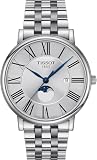
- Case Size: 40.00 mm, Band Width: 20, Case Thickness: 7.62 mm
- Swiss quartz movement, 316L stainless steel case, Roman dial type, Date/moonphase
- Stainless bracelet, butterfly clasp with push-buttons closure
- Water-resistant up to a pressure of 5 bar (50 m / 165 ft): suitable for short periods of recreational swimming and showering, but no diving or snorkeling.
- 2 Year International Warranty
What does “perpetual” mean, and what is the century exception?
“Perpetual” describes how the mechanism handles the usual calendar cycle; it does not mean that every perpetual calendar will remain correct forever without intervention. In the Gregorian calendar, century years are not leap years unless divisible by 400. The next century year that omits February 29 is 2100. Patek Philippe says a standard perpetual calendar that does not account for this exception needs manual adjustment then. IWC also describes century corrections for 2100, 2200 and 2300 in its mechanism. The exact behavior depends on the movement. See Patek Philippe’s calendar-watch overview and IWC’s explanation.
What’s actually slowing this PC down?
Pick the symptom - the matching free tool is one click away.
Can one watch have both complications?
Yes. IWC describes a perpetual calendar that also displays the moonphase, and the Patek Philippe reference 5372P manual documents both calendar and moonphase indications. A combined watch can suit someone who wants both sets of information, but check the particular model’s indications, legibility and setting instructions rather than assuming every combination works the same way.
For historical context, IWC says Kurt Klaus’s perpetual-calendar mechanism debuted in the Da Vinci Perpetual Calendar in 1985. IWC describes that mechanism as comprising about 80 parts and displaying the date, day, month, four-digit year and moonphase. Those are details of the IWC mechanism described on its perpetual-calendar page, not specifications for the category as a whole.
Quick Recap
Product prices and availability are accurate as of the date/time indicated and are subject to change. Any price and availability information displayed on Amazon at the time of purchase will apply.